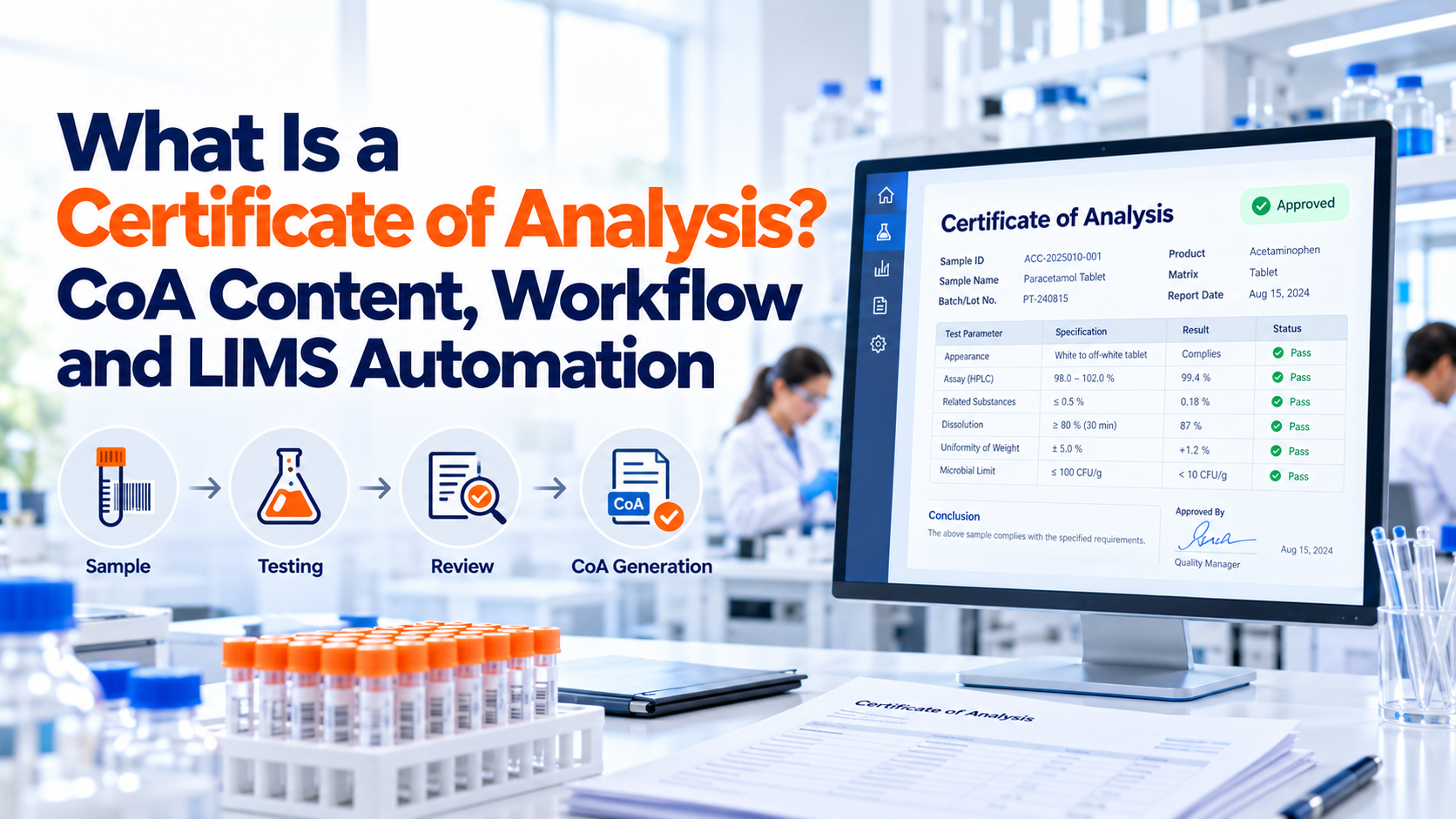
A laboratory result usually begins as data inside a testing workflow. A customer, manufacturer, quality team or other authorized recipient often needs something more useful than the raw analytical record. That is where a Certificate of Analysis comes in.
A Certificate of Analysis, commonly called a CoA, is a controlled document that reports analytical information for a specific sample, material, product, batch or lot. It typically identifies what was tested, presents relevant test methods and results, may show applicable specifications or acceptance criteria, and records the authorization needed to issue the final certificate.
The exact content of a CoA depends on the laboratory, industry, product, customer agreement and applicable requirements. There is no single universal CoA template that fits every testing laboratory.
For example, a pharmaceutical laboratory may use a CoA to report results against approved product specifications. A contract laboratory may issue a certificate containing client-specific sample and method information. A food, environmental or cannabis laboratory may use different terminology and reporting fields.
The important principle is that every value presented on the final certificate should be connected to an appropriate, reviewed laboratory record rather than copied manually from disconnected files.
NIST provides a useful real-world example. For its Standard Reference Materials, NIST describes a Certificate of Analysis as a document containing the material identity, intended purpose, certified property values, associated uncertainties, methods and other technical information needed for use of the material. The exact requirements for commercial or testing-laboratory CoAs differ, but the example illustrates the central purpose of a CoA: communicating controlled analytical information about a specific material.
What Is the Purpose of a Certificate of Analysis?
The purpose of a Certificate of Analysis is to communicate reviewed laboratory results in a controlled document that clearly identifies the material tested and the analytical information being reported.
A CoA turns laboratory data into a formal deliverable. Without that controlled reporting step, a recipient may receive individual result values without enough context to understand what sample was tested, which method applied, which specification was relevant or whether the result had completed the laboratory's review process.
A well-designed CoA creates that context.
Depending on the workflow, the certificate may help a customer confirm that a submitted sample was tested, allow a quality team to review whether a batch meets defined specifications, support product-release decisions or provide a controlled record of third-party laboratory testing.
However, a CoA should not be treated as a substitute for the underlying laboratory records. The certificate is the approved output. The laboratory still needs traceable source records showing how those reported values were produced.
What Information Does a Certificate of Analysis Usually Contain?
A useful CoA normally begins by identifying exactly what the certificate refers to. That may include the laboratory name, certificate number, client, product or material name, sample identifier, lot or batch number and relevant receipt or testing information.
The analytical section may then present the tests performed, methods or method references, specifications or acceptance criteria where applicable, measured results, units and a statement of conformity or status where the laboratory is authorized and required to provide one.
The certificate may also contain review or authorization information, issue date, approved statements, comments or other information required by the laboratory's reporting procedure. The exact fields should be defined through the laboratory's own requirements.
This is important because a CoA for a pharmaceutical excipient does not necessarily need the same information as a report issued for an environmental sample or a cannabis-testing batch. The laboratory should therefore avoid building one rigid template simply because it is called a Certificate of Analysis.
Sample or Product Identity Must Be Clear
A CoA should make it difficult to misunderstand what was tested. The certificate should connect the reported results with the correct sample, product, batch, lot or other defined material.
This is where good reporting depends heavily on good sample management.
If sample identification was inconsistent during accessioning, the reporting stage cannot reliably repair that problem.
The final CoA should therefore draw its identity information from the controlled sample record wherever possible.
LabZila's sample management software is designed to maintain sample identifiers, status, testing activity, locations and related records through the sample lifecycle so that reporting can remain connected to the correct laboratory material.
For a deeper look at that relationship, the laboratory sample tracking guide explains how sample identity can remain traceable from registration through testing and final disposition.
Methods Give Results Their Analytical Context
A numerical value by itself rarely tells the complete story. A result such as 12.6 mg/L becomes more meaningful when the recipient can understand what was measured and, where appropriate, which method or method reference was used.
Method information is particularly important when multiple techniques can be used for the same analyte or property. The level of method detail shown on the final certificate varies.
Some laboratories report a method number or standard reference. Others may use an internal method identifier. In certain workflows, detailed analytical procedures remain in the laboratory record while the CoA contains only the approved method reference.
The correct approach depends on reporting requirements.
For U.S. pharmaceutical manufacturing laboratories, 21 CFR 211.194 requires laboratory records to include the sample description, methods used, test data, calculations, results and comparison with established standards, along with performer and reviewer information. A CoA is not identical to the complete laboratory record, but those requirements illustrate why reportable results need a traceable analytical foundation.
Results Should Come From Reviewed Laboratory Records
One of the most important controls in CoA generation is determining which results are allowed to appear on the final certificate. The safest approach is to generate the CoA from results that have completed the laboratory's required review process.
This avoids situations where a preliminary value is copied into a certificate before review is complete. Imagine that an analyst initially enters a result of 4.8%, but the technical review identifies a transcription problem and the approved result becomes 4.3%.
If the certificate was prepared manually before review, the wrong value could remain in the document even though the laboratory record has already been corrected. A connected system reduces this risk by using approved source data when creating the certificate draft.
LabZila's Certificate of Analysis software is designed around this model, connecting approved sample, product or batch information, methods, specifications and reportable results with controlled CoA templates.
How Should Specifications Appear on a CoA?
Specifications may be useful when the purpose of the certificate includes showing whether results conform to defined requirements. A result might therefore be presented alongside a specification such as:
Assay: 98.0% to 102.0%Result: 99.4%
However, specifications should not simply be typed into a report from memory. Where specifications are reported, they should come from the applicable controlled record or approved reporting configuration.
This becomes particularly important when specifications change over time. A batch tested last year may have been evaluated against a different approved specification version than a batch tested today.
Historical CoAs should preserve the context that applied when the certificate was issued. The system should not silently replace earlier certificate content simply because the current specification has changed.
Should a Certificate of Analysis Say Pass or Fail?
That depends on the laboratory's reporting responsibility and the applicable workflow. Some CoAs show results alongside specifications and include a status such as Pass, Complies or Meets Specification.
Other laboratories report analytical results without making a broader conformity statement. The decision should reflect the laboratory's authorized role, contractual obligations and applicable requirements.
Software should not invent a pass or fail conclusion merely because a numeric result appears to fall within a configured range. The laboratory should define which rules may be evaluated automatically and which statements require review or authorization.
What Is the Standard Process for Generating and Approving a Certificate of Analysis?
There is no single universal CoA process for every laboratory, but a controlled workflow generally moves from completed testing to reviewed results, certificate preparation, technical verification, authorization and final issuance.
A practical sequence is: Completed testing → Result review → CoA draft generation → Certificate verification → Authorized approval → Final issuance
The exact number of review stages can vary.
A small independent laboratory may use one authorized reviewer.
A pharmaceutical QC workflow may involve technical review followed by a separate quality or release process.
A contract laboratory may need an additional check for client-specific formatting or report requirements.
The system should reflect the laboratory's approved process rather than adding unnecessary approval stages simply because the software supports them.
Step 1: Complete the Required Testing
CoA preparation should begin only after the relevant analytical work has reached the appropriate stage.
This means required tests should be complete and any necessary calculations or result processing should be performed.
If testing is still pending, the certificate should not create the impression that the laboratory has finished evaluating the sample.
Where partial reporting is permitted, it should follow a clearly defined procedure and be distinguishable from the final report.
Step 2: Review the Results
The next stage is technical or other required review. An authorized reviewer may need to examine the result together with the sample identity, method, specification, calculations, instrument data, QC information or other supporting context.
The purpose of this step is not simply to confirm that a result field contains a number. It is to establish that the result is ready to become part of the laboratory's approved output.
This is where laboratory workflow automation can be useful. Completed testing can move into an appropriate review queue, and work that requires correction can be returned before a certificate is generated or issued.
Step 3: Generate the CoA Draft
Once the appropriate results are available, the system can populate a configured certificate template.
This is where certificate of analysis software offers a major advantage over manually building documents.
Instead of copying the sample ID, batch number, method, specification and result into a separate Word document or spreadsheet, the software can use information already stored in the laboratory record.
A digital CoA template may include laboratory branding, certificate numbering, result tables, client information, product information, approved statements and authorization sections.
The goal is consistency. Two certificates for the same type of work should not have different layouts simply because different employees prepared them.
How Can I Automatically Generate Standardized Certificates of Analysis From Approved Laboratory Results?
Use a LIMS or dedicated CoA software that connects certificate templates directly with reviewed laboratory records. The system should populate the draft from approved sample, batch, method, specification and result data rather than requiring users to retype those values manually.
A practical automated workflow might operate as follows.
Testing is completed and the record enters technical review. The authorized reviewer approves the reportable results. The system makes those results eligible for CoA generation. A configured template pulls the appropriate sample information, product or batch details, methods, specifications and approved results into a certificate draft.
An authorized user then verifies the certificate before final issuance. Automation removes repetitive document preparation, but it should not remove the final controls required by the laboratory.
This is the same principle described in our previous laboratory workflow automation guide: automate predictable coordination and data transfer while keeping meaningful review and approval decisions with authorized personnel.
Step 4: Verify the Certificate Before Issuance
Even when the certificate is generated automatically, it should pass through the laboratory's required verification process.
Automation reduces transcription risk, but reporting errors can still arise from configuration problems, incorrect master data, inappropriate template selection or incomplete source records.
The reviewer should therefore confirm that the certificate represents the intended material and approved analytical data.
Depending on the workflow, this may include verifying the sample or batch identity, test results, specifications, method references, certificate statements and recipient information. The review should focus on meaningful correctness rather than becoming a routine click.
Step 5: Authorize and Issue the Final Certificate
After the required review is complete, an authorized user can approve the certificate for issuance. Authorization should be separate from simply viewing or editing the document.
In a controlled system, role-based permissions help ensure that only appropriate users can perform final approval or issuance.
Where electronic signatures are used, the laboratory should evaluate the controls required by its regulatory and quality environment.
For regulated workflows where electronic records and signatures fall within Part 11 scope, LabZila also provides a dedicated 21 CFR Part 11 LIMS capability overview.
Software can support electronic signatures and controlled approvals, but the laboratory remains responsible for determining applicable requirements, validating the system where required and maintaining appropriate procedures.
What Makes a Digital CoA Different From a PDF?
A PDF is only a file format.
A digital CoA workflow is the controlled process behind the document.
A laboratory can manually create a certificate in Word, export it as PDF and email it to a customer. That produces a digital file, but the underlying workflow may still depend on manual copying, local folders and email approvals.
A stronger digital workflow connects the certificate with the original laboratory records.
The system knows which sample generated the certificate.
It knows which results were used.
It retains the approved version.
It records the relevant approval or issuance activity.
If the certificate is revised, the earlier version remains traceable.
That connected history is more important than whether the final document happens to be PDF.
How Do You Maintain a Traceable Link Between a Final CoA and the Original Sample, Tests and Results?
Maintain the CoA as a controlled record that references the same sample, batch, test, method, specification and approved result records used to generate it rather than storing the final certificate as an unrelated standalone file. Traceability should work in both directions.
From the CoA, an authorized user should be able to determine which sample or batch it represents and which approved results support the reported values.
From the laboratory record, the team should be able to identify which certificate was ultimately issued.
This relationship becomes particularly valuable when a customer asks about a result months later. Instead of searching email attachments and trying to determine which spreadsheet was used to prepare the certificate, laboratory personnel can return to the connected records.
A chain-of-custody workflow can provide additional traceability around sample receipt and handling where custody documentation is required, while the CoA provides the controlled reporting output near the end of that lifecycle.
Certificate Numbering Helps Identify the Issued Record
Many laboratories use a unique certificate or report number. This helps distinguish the issued document from the underlying sample number.
For example, one batch may have several samples but one final certificate, or one sample may lead to multiple certificates under different reporting scenarios.
The numbering structure should fit the laboratory's reporting process. The important point is uniqueness and traceability rather than creating an overly complicated number.
A certificate number can also help support revision control. For example, an amended certificate may preserve the original certificate number while adding a revision indicator according to the laboratory's procedure.
Version Control Matters After Issuance
A CoA should not become editable without history after it has been issued. If a correction is needed, the laboratory should use a controlled amendment or revision process.
The exact process depends on the quality system, but the general principle is that the issued history should remain understandable.
A corrected certificate may need to show a new revision number or issue date, identify that it supersedes an earlier version and record an appropriate reason for the change.
The original issued certificate should not simply disappear. This protects both the laboratory and the recipient from uncertainty about which document is current.
LabZila's CoA workflow is designed to preserve certificate versions, revisions, superseded certificates, reasons for change and approval activity rather than overwriting the certificate history.
What Happens When a CoA Needs an Amendment?
An amendment should begin by determining what needs to change and why. A formatting correction is different from a changed analytical result.
If the analytical record itself changes, the laboratory may first need to address the underlying result according to its correction, investigation or review procedure before the CoA can be reissued.
The revised certificate should then pass through the appropriate review and approval workflow.
This prevents a user from changing a reported value directly in the final document while leaving the source laboratory record unchanged.
The certificate should reflect approved source data, not become an independent second version of the laboratory's results.
Avoid Manual Copy-and-Paste CoA Generation Where Possible
Manual certificate preparation creates an additional transcription step. The analyst or reporting employee may copy a sample number, method, specification and several results from one system into another document.
Even if every source record is correct, the report can still contain a copying error. The risk becomes larger when certificates contain dozens of analytes or when a laboratory processes many reports each day. Automated population reduces that unnecessary re-entry.
However, automation should pull from controlled fields rather than unreviewed or ambiguous sources. A fast automated report is not useful if the system is drawing the wrong specification or preliminary result.
CoA Templates Should Be Controlled
Templates themselves should be governed. If every user can independently change result tables, statements, headers and approval sections, the laboratory may end up with inconsistent certificates even when the underlying data is correct.
A controlled template can define which fields appear, how results are formatted, where authorization information is displayed and which approved statements are included.
Different clients, products or industries may still require different templates. The objective is not one template for everything. The objective is controlled templates for defined reporting use cases.
Laboratory Reporting Software Should Handle Exceptions
A good CoA workflow should also answer what happens when normal reporting cannot proceed.
What if one required result is still pending?
What if a reviewer sends a result back for correction?
What if the wrong template was selected?
What if a sample is cancelled after some tests were completed?
What if the customer requests an amended certificate?
What if the certificate was issued to the wrong recipient?
These exception paths should be defined before they occur. Otherwise, staff may start editing PDFs manually or storing corrected documents in local folders, which breaks the traceability the digital system was supposed to provide.
CoA Requirements Differ by Industry
The term "Certificate of Analysis" is used across many industries, but the content and purpose vary.
Pharmaceutical and manufacturing environments often use CoAs to communicate whether tested material or product conforms to defined specifications.
Cannabis testing laboratories may issue CoAs containing regulatory testing panels and product-specific results.
Food and beverage laboratories may report microbiological, chemical, allergen or other analytical results depending on the testing program.
Contract testing laboratories may create client-specific reports with method references, project information and authorized results.
Reference-material producers may issue certificates containing certified values, measurement uncertainties and technical instructions, as NIST does for its Standard Reference Materials.
This variation is why a LIMS should support configurable certificate content rather than assuming one universal certificate layout.
Is a Certificate of Analysis the Same as a Full Laboratory Record?
No. A CoA is a reporting document.
The complete laboratory record may contain much more information than the certificate presents, including raw instrument data, calculations, preparation records, QC results, comments, review history and other supporting evidence.
For example, 21 CFR 211.194 requires pharmaceutical laboratory records to include complete test data, calculations and performer and reviewer information. The final certificate may summarize relevant approved information from those records, but it should not be confused with the complete underlying data set.
This distinction is important for both compliance and traceability. The CoA should remain connected to the evidence supporting it.
How CoA Software Fits Into the LIMS Workflow
A CoA should sit near the end of a connected laboratory workflow rather than exist as a separate reporting activity. The broader process looks like this:
Sample registration → Test assignment → Testing → Result capture → Review → Approval → CoA generation → Certificate authorization → Issuance → Controlled amendment if required
Each earlier stage affects the reliability of the certificate.
Incorrect sample identification creates an incorrect certificate.
An incorrect method assignment creates the wrong analytical context.
An unreviewed result can create an unreliable report.
Missing approval can result in premature issuance.
This is why CoA software becomes much more valuable when it is connected with the underlying LIMS rather than operating as a separate document generator.
How LabZila Supports Certificate of Analysis Workflows
LabZila connects certificate preparation with the laboratory records used to produce the final output. Approved sample information, product or batch details, test methods, specifications and reportable results can be brought into configurable CoA templates.
Certificates can then move through controlled review and authorization workflows. The system can preserve issuance history and certificate revisions so the final document remains linked to the laboratory information that supports it.
This does not mean every laboratory should configure the same certificate.
The reporting structure should reflect the laboratory's industry, client requirements, methods, specifications and quality procedures. The advantage is that those differences can be managed within a controlled reporting process rather than through repeated manual document creation.
Final Thoughts
A Certificate of Analysis is more than a formatted table of test results. It is the controlled reporting point where sample identity, analytical methods, specifications, reviewed results and authorization come together.
The most reliable CoA process therefore starts long before the certificate is generated.
Samples need dependable identities.
Tests and methods need to be correctly assigned.
Results need to remain connected with their source records.
Reviews need to be completed.
Only then should approved laboratory information become part of the final certificate.
A connected digital workflow can reduce repetitive report preparation while strengthening consistency and traceability.
LabZila's Certificate of Analysis software connects approved laboratory information with configurable templates, review workflows, authorization and certificate history. Laboratories that want to replace manual CoA preparation with a more controlled process can contact LabZila to discuss their reporting and certificate requirements.
Frequently Asked Questions
How can I automatically generate standardized Certificates of Analysis from approved laboratory results?
Use a LIMS or CoA software that connects controlled certificate templates directly with reviewed laboratory records. After required testing and review are complete, the system can populate the certificate draft with approved sample or batch information, methods, specifications and reportable results. An authorized user should then complete the laboratory's required verification and approval before final issuance.
What is the standard process for generating and approving a Certificate of Analysis?
There is no single universal process for every laboratory, but a controlled workflow commonly moves from completed testing to result review, CoA draft generation, certificate verification, authorized approval and final issuance. The number of review stages should reflect the laboratory's procedures, industry and reporting responsibilities rather than using unnecessary approvals simply because the software supports them.
How do you maintain a traceable link between a final CoA and the original sample, tests and results?
Generate and retain the CoA as part of the same controlled laboratory data structure used for the sample and testing workflow. The certificate should reference the relevant sample or batch and use approved test, method, specification and result records as its source. Certificate numbering, issuance history and controlled revision records should make it possible to trace from the final certificate back to the supporting laboratory data and from the laboratory record to the certificate that was issued.