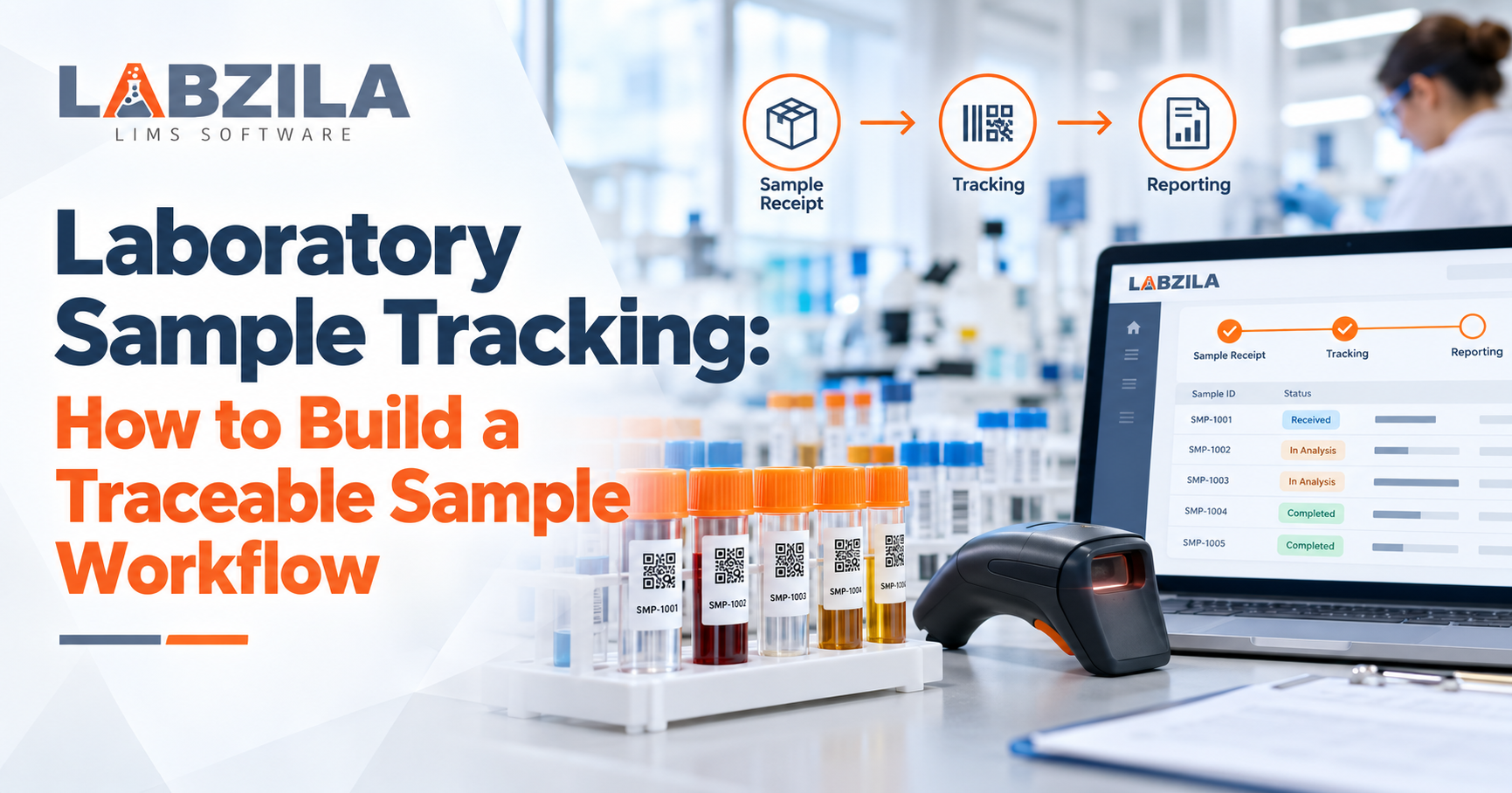
Laboratory sample tracking is the process of maintaining a reliable record of a sample from the moment it enters a laboratory until testing, review, retention, return or final disposal is complete. Effective tracking connects the physical sample with its digital identity, current location, testing status, transfers, results and history so laboratory teams can determine what happened to the sample without relying on separate spreadsheets, paper records or verbal follow-up.
For a small laboratory, sample tracking may initially seem simple. A spreadsheet can record a sample number, receipt date and test status. Problems usually appear as sample volumes increase, more people handle the same material, samples are divided into aliquots, testing takes place across different departments and records must remain available for review.
At that point, the challenge is no longer simply knowing that a sample exists. The laboratory needs reliable sample traceability across the complete sample lifecycle.
A modern Laboratory Information Management System can provide the structure required to connect those stages. NIST identifies sample tracking as a common LIMS capability within digital information management and describes LIMS as part of a broader framework connecting laboratory workflows, data and research processes.
If you need a broader introduction to this type of system, the LabZila guide to what a LIMS is explains how samples, testing, instruments, quality processes and reporting fit together.
What Does Laboratory Sample Tracking Actually Mean?
Laboratory sample tracking means maintaining enough connected information to identify a sample, understand where it is, know what work has been assigned or completed, and reconstruct important events in its history. A tracking record may therefore include much more than a sample number.
When a sample is registered, the laboratory may capture its source, sample type, client or project, receipt date, condition, priority and required tests. As the sample moves through the laboratory, its record may also need to reflect storage location, transfers, preparation steps, aliquots, assigned testing, review status, retention and final disposition.
This is why laboratory sample tracking software should not be evaluated only by asking whether it can create a sample record. The more useful question is whether the system can maintain the relationships around that sample throughout its lifecycle.
EPA laboratory quality guidance has long emphasized this principle. Its analytical quality-control guidance describes the use of a sample log to record information including sample identification, origin, chain-of-custody information, analyses performed and final results.
That connection between identity, custody, testing and results is at the core of traceable laboratory sample management.
What Is the Best Way to Track Laboratory Samples and Test Results Across a Team?
The best approach is to use a single controlled sample record that follows the sample across departments and keeps its identity, location, testing, results and review status connected.
When different teams maintain separate spreadsheets, notebooks, shared folders or email threads, each system may contain only part of the sample history. Receiving may know when the sample arrived. Analysts may know which tests are running. A storage spreadsheet may show its freezer location. A reviewer may have the result in another file.
Each individual record may be correct, but the laboratory still lacks one dependable view of the sample. A centralized sample record avoids this fragmentation.
For example, an authorized user looking at one sample should ideally be able to understand its current status, storage location, required testing, completed work, pending review and relevant history without contacting several departments.
LabZila's sample management software is designed around this model, connecting sample registration, identifiers, status, locations, testing activity, transfers, storage and retention within one configurable workflow.
The objective is not simply convenience. Connected records reduce ambiguity about which physical sample, test activity and result belong together.
Start With a Unique Sample Identity
A traceable workflow begins with reliable identification. When a sample enters the laboratory, it should receive a unique laboratory identifier according to the laboratory's procedures. That identifier becomes the connection between the physical material and the electronic record used throughout the workflow.
A well-designed identifier should remain associated with the sample even if the sample changes status, moves to another location or is divided into additional containers.
The record may also contain information such as the submitter, client, project, collection information, sample matrix, batch or lot, requested analyses, priority and receipt condition. The exact fields depend on the laboratory.
An environmental laboratory may care heavily about collection location, preservation and holding times. A pharmaceutical QC laboratory may connect samples with batches, specifications and stability studies. A contract laboratory may need strong client and project relationships.
The tracking system should therefore be configurable around the laboratory rather than forcing every laboratory to collect the same information.
Use Barcodes or QR Codes to Connect the Physical Sample to Its Record
Unique IDs become more useful when they can be read directly from the physical sample.
Barcode or QR-code labels can reduce repeated manual entry and help users open the correct electronic record when samples are received, moved, tested or stored.
Scanning can be especially useful where many visually similar containers are handled during the same shift.
However, a barcode by itself does not create traceability. The label identifies the sample. The underlying system must still record what happens after the scan.
For example, if a technician scans a sample before moving it from receiving into refrigerated storage, the workflow should be able to associate that action with the correct record and, where required, capture information such as the destination location, time or responsible user.
A later October article will examine barcode sample tracking in more detail. For the broader workflow, the important principle is that physical identification and electronic records should remain synchronized.
Track Sample Status, Not Just Sample Location
Knowing where a sample is physically located is useful, but laboratory teams also need to know what stage of work it has reached. A sample might be:
received,
awaiting accessioning,
ready for preparation,
in testing,
waiting for additional testing,
awaiting review,
approved,
retained,
returned,
or disposed of. The exact statuses should match the laboratory's real process.
A well-configured sample workflow makes those statuses meaningful. A user should be able to distinguish a sample waiting for testing from one whose testing is complete but whose results are still awaiting review.
That distinction matters operationally. If all samples simply appear as "in progress," laboratory managers cannot easily identify where work is becoming delayed.
The earlier guide to how a LIMS works explains how sample records can move through testing, review, reporting and final disposition while remaining connected to the same laboratory workflow.
Record Sample Location at the Level Your Laboratory Actually Needs
Location tracking should be detailed enough that an authorized user can retrieve the correct physical sample without relying on memory. For a small laboratory, a location may simply be "Cold Room 1."
A larger laboratory may need a hierarchy such as: Freezer 3, Shelf B, Rack 4, Box 8, Position C5.
The tracking structure should reflect real operations. It should also record important movements where traceability requires them. If a sample moves from receiving to preparation, then to an instrument area and finally into retention storage, those changes may need to remain part of the sample history.
The same principle applies when materials move between laboratory locations or departments. Location tracking is therefore not just an inventory function. It is part of maintaining continuity between the physical sample and its laboratory record.
Connect Testing Requirements to the Sample Record
A laboratory sample becomes operationally useful only when the system also knows what must be done with it. The sample record should be connected to required tests, applicable methods, priorities and other relevant testing information.
This prevents teams from maintaining one system for sample identity and another for analytical work. For example, an authorized analyst should be able to determine which tests are assigned to a sample and whether those activities are pending, underway or completed.
When results are generated, they should remain associated with the correct sample, test and method context.
The core components of a LIMS are designed to work together for exactly this reason. Sample tracking is far more valuable when it is connected with test management, result management, review and reporting rather than operating as an isolated database.
Track Transfers and Handoffs
Every sample movement does not necessarily require a formal legal chain-of-custody procedure, but laboratories should define which transfers need to be recorded.
Where custody is important, the record may need to identify who transferred the sample, who received it, when the transfer occurred and where the sample moved.
EPA guidance describes chain of custody as an unbroken trail of accountability used to document sample identity and integrity, including the location of samples and records of relinquishment and receipt.
EPA Quality Assurance Handbook guidance on sample handling and custody
This level of documentation is particularly important for laboratories working with regulated, contractual or evidentiary samples.
Even when formal chain of custody is not required, recording significant transfers can still improve operational traceability.
Can a LIMS Track Aliquots and Derivatives From the Original Sample Through Final Disposal?
Yes, a properly configured LIMS can track aliquots, sub-samples or derivatives while preserving their relationship with the original parent sample. This matters because laboratory work frequently changes the physical structure of a sample.
A received specimen might be divided into several aliquots. One may be used for primary testing, another for confirmation and another retained for future analysis. If each new container is created as an unrelated record, lineage becomes difficult to reconstruct.
A better structure creates a parent-child relationship.
The original sample remains the parent record, while each aliquot or derivative receives its own identifier and operational history. The system can then show which original material produced each child sample and what happened to each one.
LabZila's current sample-management structure supports batches, aliquots, sub-samples and derivatives while preserving their connection to the original sample. This is especially useful when different aliquots are stored in different locations, assigned to different tests or disposed of at different times.
Sample Lineage Should Remain Understandable
Lineage means more than storing a parent sample number in a field. The relationship should remain understandable throughout testing. Imagine a sample called S-1001.
The laboratory creates three aliquots:
S-1001-A for chemistry,
S-1001-B for microbiology,
and S-1001-C for retained material.
If the chemistry aliquot is further diluted or prepared into another working sample, the laboratory may need to preserve that additional relationship. A traceable system should allow users to work backward from a result or derivative to the original received sample.
It should also allow authorized users to move forward from the original sample and identify every associated aliquot, test and final disposition. This lineage becomes increasingly difficult to maintain reliably in independent spreadsheets.
Connect Sample Tracking With Workflow Automation
Sample tracking tells the laboratory where work stands. Workflow automation can help move that work forward.
For example, registration may trigger test assignments. Completion of testing may move a record into a review queue. Rejection by a reviewer may return the work to the appropriate person. Approval may make the results available for reporting.
These transitions should follow the laboratory's defined process. They should not replace scientific or quality judgment.
The LabZila laboratory workflow automation capability is intended to support assignments, routing, reviews, approvals and notifications while keeping the relevant work connected to the sample record.
The important principle is that automation should make sample status clearer, not hide how decisions were made.
Review Is Part of Sample Traceability
Sample tracking should not end when an instrument produces a result. A complete laboratory workflow also needs to show what happens during review.
Depending on the laboratory, a result may need technical review, quality review or another authorization step before it becomes final. The record should therefore distinguish between:
testing completed,
results entered,
results under review,
results approved,
and reporting completed.
These differences matter because a laboratory manager may see that testing is finished while the client or production team is still waiting for an approved result. Good sample tracking makes the bottleneck visible.
Retention and Final Disposition Should Be Recorded
Samples do not remain in the laboratory indefinitely.
After testing and reporting are complete, laboratory procedures may require samples to be retained for a defined period, returned to a customer, transferred to another location or disposed of. The final action should be traceable where required.
A useful record may include the retention requirement, storage location, planned disposition date, actual disposition action and responsible user.
This closes the sample lifecycle. Without a documented final stage, laboratories can accumulate material that appears indefinitely "active" even though the analytical work was completed months earlier.
What Does a Traceable Sample Lifecycle Look Like?
A practical sample lifecycle can be viewed as one connected sequence:
Registration → Identification → Test Assignment → Movement and Storage → Testing → Result Review → Reporting → Retention or Disposal
The exact stages vary by laboratory, but the important point is continuity. The identifier created during registration should remain connected with the sample's testing and history through the final stage.
NIST's LIMS roadmap treats sample tracking as one part of an integrated laboratory information environment rather than an isolated function, which reflects this broader lifecycle approach.
NIST: A Roadmap for LIMS at the Material Measurement Laboratory
Common Sample Traceability Gaps
Sample tracking problems are often caused by gaps between otherwise reasonable processes. A laboratory may have excellent sample registration but poor location tracking.
Another may track samples accurately during testing but lose visibility once work is waiting for review.
A third may maintain a spreadsheet for physical samples and a separate application for results, making it difficult to connect the two.
Other common gaps include duplicate identifiers, handwritten status changes, unrecorded transfers, samples stored under informal location names, child samples without clear parent relationships and final disposal that is never documented.
These issues do not necessarily mean a laboratory lacks procedures. They often mean too many disconnected systems are being used to execute those procedures.
This is one reason laboratories eventually compare spreadsheets with a LIMS. The LIMS vs spreadsheets guide explains when manual tracking begins to create more reconciliation and traceability work than it saves.
How Can a Growing Laboratory Replace Paper and Spreadsheets With Digital Sample Tracking?
A growing laboratory should replace manual tracking in stages rather than trying to digitize every process at once.
The first step is to document the current sample lifecycle. Identify how samples are received, numbered, labelled, stored, assigned to testing, transferred, reviewed and disposed of. Then determine which information must follow the sample throughout that process.
Next, standardize sample identifiers, statuses and location names before moving them into software. Migrating inconsistent terminology directly from several spreadsheets can reproduce the same problems inside a new system.
After that, configure the digital workflow around the laboratory's real process.
Start with the functions that provide the greatest traceability benefit, such as registration, unique IDs, status, locations, testing and final disposition.
Barcode scanning, chain of custody, workflow automation and more advanced integrations can then be introduced according to operational needs.
It is also important to define who is responsible for maintaining each type of information. Digital systems do not remove the need for ownership.
The transition succeeds when laboratory personnel understand which system is now the authoritative record and when older spreadsheets should stop being used for active tracking.
What Should You Look for in Laboratory Sample Tracking Software?
The right sample tracking software should reflect the complexity of your laboratory rather than simply offer the longest feature list.
A useful system should make it practical to identify samples uniquely, see their current status and location, connect them with required testing, record important movements, preserve parent-child relationships, maintain historical records and complete retention or disposition workflows.
It should also fit the laboratory's broader information environment. Ask whether the sample data can connect with instruments, quality processes, reporting and external systems where required. Consider usability as well.
A technically powerful system that requires excessive administrative work for every routine update may encourage users to return to spreadsheets.
Finally, consider scalability. The system should still work when sample volumes, users, tests, storage locations or sites increase.
Laboratory Sample Tracking Is About Traceability, Not Just Location
A sample-management system should answer more than: Where is the sample?
It should also help answer:
What is this sample?
Where did it come from?
What testing was required?
What has already happened?
Who handled or reviewed it?
Which aliquots came from it?
Where is it now?
What still needs to happen?
What happened to it at the end of its lifecycle?
When those answers are connected in one record, laboratories gain a much stronger foundation for daily operations.
LabZila is designed to connect sample registration, identification, testing, storage, transfers, review and final disposition within one configurable LIMS workflow. Laboratories evaluating a move away from fragmented sample tracking can contact LabZila to discuss sample volumes, workflows, traceability requirements and implementation needs.
Frequently Asked Questions
What is the best way to track laboratory samples and test results across a team?
The best approach is to use a centralized laboratory sample tracking system in which each sample has a unique identity and its location, testing, results, transfers and review status remain connected to the same record. This reduces the need to reconcile separate spreadsheets, paper logs and departmental files and gives authorized team members a consistent view of the sample lifecycle.
Can a LIMS track aliquots and derivatives from the original sample through final disposal?
Yes. A LIMS can create parent-child relationships between an original sample and its aliquots, sub-samples or derivatives. Each child sample can have its own identifier, tests, storage location and disposition history while remaining traceable to the original sample. The exact structure should be configured around the laboratory's sample-handling process.
How can a growing laboratory replace paper and spreadsheets with digital sample tracking?
Start by mapping the current sample lifecycle and standardizing identifiers, statuses, locations and responsibilities. Then configure a digital system to manage registration, tracking, testing, storage, review and disposition before retiring spreadsheets as active tracking tools. Additional capabilities such as barcode scanning, chain of custody, integrations and workflow automation can be introduced as the laboratory's needs grow.