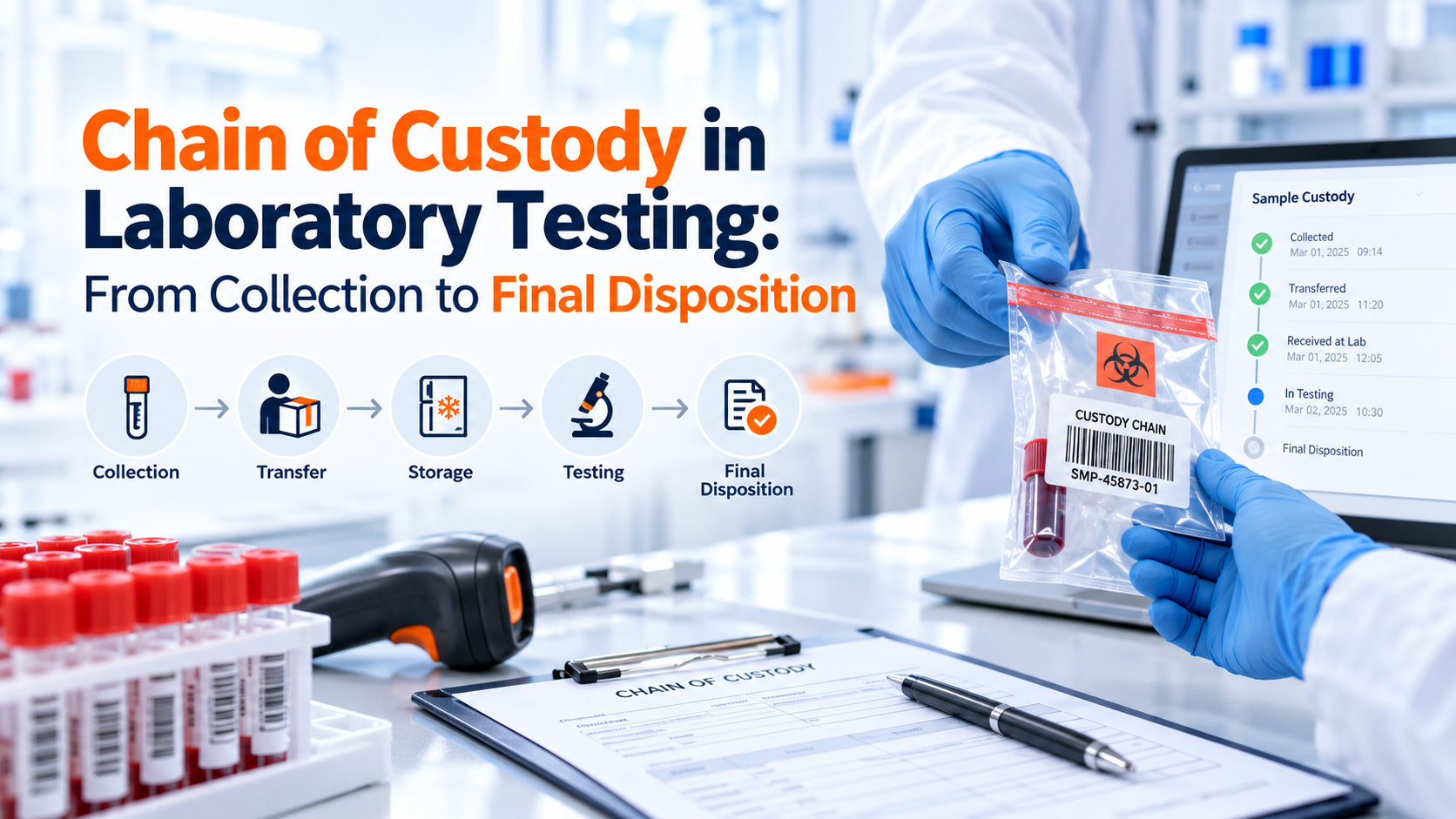
A laboratory result is only useful when the laboratory can reliably connect it to the correct sample and explain how that sample was handled. That is the purpose of chain of custody.
Chain of custody in laboratory testing is the documented history of who collected, received, transferred, stored, handled or otherwise had responsibility for a sample as it moved through its lifecycle. A strong custody process helps preserve sample identity, integrity and accountability from collection or receipt through laboratory handling, testing, retention and final disposition.
For some laboratories, chain of custody is especially important because samples may support regulatory, contractual, environmental, forensic or other decisions where the history of the material needs to be demonstrable. Other laboratories may use a less formal custody model but still need dependable records of receipt, transfers, storage and handling.
The important principle is continuity. When responsibility for a sample changes, the record should change with it.
EPA guidance on sample handling describes chain of custody as a means of maintaining the identity and integrity of a sample through collection, transport, laboratory handling and reporting, with documentation maintained through custody forms, notebooks or electronic records.
For laboratories that first need to establish broader sample visibility, the laboratory sample tracking guide explains how identity, status, location, testing and final disposition fit into the complete sample lifecycle.
What Is Chain of Custody in a Laboratory?
Chain of custody is a traceable record of possession, transfer and handling.
It should allow an authorized reviewer to reconstruct important events in the sample's history and answer questions such as who collected or submitted it, when it was received, where it was stored, who transferred it, who accepted responsibility for it and what ultimately happened to it.
A chain-of-custody process therefore does more than show the current sample location. It creates accountability across transitions.
Consider an environmental sample collected in the field. The sampler records the sample identity and collection information. The sample is packaged and transported. A laboratory employee receives it and evaluates the shipment and associated documentation. The sample then moves into controlled storage, preparation and testing. Portions may be transferred to analysts or other departments. After testing, remaining material may be retained temporarily and eventually returned or disposed of according to the laboratory's procedures.
Every significant change in possession or custody may need to remain traceable. The level of documentation should match the laboratory's work, applicable requirements and the intended use of the results.
Chain of Custody Is Not the Same as Sample Tracking
The two concepts overlap, but they are not identical.
Sample tracking focuses broadly on the sample's identity, status, location, testing progress and lifecycle.
Chain of custody focuses more specifically on accountability for possession, transfer, handling and security.
A sample tracking record might tell you that Sample A is currently stored in Freezer 2 and awaiting chemistry testing.
A custody record should help explain how Sample A reached that location, who transferred it, when the transfer occurred and who accepted responsibility where that level of documentation is required.
A good sample management system can connect both views rather than forcing laboratories to maintain a tracking spreadsheet and a separate custody record.
Where Does Chain of Custody Begin?
Chain of custody should begin at the point defined by the laboratory's procedure and project requirements, often when the sample is collected or first placed under controlled responsibility. For field samples, this may begin with the person collecting the sample.
For customer-submitted contract testing samples, the external submitter may complete submission documentation before the laboratory formally assumes custody at receipt.
For manufacturing or QC laboratories, custody may begin when material is sampled from a batch or production process. The exact starting point varies, but it should be defined rather than assumed.
The important question is: At what point does our organization need to start proving who had responsibility for this sample?
Once that point is established, the custody process should continue without undocumented gaps.
What Information Should a Laboratory Chain-of-Custody Record Contain?
A laboratory chain-of-custody record should contain enough information to identify the sample uniquely and reconstruct important transfers and handling events.
The exact fields depend on the laboratory and project, but commonly relevant information includes the sample identifier, collection or submission information, collection date and time when applicable, sample type or matrix, requested analyses, preservation or handling information where relevant, the people relinquishing and receiving custody, transfer dates and times, shipment or container information, laboratory receipt information and relevant comments about sample condition.
EPA's Quality Assurance Project Plan guidance explains that custody procedures should document samples from collection through transfer, storage, laboratory procedures and disposal, and should maintain an accurate record of sample handling and treatment. It also emphasizes authorized handling and procedures for custody within the laboratory.
The record does not need unnecessary information simply to appear complete. It needs the information required to establish identity, accountability and integrity for the laboratory's use case.
Sample Identification Must Remain Consistent
Chain of custody depends on reliable sample identification. If the identifier written on a sample container differs from the identifier used on the custody record, laboratory worksheet or electronic system, the chain immediately becomes difficult to defend.
A laboratory should therefore use a consistent identifier throughout the workflow.
When the laboratory receives a sample, that identifier may be retained or connected to an internal laboratory ID. If an internal ID is created, the relationship between the external identifier and laboratory identifier should remain clear.
Barcodes and QR codes can make this easier by connecting the physical container to its electronic record, but the underlying identification rules are still important. A barcode cannot correct an incorrect sample identity that was entered during registration.
Collection Is the First Critical Custody Event
For samples collected in the field, good custody begins before the sample reaches the laboratory.
The collector may need to document information such as where and when the sample was collected, the sample identifier, collection method, sample type, preservative or storage requirement and any unusual observations relevant to the sample.
The container should also be identified appropriately. Where formal custody seals are required, their condition may become part of the documented custody history.
This is especially important for environmental testing, where field collection and transport may affect whether analytical results are usable. Laboratories managing these workflows can also review how an environmental testing LIMS can connect field samples, chain of custody, testing and reporting.
Transportation Should Preserve Both Sample Integrity and Documentation
The physical sample and its documentation should travel through a controlled process. That does not mean every laboratory needs the same shipping procedure.
Some samples may be hand-carried between rooms. Others may travel across a city, state or country. Some may require temperature control, specific preservatives or secure containers. Whatever the method, the custody process should address two separate questions.
First, was the sample maintained under appropriate conditions?
Second, can the laboratory establish who was responsible for it during relevant transfers?
A perfect custody form cannot compensate for a sample that was handled under inappropriate conditions. Likewise, a physically intact sample may still create questions if its transfer history cannot be reconstructed.
Laboratory Receipt Is a Major Custody Checkpoint
Receipt is where responsibility commonly transfers from the collector, courier or submitting organization to the laboratory. This is an important point for verifying both the physical sample and the accompanying records.
The receiving process may need to confirm that the sample identifier matches the paperwork, the expected containers are present, packaging or seals are in the expected condition, required preservation or temperature conditions are acceptable where applicable and the requested testing information is clear.
Any discrepancy should be handled according to the laboratory's procedures. For example, the laboratory may discover that a sample arrived without required custody documentation, that a container identifier does not match the submission record or that packaging shows evidence of damage.
The important point is not to hide the discrepancy. It should be documented and routed to the appropriate person for a decision. The earlier guide to how a LIMS works explains how laboratory receipt can become the beginning of a connected electronic workflow rather than another isolated paper step.
Handoffs Inside the Laboratory Matter Too
A common weakness in custody processes is documenting the field-to-laboratory transfer carefully and then losing visibility once the sample enters the building. Internal transfers may matter just as much.
A sample may move from receiving to refrigerated storage, from storage to sample preparation, from preparation to an analyst, from one department to another and eventually back into retention storage.
Where those transfers are significant to the laboratory's custody requirements, the record should identify the relevant person, location and time.
This does not mean every employee who walks past a freezer needs to sign a custody record. The laboratory should define what constitutes a custody event.
For one workflow, physically transferring possession between analysts may require documentation. For another, scanning a sample into a controlled storage location may be sufficient. The process needs to be defensible and consistently followed.
Timestamps Create the Sequence of Custody
A custody record is useful because it reconstructs sequence. That makes time information important.
When one person relinquishes a sample and another accepts it, the relevant date and time can show when responsibility changed.
Timestamps can also help explain storage durations, transportation intervals and whether time-sensitive requirements were met.
In a digital system, these timestamps should be associated with the relevant user or system action rather than entered as disconnected notes wherever possible.
This is one advantage of properly configured chain of custody software. The record can be built as events occur rather than reconstructed manually later.
Responsible Users Should Be Identifiable
A custody entry needs accountability. If a record says only "sample transferred," an auditor or laboratory manager may still need to ask who actually performed the transfer.
The system should therefore identify the responsible user according to the laboratory's access and authentication model.
Digital records can make this stronger when individual users authenticate separately and actions are associated with their accounts.
Shared logins undermine this principle because they make it difficult to determine which person actually performed the action.
Where laboratory procedures require signatures or formal acknowledgments, the system and workflow should support the appropriate controls.
Sample Storage Is Part of the Custody Process
A sample does not stop needing traceability simply because it has been placed in a freezer or cabinet. The laboratory should know where controlled samples are stored and, where required, who can access them. Storage locations can be organized hierarchically.
For example, a laboratory might use:
Cold Room 2, Freezer 4, Rack B, Box 7.
Another laboratory may only need a room and shelf.
The level of detail should match operational needs.
The key is that the electronic record and physical reality remain consistent.
If the system says a sample is in Freezer 4 but the container was moved to another location without updating the record, the laboratory has created a custody gap.
What Happens When a Sample Is Split Into Aliquots?
Aliquots complicate custody because one original sample can become several physical materials. The laboratory should preserve the relationship between the original sample and the child aliquots or derivatives. Each aliquot may then develop its own custody history.
For example, one aliquot may move to chromatography, another to microbiology and another into long-term retention.
If they are all recorded simply under the same original sample number without sufficient distinction, it may become difficult to establish which material produced which result.
A structured LIMS can preserve parent-child relationships so each aliquot remains connected to its origin while also maintaining its own status, location and handling history.
That is one reason custody works best when it is part of the wider sample-management architecture rather than a standalone form.
How Should Custody Corrections Be Handled?
A correction should preserve the original history rather than silently rewriting it.
Mistakes happen.
A user may select the wrong storage location, record the wrong transfer destination or discover that a field was entered incorrectly. The appropriate response is not to make the history disappear.
The laboratory should follow its approved correction procedure so the record shows what was corrected and retains enough context to understand the change.
In a controlled digital workflow, this may involve retaining the original value, recording the corrected value, capturing the responsible user and timestamp and, where required, documenting the reason for the correction.
The precise control should reflect the laboratory's quality and regulatory requirements. The principle is simple: corrections should improve the record without destroying traceability.
Digital Chain of Custody vs Paper Chain of Custody
Paper custody forms can work well when they are completed consistently, stored securely and easy to retrieve. They also have limitations.
A paper form may travel separately from the operational data. Copies can become difficult to reconcile. Handwriting may be unclear. Laboratory staff may need to re-enter custody information into another system. Finding one transfer in years of archived paperwork can be time-consuming.
Digital custody records can reduce some of these problems by connecting each transfer directly to the sample record.
An electronic system can associate receipt, transfer, location changes and responsible users with timestamps as the work happens. Barcode scanning can also reduce manual entry at custody checkpoints.
However, digital does not automatically mean reliable. A poorly configured system can create the same traceability problems as paper.
The laboratory still needs defined procedures, controlled access, clear user responsibilities, appropriate correction practices and training. The technology should support the custody procedure, not replace it.
Can LIMS Software Manage Digital Chain of Custody From Sample Receipt Through Disposal?
Yes. A properly configured LIMS can maintain digital chain-of-custody records across sample receipt, transfers, locations, testing, storage, retention and final disposition. The system can connect custody events with the sample's unique identity and broader laboratory workflow.
For example, LabZila's sample management software is designed to maintain time-stamped records of sample receipt, transfers, handoffs, status changes and responsible users while also connecting those events to sample locations, assigned testing, storage and disposition.
That allows custody to remain part of the same sample record rather than existing as a separate paper document that has to be reconciled later.
Digital custody can also work alongside laboratory workflow automation so specific sample events can trigger routing, notifications or defined next steps where appropriate.
The laboratory still determines which custody events must be recorded and what level of control its work requires.
How Can Laboratories Maintain Full Traceability When Samples Move Between People, Locations and Testing Stages?
The most reliable approach is to treat each significant transfer as a structured event linked to the same sample identity. The transfer should answer the appropriate combination of four questions:
Who had responsibility?
What sample was involved?
Where did it move?
When did the transfer occur?
Depending on the workflow, the record may also need the condition of the sample, reason for transfer, storage requirements or other relevant information.
A laboratory should then ensure the same process applies across departments rather than allowing each section to create its own informal tracking method.
For example, receiving should not use one spreadsheet while chemistry uses handwritten notebooks and retention storage uses email. Those separate systems create gaps between custody events. A centralized record is much easier to follow.
Custody Should Connect With Testing Status
Possession and testing status are different, but the two should remain connected. Suppose an analyst receives a sample for testing. The custody history may show that the analyst accepted the sample at 10:15 AM.
The workflow record may separately show that preparation began, testing was completed and results moved into technical review.
Together, those records create much stronger traceability than either one alone. This is why custody should not become an isolated compliance form. It should be part of the complete sample-to-report workflow.
What Happens After Testing Is Complete?
Chain of custody may continue after analytical work is finished.
Remaining sample material may need to be retained for a defined period, returned to the submitter, transferred into archive storage or disposed of according to laboratory procedures. The system should reflect the correct status.
If a sample has been disposed of, it should not continue appearing as though it is physically available.
If it has been returned, the transfer should be recorded where required.
If it is being retained, the laboratory should be able to identify its retention location and applicable retention requirements.
Final disposition closes the physical sample history.
Final Disposition Should Be Traceable
A sample lifecycle without a documented ending is incomplete. For some laboratories, final disposition may simply be a recorded disposal event. Other workflows may require additional authorization or documentation.
The laboratory should define who may authorize disposal, when it is allowed and what information needs to be retained. The custody record should not necessarily disappear when the physical sample is gone.
The historical record may still need to be retained according to applicable procedures, contracts or regulatory requirements.
How Chain of Custody Supports Audit Readiness
Audit readiness is easier when custody is recorded during routine work rather than reconstructed before an inspection or customer audit.
An auditor or reviewer may want to understand whether sample identities remained consistent, whether handoffs were documented, whether storage and handling records were available and whether corrections preserved traceability.
A centralized custody history makes those questions easier to answer. It also allows the laboratory to identify weaknesses before an external review.
For example, management may discover that field-to-laboratory transfers are documented well but internal storage movements are inconsistent. That becomes an operational improvement opportunity rather than an audit surprise.
Common Chain-of-Custody Gaps
Many custody problems do not begin with an obvious sample loss. They begin with small documentation gaps. A transfer is performed but never recorded. Two containers have similar labels.
A sample changes freezers but the electronic record is not updated.
An aliquot is created without a clear parent relationship.
A paper custody form does not match the electronic sample ID.
A correction overwrites an earlier entry without preserving history.
A shared user account makes it unclear who accepted a sample.
A retained sample is eventually discarded but the system still lists it as available.
Individually, each issue may seem minor. Together, they weaken the ability to reconstruct the sample's history.
Building a Better Chain-of-Custody Workflow
A strong custody workflow begins by mapping the real movement of samples through the laboratory. Start with collection or initial submission.
Then identify receipt, accessioning, storage, preparation, analytical transfers, temporary storage, review-related handling, retention and final disposition.
At each stage, determine whether responsibility changes and whether that change must be recorded.
Then standardize sample identifiers, location names, transfer statuses and user responsibilities. The digital system can only enforce a process that the laboratory has first defined clearly.
After that, decide where barcodes or QR codes can reduce manual entry, which events require timestamps, which actions need authorization and how discrepancies or corrections should be handled. Finally, test the workflow using realistic exceptions.
What happens if a sample arrives without complete documentation?
What happens if the custody seal is damaged?
What happens if a sample goes to the wrong storage location?
What happens if an aliquot is created?
What happens when the sample is returned or disposed of?
A custody process is only reliable when it can handle normal work and exceptions.
Chain of Custody Across Different Laboratory Types
The underlying principle is consistent, but the details differ by industry.
Environmental laboratories may place strong emphasis on field collection, preservation, transport, holding times and documented handoffs.
Cannabis laboratories may need traceable intake, sample transfers, testing panels and reporting within state-specific requirements.
Contract testing laboratories may receive samples from many clients, requiring careful separation of client records and sample identities.
Pharmaceutical QC laboratories may need to maintain traceability between sampled materials, batches, tests, specifications, results and controlled review processes.
Clinical laboratories have their own specimen-handling and patient-identification requirements and may use LIS or other clinical systems alongside LIMS capabilities.
This is why chain-of-custody software should be configurable rather than assuming every laboratory follows the same procedure.
Chain of Custody Is a Process, Not Just a Form
The biggest mistake is treating chain of custody as a document that needs signatures rather than an operational process. The form matters because it records what happened. But the real objective is to maintain continuity between the physical sample and its history.
A complete custody process should make it possible to move backward from a reported result to the sample that produced it, then through the important handling events associated with that sample.
It should also allow the laboratory to move forward from receipt and understand where the sample went, what happened to it and how its lifecycle ended.
When that information is connected, chain of custody becomes part of everyday laboratory control rather than paperwork completed only because someone may eventually ask for it.
LabZila connects sample identity, transfers, responsible users, locations, testing activity, storage and final disposition within a configurable LIMS workflow. Laboratories that want to replace fragmented paper or spreadsheet custody records can contact LabZila to discuss their sample-handling and traceability requirements.
Frequently Asked Questions
What information should a laboratory chain-of-custody record contain?
A laboratory chain-of-custody record should contain enough information to identify the sample and reconstruct relevant custody events. Depending on the workflow, this can include the sample ID, collection or submission details, date and time, sample type, requested testing, preservation information, transfer details, people relinquishing and receiving custody, laboratory receipt information, storage or handling information and relevant comments or discrepancies. The exact fields should be based on the laboratory's procedures and applicable project or regulatory requirements.
How can laboratories maintain full traceability when samples move between people, locations and testing stages?
Use one consistent sample identity and record each significant custody event against the same centralized sample record. Transfers should identify the responsible users, relevant date and time, and location or destination where required. Sample location, custody history and testing status should remain connected rather than being managed in separate spreadsheets or paper systems. Defined SOPs, individual user accounts and consistent transfer practices are also essential.
Can LIMS software manage digital chain of custody from sample receipt through disposal?
Yes. A LIMS can maintain digital custody events from receipt through transfers, testing, storage, retention and final disposition while linking those events with the sample's identity and workflow history. Depending on configuration, it can also support barcode scanning, timestamps, responsible-user records, sample locations, aliquot relationships and controlled corrections. The laboratory remains responsible for defining its custody procedures and determining which events and controls are required.