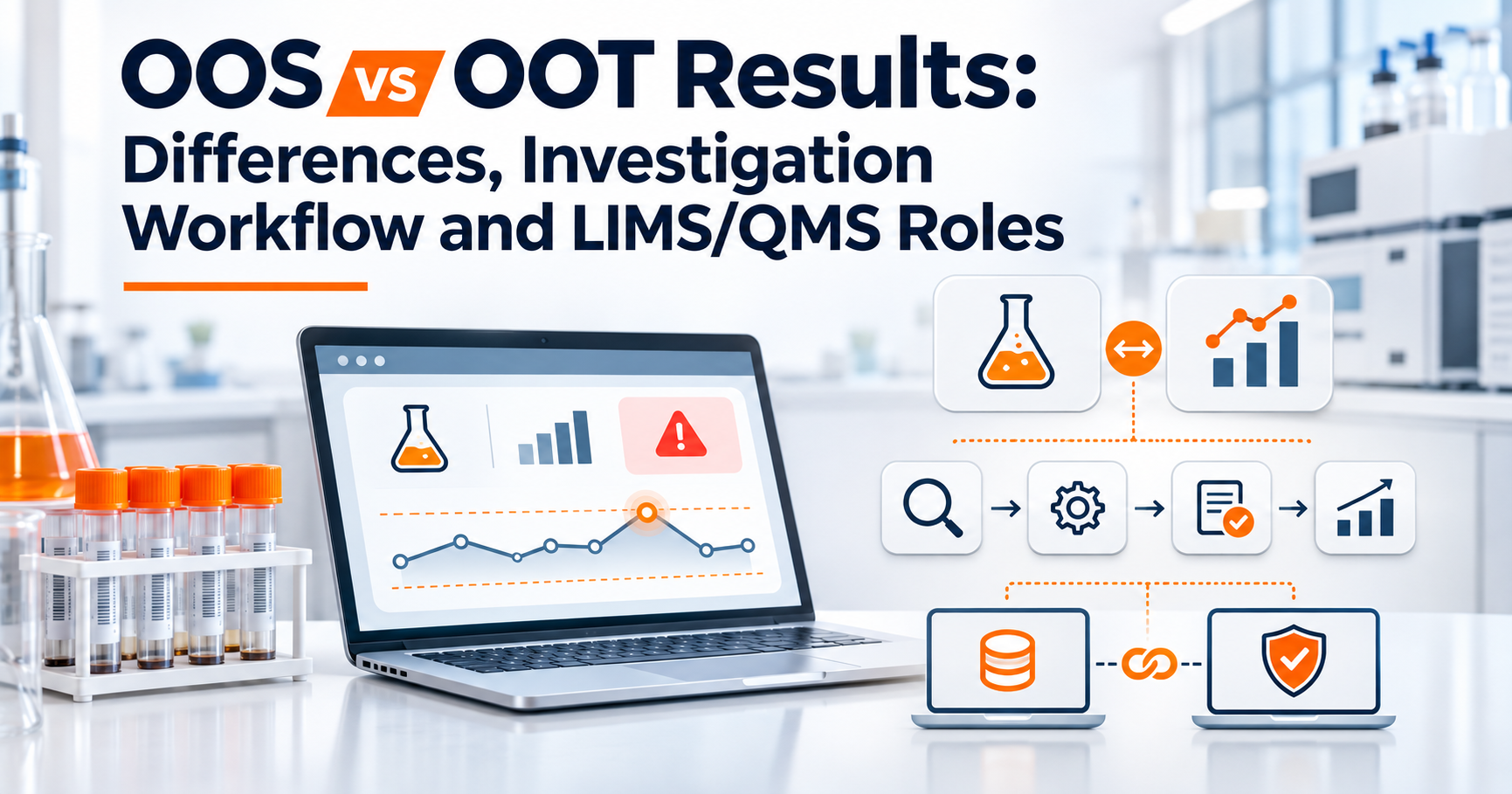
An unexpected laboratory result can create more work than the original test. The analyst needs to review the data, the supervisor needs to understand what happened, and the quality team may need to investigate before the result can be accepted or the affected material can be released.
The process becomes harder when test results are stored in a LIMS, investigation notes are maintained in spreadsheets, and corrective actions are tracked in a separate quality system.
For pharmaceutical quality control laboratories, understanding OOS vs OOT results is important, but knowing how to manage them is equally important. Both situations require reliable data, appropriate investigation procedures, and clear responsibilities. However, they do not always trigger the same response.
Laboratories evaluating OOS investigation software should therefore look beyond basic result alerts. A useful system should connect the original result with its specifications, historical trends, investigation records, technical reviews, and applicable quality actions.
LabZila provides laboratory quality control software designed to help teams monitor these results and manage their associated review workflows.
OOS vs OOT Results: What Is the Difference?
An out-of-specification (OOS) result falls outside an established specification or acceptance criterion. An out-of-trend (OOT) result differs from an expected historical pattern or established trend criterion, even when the value remains within the product's specification.
For example, consider a pharmaceutical assay with an approved specification of 95% to 105%.
A result of 93% falls outside that specification and is considered OOS. A result of 96% remains within specification, but it may warrant OOT assessment if the laboratory's historical data and approved trend criteria indicate an unusual shift.
The difference matters because specifications establish acceptance boundaries, while trend monitoring helps laboratories identify changes in analytical or product performance.
A result may also be both OOS and OOT. Similarly, not every unusual-looking result qualifies as OOT. Laboratories need scientifically justified criteria, suitable historical data, and approved procedures to decide when a trend requires investigation.
In pharmaceutical manufacturing, the FDA's guidance on investigating OOS test results explains the expectations for evaluating results outside established specifications.
For OOT results, the laboratory should establish appropriate statistical or scientific trend criteria and determine the response through its approved procedures.
This distinction should also be reflected in laboratory software. A system that only flags specification failures may miss changes in performance that deserve attention before a formal failure occurs.
Why OOS and OOT Investigations Become Difficult Without Connected Software
Many laboratories already have procedures for handling OOS and OOT results. The difficulty often lies in coordinating those procedures across multiple records and systems.
A result may need to be checked against a specification, compared with historical results, reviewed against instrument and method information, and linked to an investigation. If the investigation identifies a wider quality problem, a deviation or corrective and preventive action (CAPA) may also be required.
When this information is disconnected, reviewers may spend unnecessary time locating the original test data, confirming which specification applied, collecting instrument records, or checking whether an earlier investigation involved the same issue.
For laboratories assessing laboratory quality control software, the priority should be a traceable connection between the analytical result and the decisions made afterward.
That connection helps technical reviewers and quality personnel work from consistent information rather than reconstructing the investigation through emails and attachments.
How Should an OOS Investigation Workflow Be Managed?
A reliable OOS investigation workflow should follow the laboratory's approved procedures and applicable regulatory requirements. Software can organize the records and responsibilities, but it cannot replace the scientific assessment.
1. Identify the OOS Result and Preserve the Original Data
The process begins when a result falls outside its applicable specification or acceptance limit.
A LIMS can compare the recorded result with configured criteria and identify the exception. The result should remain associated with its sample, test method, instrument, analyst, applicable specification, and supporting data.
Original test information must remain available for review. An unfavorable result should not disappear because additional testing produces a different outcome.
When evaluating LIMS OOS management, laboratories should confirm that result histories, relevant changes, and review decisions remain traceable.
2. Perform the Initial Laboratory Investigation
An initial laboratory investigation examines whether an identifiable laboratory error may have contributed to the unexpected result.
The analyst and supervisor may review the analytical method, sample preparation, calculations, instrument performance, system suitability, standards, reagents, and original laboratory records.
The FDA describes this initial evaluation as Phase I of its pharmaceutical OOS investigation process.
The objective is to establish what the available evidence supports, not simply to find a reason to disregard the result.
A structured laboratory workflow can help assign the assessment to the appropriate personnel, maintain supporting evidence, and document the conclusion before further action is taken.
3. Expand the Investigation When Necessary
When the initial assessment does not establish a scientifically justified laboratory cause, the investigation may need to expand beyond the laboratory.
Under the FDA's pharmaceutical OOS guidance, Phase II involves a full-scale investigation that can include production processes, sampling procedures, relevant manufacturing records, and other potentially affected batches or products.
This is where disconnected quality records become particularly difficult to manage.
The investigation may involve laboratory analysts, supervisors, production personnel, and the quality unit. Each team needs access to the information relevant to its responsibilities.
A connected LIMS and QMS environment can help maintain the relationship between analytical evidence and the broader quality investigation, while allowing authorized personnel to review and document decisions.
4. Manage Retesting and Resampling Through Controlled Procedures
Retesting and resampling must not become shortcuts for obtaining an acceptable result.
Retesting generally involves additional analysis of the original sample material, while resampling involves collecting another sample from the batch or lot.
FDA guidance explains that these activities require appropriate scientific justification and documented procedures. Repeated testing simply to obtain a passing result, commonly described as testing into compliance, is unacceptable.
Passing retest results do not automatically invalidate the original OOS result. The complete investigation and all relevant results must be considered.
An effective OOS investigation workflow should preserve the original result, distinguish additional testing from the initial analysis, document the justification, and maintain the associated review history.
LabZila's configurable laboratory workflows can support organized testing records and controlled review activities. The laboratory remains responsible for determining whether retesting or resampling is appropriate.
5. Complete the Investigation and Determine Follow-Up Actions
The investigation should conclude with a documented assessment of the findings, the impact of the result, and the necessary follow-up.
Some investigations identify an assignable laboratory error. Others reveal equipment issues, method problems, manufacturing variation, or recurring quality concerns.
When corrective or preventive action is warranted, the investigation can lead to a CAPA record.
The quality team should then manage the assigned actions, supporting evidence, review, and effectiveness checks according to its procedures.
A connected system helps preserve the link between the original OOS result and the actions taken after the investigation.
How Is an OOT Investigation Different?
An OOT investigation focuses on results that depart from an expected pattern. The result may still meet the approved specification, but its behavior could indicate a developing issue that requires technical assessment.
For example, a pharmaceutical stability study may show a gradual change in assay results over successive timepoints. Each result could remain within specification, while the overall pattern meets the laboratory's criteria for an OOT assessment.
The reviewer may need to examine historical results, testing conditions, analytical variability, instrument performance, product characteristics, and other relevant information before determining the significance of the change.
Unlike an OOS result, an OOT finding does not automatically establish that the tested material has failed its specification.
The required response depends on the laboratory's procedures, the type of testing, the established trend criteria, and the scientific assessment.
For laboratories comparing OOT investigation software, trend monitoring is therefore a central capability.
The software should help users review results over time, compare them with suitable historical data, identify exceptions using configured rules, and retain the review decisions.
LabZila's laboratory quality control module includes configurable limits, supported control charts, trend monitoring, and OOS/OOT exception review to help laboratories organize this process.
What Are the Roles of LIMS, QC Software and QMS in OOS/OOT Management?
OOS and OOT investigations involve several related functions, but those functions should not be treated as interchangeable.
- A LIMS manages the operational testing records. It maintains information about samples, methods, specifications, test assignments, instruments, results, and the associated review workflow.
- Laboratory QC software supports analytical quality monitoring. It helps laboratories evaluate control results, acceptance limits, historical performance, unusual patterns, and applicable OOS or OOT exceptions.
- A laboratory QMS manages broader quality processes. It supports deviations, investigations, CAPAs, controlled documentation, approvals, assigned responsibilities, and effectiveness reviews.
Consider an OOS assay result identified during pharmaceutical finished-product testing. The LIMS maintains the sample and analytical records. The QC workflow identifies the result that needs attention and supports its technical assessment.
If a formal quality investigation is required, the QMS manages the related deviation and any necessary CAPA activities. The quality records should remain linked to the original laboratory evidence.
LabZila supports this separation through its laboratory operations, QC, and laboratory QMS software. For a more detailed comparison of these responsibilities, read LabZila's existing article on LIMS vs QMS: Differences, Overlap and How the Systems Work Together.
What Should Laboratories Look for in OOS and OOT Investigation Software?
Choosing the right software involves more than checking whether a vendor offers OOS and OOT alerts.
Laboratories should evaluate what happens after the exception is identified, how the necessary records are connected, and whether the workflow can reflect their approved procedures.
- Configurable Specifications and Trend Monitoring
The software should support approved specifications, appropriate warning or action limits, and trend criteria based on the laboratory's testing requirements.
During a demonstration, ask the vendor to show how the system distinguishes a result outside an acceptance limit from a result that requires trend review.
It is also important to understand how changes to specifications and criteria are controlled, particularly when previous results must remain associated with the requirements applicable at the time of testing.
- Connected Investigation and Deviation Records
An important requirement is the ability to connect an OOS or OOT exception with the investigation that follows.
Reviewers should be able to identify the affected sample, test, method, instrument, related evidence, assigned investigation, and resulting quality actions without rebuilding the record manually.
For laboratories already using separate quality-management applications, integration and clear record ownership are especially important.
- Controlled Reviews and Responsibilities
Investigation software should support clearly assigned responsibilities and appropriate approval stages.
The laboratory may need different permissions for analysts, technical reviewers, laboratory supervisors, and quality personnel.
Configurable notifications and workflow routing can help move records to the correct person, while the scientific and quality decisions remain with authorized staff.
- CAPA and Effectiveness Tracking
Not every OOT finding or OOS investigation requires CAPA. However, when an investigation identifies a problem requiring corrective or preventive action, the associated quality record should remain traceable.
Laboratories should look for the ability to manage action owners, deadlines, supporting evidence, implementation status, effectiveness checks, and final approvals.
LabZila's article on CAPA Management in Laboratories explains how deviations, investigations, corrective actions, and effectiveness reviews fit into a structured quality-management process.
- Audit Trails and Data Integrity
Regulated laboratories should also evaluate how the software preserves electronic records, result corrections, investigation activities, and review histories.
The requirements depend on the regulatory context and the intended use of the system. Where applicable, 21 CFR Part 11 LIMS controls can support electronic-record management, access restrictions, electronic signatures, and traceable approvals.
These capabilities are useful, but software does not automatically establish compliance. The laboratory must still manage configuration, validation, procedures, training, and appropriate oversight.
How LabZila Supports OOS and OOT Investigation Workflows
LabZila provides configurable LIMS, laboratory QC, and QMS capabilities that help laboratories maintain a connected process from analytical testing through exception review and quality follow-up.
Its laboratory QC software supports control-sample management, configured acceptance criteria, supported QC charts, result trend monitoring, OOS/OOT identification, and technical review workflows.
When an exception requires further investigation, LabZila can connect the relevant laboratory records with deviations, investigations, or CAPAs in its QMS environment.
The QMS supports investigation documentation, assigned responsibilities, review stages, corrective actions, effectiveness checks, and traceable closure records.
For pharmaceutical laboratories, LabZila also provides pharmaceutical LIMS software designed around raw-material testing, in-process control, finished-product analysis, stability studies, specifications, and controlled result approvals.
These capabilities can help reduce the need to coordinate investigation information through separate spreadsheets, emails, and disconnected records.
However, the actual workflow should be reviewed against the laboratory's methods, quality procedures, regulatory obligations, and implementation requirements.
The practical question for a prospective buyer is whether the configured system can support the complete investigation process their team follows.
Frequently Asked Questions
1. What is the difference between an OOS result and an OOT result?
An OOS result falls outside an established specification, while an OOT result departs from an expected historical trend or defined trend criterion.
An OOS investigation evaluates why a result does not meet its acceptance criteria. An OOT investigation examines an unusual pattern or change in performance, which may occur even when the result remains within specification.
Laboratories can use LIMS and QC software to identify exceptions against configured criteria, organize the supporting data, and route results for appropriate review. The investigation requirements depend on the testing activity, applicable regulations, and laboratory procedures.
2. What laboratory software helps manage out-of-specification results without the review process becoming fragmented?
A LIMS with connected laboratory quality control and QMS capabilities can help manage OOS results without separating testing, investigations, and corrective actions into unrelated records.
The system should maintain the original analytical result, applicable specifications, associated test information, review history, investigation evidence, and any linked deviation or CAPA.
LabZila provides configurable LIMS, QC, and QMS functionality for these workflows. Its connected approach can help analysts and quality personnel access relevant information while maintaining clear responsibilities for investigation and approval.
3. Can an OOS investigation be linked automatically with deviations and CAPA records?
Yes. OOS investigations can be linked with deviations and CAPA records through laboratory software that supports connected quality workflows and appropriate configuration.
LabZila supports linking OOS/OOT exceptions with relevant investigations, deviations, and CAPAs. Configurable workflow routing can help coordinate responsibilities and review stages.
However, whether a deviation or CAPA is created automatically depends on the specific rules and implementation. The laboratory should confirm that behavior during software evaluation.
An OOS result does not automatically mean CAPA is required. Qualified personnel must determine the investigation outcome and whether corrective or preventive action is necessary under the laboratory's quality procedures.
Evaluate LabZila for Your OOS and OOT Investigation Workflow
OOS and OOT management requires more than identifying an unexpected result. Laboratories need reliable testing records, appropriate investigation procedures, controlled reviews, and a clear connection between analytical evidence and quality actions.
When choosing laboratory quality control software, the most useful evaluation is a real workflow demonstration. Ask the vendor to show how an OOS or OOT result is identified, how an investigation is documented, and how any required deviation or CAPA remains connected to the original test.
LabZila brings laboratory operations, QC monitoring, and quality-management workflows into one configurable environment.
If your laboratory is evaluating a LIMS or replacing disconnected investigation records, contact LabZila to discuss your OOS/OOT procedures, quality-control requirements, and investigation workflow.