A laboratory quality problem is not resolved simply because the immediate issue has been fixed.
An instrument can be recalibrated. A result can be corrected. An analyst can repeat a step. A missing document can be added. Those actions may restore the immediate situation, but they do not necessarily explain why the problem occurred or whether it could happen again.
That is where corrective and preventive action becomes important.
CAPA management in laboratories is the structured process of investigating significant quality problems, identifying their causes, deciding what corrective or preventive actions are appropriate, assigning responsibility, implementing those actions, verifying that they were effective and formally closing the quality record.
The strongest CAPA process is not the one that creates the most CAPAs. It is the one that identifies which events genuinely require corrective or preventive action and follows those actions through to evidence-based closure.
For pharmaceutical quality systems, FDA's ICH Q10 guidance describes CAPA as a system for actions arising from complaints, product rejections, nonconformances, recalls, deviations, audits, regulatory findings and process or product trends. It also emphasizes a structured investigation with the objective of determining root cause and evaluating the effectiveness of resulting actions.
FDA: ICH Q10 Pharmaceutical Quality System
Those principles are particularly relevant to pharmaceutical laboratories, but the broader quality-management logic is useful across many laboratory environments: identify the event, understand its significance, investigate appropriately, address the cause and confirm whether the action actually worked.
What Is CAPA Management in a Laboratory?
CAPA stands for Corrective Action and Preventive Action. A CAPA process provides a controlled way to respond when a quality problem cannot be handled adequately through a simple correction or routine operational adjustment.
The process may begin with a laboratory deviation, audit finding, recurring equipment issue, trend, complaint, failed process, OOS investigation, document-control problem, training gap or another quality event.
The laboratory first needs to understand what happened and assess its significance. If further investigation is warranted, the team examines the event, gathers evidence and works toward an evidence-supported cause or contributing causes.
The laboratory then decides what action is appropriate.
That action should address the problem at the correct level.
If the action is implemented, the laboratory should later determine whether it produced the intended result before the CAPA is considered complete. This is why CAPA is better understood as a lifecycle than as a form.
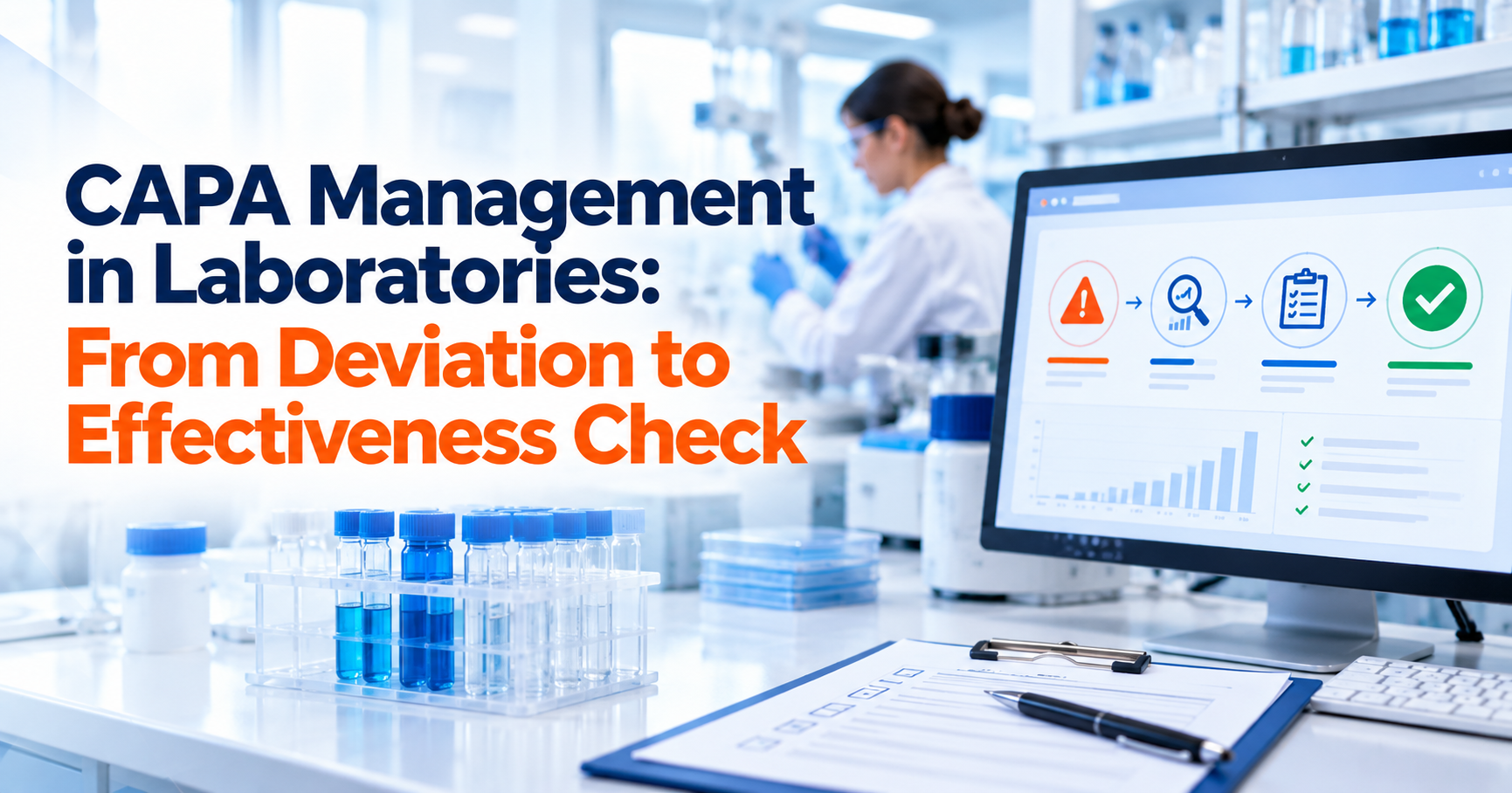
A practical sequence is: Quality event → Assessment → Investigation → Root cause analysis → CAPA decision → Action implementation → Effectiveness check → Approval and closure
The exact workflow will vary according to the laboratory, industry and applicable quality system.
What Is the Difference Between a Deviation and a CAPA?
A deviation records that something departed from an approved procedure, expected condition or defined requirement.
A CAPA addresses an identified cause or quality-system weakness when corrective or preventive action is warranted. The two are related, but they are not interchangeable.
Suppose an analyst discovers that a controlled laboratory procedure was not followed exactly.
The laboratory may create a deviation record describing what happened, when it occurred, which work may be affected and what immediate action was taken.
The investigation may show that the event was isolated, understood and adequately handled without a broader corrective action.
In that case, a separate CAPA may not be necessary. In another case, the same investigation may reveal that several analysts misunderstood the procedure because the instruction itself was ambiguous.
Now there may be a systemic issue that requires corrective action. The laboratory might revise the procedure, retrain affected personnel and later verify whether the problem stopped recurring.
That is CAPA territory. A good laboratory QMS should therefore allow deviations and CAPAs to remain related without forcing every deviation into an identical corrective-action workflow.
Not Every Quality Event Should Automatically Create a CAPA
Automatically opening a CAPA for every minor laboratory event can make the quality system harder to manage.
Teams become overloaded with low-value records, significant actions compete with trivial ones and overdue CAPAs begin accumulating because the process has become administrative rather than risk-focused.
The better approach is to define criteria for when escalation to CAPA is appropriate.
The laboratory may consider factors such as severity, recurrence, potential impact, regulatory significance, effect on data or results, breadth of the problem and whether the cause indicates a broader weakness.
The decision should be documented according to the quality procedure.
Software can route the record and enforce required fields, but it should not automatically decide that every deviation requires corrective action. That decision often requires quality and technical judgment.
What Is the Difference Between a Correction and Corrective Action?
A correction deals with the immediate problem.
Corrective action deals with its cause.
Imagine that an instrument produces an unacceptable calibration result.
Taking the instrument out of service is an immediate containment or correction.
Repairing the instrument may also be part of resolving the immediate condition.
But if the investigation identifies that preventive maintenance was repeatedly missed because the scheduling process was unreliable, addressing that process weakness would be a corrective action.
The distinction matters because laboratories can create the appearance of a CAPA program while repeatedly fixing symptoms. If the only action is "retrain the analyst" every time something goes wrong, the organization may never examine why the error continues to occur.
What Is Preventive Action?
Preventive action addresses a potential problem before the same type of failure occurs. It is often informed by risk assessments, recurring trends, audit observations, near misses or findings from related processes.
For example, an investigation may identify that one laboratory instrument failed because maintenance responsibilities were unclear.
The corrective action may address that specific instrument and process. The laboratory may then discover that several other instruments use the same scheduling approach.
A broader preventive action could strengthen maintenance ownership across those instruments before additional failures occur.
Corrective and preventive actions can therefore come from the same investigation, but they answer different questions.
Corrective action asks: How do we prevent this identified problem from recurring?
Preventive action asks: Where else could a similar problem occur, and what should we change before it does?
What Software Can Manage Laboratory Deviations and Trigger CAPA Workflows?
Laboratory QMS or LIMS software with structured quality-management functionality can record deviations, route investigations, link supporting laboratory records, create CAPAs when required, assign owners and due dates, attach evidence and manage effectiveness review through final closure.
The important requirement is process coverage.
A generic task-management system may assign an action and due date, but it may not understand the relationships among the deviation, sample, result, instrument, method, CAPA, investigation and supporting evidence.
That context matters in laboratory quality management.
LabZila's laboratory QMS software supports quality events, deviations, CAPAs, controlled documents, training and audits within connected quality workflows.
A deviation can remain associated with affected samples, methods, equipment and supporting records, while corrective or preventive actions can have owners, deadlines, evidence and effectiveness checks.
This gives QA and laboratory teams a connected history rather than a collection of separate emails and spreadsheets.
Start With a Clear Quality-Event Record
Good CAPA management starts before the root-cause investigation. The initial quality record should describe what actually happened. That means separating observations from assumptions.
For example: "Instrument HPLC-04 produced a system-suitability failure during Sample Batch B2610 testing" is an observation. "The analyst caused the problem" is a conclusion.
The second statement should not appear as the assumed cause before the investigation has established supporting evidence. The initial record should capture enough context for the investigation to begin.
Depending on the event, that can include when it occurred, who identified it, the affected process, sample, test, method, equipment or document, immediate containment, potential impact and related records.
The objective is not to write a lengthy narrative at intake. It is to preserve the facts available when the event was identified.
Immediate Containment Should Be Separate From Root Cause
Some events require immediate action before the complete investigation is finished.
An instrument may need to be restricted.
Testing may need to be placed on hold.
A sample may need to be quarantined.
A document may need to be temporarily withdrawn.
These containment actions reduce immediate risk.
They should not be mistaken for the final corrective action.
For example, taking an instrument out of service may prevent additional testing from being affected, but it does not explain why the instrument failed. That question belongs in the investigation.
The laboratory calibration management workflow is a good example of where equipment status, maintenance and quality records may need to connect when an out-of-calibration event becomes a broader investigation.
How Should a Laboratory Connect Deviations, Root-Cause Investigations and Corrective Actions?
The deviation should remain the source quality event, the investigation should document how the laboratory evaluated the event and identified its cause, and each CAPA action should remain linked to that cause and to the evidence showing implementation and effectiveness.
Those records should not become unrelated forms.
A strong relationship looks like this: Deviation identified → Investigation opened → Evidence reviewed → Cause determined → CAPA justified → Actions assigned → Evidence collected → Effectiveness verified → Record closed
The investigation explains why the action was chosen.
The CAPA explains what the laboratory is changing.
The effectiveness check demonstrates whether that change worked.
If those stages are disconnected, a reviewer may see that an SOP was revised but have no clear evidence explaining why that particular revision was expected to prevent recurrence. A connected QMS preserves that reasoning.
Root Cause Analysis Should Be Evidence-Based
Root cause analysis is one of the most important and frequently misunderstood parts of CAPA. The objective is not to find a phrase that allows the investigation to close. The objective is to understand why the event occurred well enough to choose an appropriate action.
Common techniques can include the Five Whys, fishbone analysis, fault-tree approaches, process mapping, comparison of historical records and other structured investigation methods. The technique matters less than the quality of the evidence.
A Five Whys exercise can still produce a weak conclusion if every answer is based on assumption.
A laboratory should consider relevant evidence such as training records, instrument history, method requirements, calibration records, sample records, environmental conditions, system logs, prior deviations, similar events and interviews with involved personnel.
The scope should match the event. A minor documentation discrepancy does not necessarily require the same investigation depth as a recurring laboratory failure affecting released product.
Avoid Using "Human Error" as the Final Explanation Too Quickly
People make mistakes, but "human error" often describes what happened rather than why it happened. Suppose an analyst selected the wrong method version. Stopping at "analyst error" may lead to retraining.
A deeper investigation might discover that the obsolete and current versions had nearly identical titles, both remained visible in the system and the selection screen did not distinguish effective status clearly.
Now the corrective action may involve method control and system configuration rather than training alone.
Human performance can absolutely be a legitimate contributing factor, but the laboratory should evaluate whether procedure design, workload, system usability, training, supervision or other conditions contributed to the event.
The CAPA should address the evidence-supported cause, not the easiest explanation.
Scope the Investigation Beyond the Single Event When Appropriate
A root cause may affect more than the sample or test where the problem was discovered.
If an incorrect calculation formula was used in one method, the laboratory should ask whether the same formula appears elsewhere.
If a calibration process failed for one instrument, determine whether other equipment follows the same flawed process.
If an analyst misunderstood a procedure, assess whether the ambiguity could affect other trained users.
FDA's 2022 OOS guidance for pharmaceutical production emphasizes that investigations should evaluate laboratory errors carefully, consider whether an investigation needs to expand beyond the laboratory and evaluate all relevant test results before reaching conclusions.
FDA: Investigating Out-of-Specification Test Results for Pharmaceutical Production
That specific FDA guidance applies to pharmaceutical production testing within its stated scope. Other laboratories should follow their own applicable regulatory, accreditation, contractual and quality-system requirements.
The CAPA Decision Should Follow the Investigation
CAPA should not be predetermined before the investigation is complete. If the team decides the corrective action first, there is a risk that the investigation becomes an exercise in justifying a solution that was already chosen.
Instead, the investigation should establish what happened and why. The quality team can then determine whether correction alone is adequate or whether formal corrective or preventive action is needed.
That decision should consider the significance of the problem and the likelihood that the proposed action will address the identified cause.
A Corrective Action Should Match the Root Cause
There should be a logical connection between cause and action. Suppose the root cause is that instrument calibration reminders were stored in a spreadsheet that was not reviewed consistently.
A corrective action consisting only of analyst retraining does not address that cause.
A more relevant action might involve establishing controlled scheduling, responsible ownership, automatic reminders and equipment-status rules.
Similarly, if the root cause is an unclear SOP, replacing a piece of equipment may not solve the actual problem.
A useful quality review question is: If this action is completed successfully, why should it prevent the identified problem from recurring?
If the team cannot answer that question clearly, the CAPA may need redesign.
Assign One Clear Owner to Each CAPA Action
CAPA records often become overdue because responsibility is vague. "QC team" is not always sufficient ownership.
A quality system should identify the person or role responsible for ensuring each action progresses. That does not mean one person must personally perform every task.
A CAPA may involve several departments.
The owner is responsible for coordination and completion.
For example, a method-related CAPA might require contributions from QC, QA, training and system administration. Each activity can have its own responsible person while the CAPA record maintains overall accountability.
Due Dates Should Be Realistic and Controlled
Every CAPA should have a defined timeline appropriate to its significance and complexity.
A procedure update may take days.
A major method redevelopment or system change may take considerably longer.
The due date should reflect the actual work required.
The quality system should also make approaching and overdue actions visible.
This is where laboratory workflow automation can help by routing assignments, sending notifications and escalating overdue activities according to configured rules.
However, reminders do not replace management oversight. If important CAPAs repeatedly become overdue, the laboratory should examine the underlying workload, prioritization and process rather than simply sending more alerts.
CAPA Due-Date Extensions Need Control
Sometimes a due date must change.
A supplier may delay a critical component.
Validation may take longer than expected.
An external service may become unavailable.
Changing a deadline can be reasonable, but the original commitment should not simply disappear. A controlled workflow should capture why the extension was needed, the revised date and any required approval.
The team should also consider whether delaying the action creates additional risk that needs temporary controls. Repeated extensions can be a signal that CAPAs are being scoped poorly or resources are inadequate.
Implementation Evidence Matters
Marking an action "Complete" should mean more than entering a completion date. The CAPA record should contain appropriate evidence showing what was actually done.
If the action was to revise a procedure, the evidence may include the approved revised version.
If training was required, completion records may be relevant.
If software was changed, testing or validation evidence may be needed according to the intended use and applicable requirements.
If equipment was modified, service and qualification information may be appropriate.
The type of evidence should match the action. Good CAPA management software keeps this evidence connected to the action instead of requiring reviewers to search shared folders to determine whether the work was actually completed.
What Is a CAPA Effectiveness Check?
A CAPA effectiveness check is a planned evaluation performed after implementation to determine whether the corrective or preventive action achieved its intended result and whether the problem has been adequately controlled without creating unacceptable new issues.
Implementation answers: Did we complete the action?
Effectiveness answers: Did the action work?
Those are different questions. An SOP can be revised successfully and still fail to prevent recurrence. Training can be completed by every employee and still fail to change performance.
A system configuration can be deployed and still create another workflow problem. This is why CAPA should not normally be closed solely because implementation tasks have been completed.
Define the Effectiveness Check Before Closing the CAPA
An effectiveness check should have measurable or otherwise objective criteria wherever practical.
For example, if a CAPA was opened because calibration activities were repeatedly overdue, an effectiveness criterion might assess whether calibration activities remain on time over a defined period.
If a CAPA addressed recurring sample-registration errors, the laboratory could review accessioning error rates after implementation.
If the problem involved incomplete technical reviews, the effectiveness assessment might sample completed records to determine whether the required review information is now consistently present.
The measure should match the problem. "QA reviewed the CAPA" is not an effectiveness criterion.
"Zero recurrence" can also be misleading if the event is naturally rare and the observation period is too short. The laboratory should select enough time and evidence to reach a meaningful conclusion.
CAPA Effectiveness Does Not Always Mean Zero Events Forever
Real processes have variation. A single later event does not automatically prove that a CAPA failed, just as no observed recurrence during a short period does not automatically prove that it succeeded.
The reviewer should assess whether the defined cause was controlled and whether the expected improvement occurred. For recurring problems, trend data can be especially useful.
A process that previously generated ten similar deviations per month and later produces one may show substantial improvement even though the count is not zero.
The effectiveness criterion should therefore be defined before the review whenever possible rather than chosen afterward to make the CAPA appear successful.
What Happens If the CAPA Is Not Effective?
An ineffective CAPA should not simply be closed and forgotten. The laboratory should determine why the action did not achieve the intended result.
Perhaps the root cause was incomplete.
Perhaps the action addressed only one contributing factor.
Perhaps implementation was inconsistent.
Perhaps the effectiveness measure revealed a related problem that had not been identified originally.
Depending on the findings, the CAPA may require additional action, reopened investigation or another linked quality event. A digital quality system should preserve this history. An unsuccessful first action is still important quality information.
How Can LIMS or QMS Software Track CAPA Responsibilities, Due Dates and Effectiveness Checks?
The system should maintain a structured CAPA record containing the linked source event, investigation, responsible owner, individual actions, due dates, completion evidence, review status, effectiveness plan, effectiveness results and final approval. Notifications and escalation rules can help keep overdue work visible.
LabZila's QMS functionality supports corrective and preventive actions created from deviations, audit findings or recurring issues. Actions can be assigned to responsible users, given deadlines, supported with evidence and moved through effectiveness review before final closure.
The advantage of keeping this information in a structured system is visibility.
A quality manager can distinguish between a CAPA that is still under investigation, one waiting for action implementation and one waiting for an effectiveness check. Without that distinction, a spreadsheet containing one "Status" column often hides where the work is actually delayed.
Connect CAPA With the Original Laboratory Context
A laboratory CAPA is stronger when the quality record remains connected to the operational evidence behind it. Suppose an OOS investigation involves:
Sample P-26104
Assay Test ASSAY-02
HPLC HPLC-04
Method M-102 Rev. 5
Calibration record CAL-944
Deviation DEV-2026-81
CAPA CAPA-2026-27
If each item lives in a separate system with no relationship, investigators must reconstruct the story manually. A connected LIMS and QMS environment can preserve those relationships.
The LIMS vs QMS guide explains this division clearly. The LIMS manages samples, testing, methods, results, instruments and operational workflows. The QMS manages deviations, CAPAs, documents, training, audits and related quality processes.
The value comes from connecting them when laboratory work becomes a quality issue.
LIMS and QMS Should Have Clear Ownership
A laboratory should decide which system owns each process.
If the organization already uses an enterprise QMS for CAPA, recreating the same CAPA independently inside the LIMS may cause duplicate records and disagreement about which system is authoritative.
In that environment, integration may be more appropriate.
Another laboratory may intentionally use one platform for both laboratory operations and quality workflows.
Neither architecture is automatically better.
The important requirement is clear ownership.
Users should know where the official deviation lives, where the official CAPA lives and how those records connect with the sample or result that triggered them.
CAPA and Laboratory QC Are Related but Not the Same Thing
Laboratory QC detects and monitors analytical performance. CAPA addresses broader quality problems when investigation shows corrective or preventive action is warranted.
For example, a control chart may identify an unusual shift.
That signal belongs initially to the QC process.
Investigation may show that the change is expected and acceptable.
No CAPA may be necessary.
Alternatively, the investigation may reveal a recurring instrument problem that requires corrective action. That is when the quality issue can move into a CAPA workflow.
LabZila's laboratory quality control software and QMS capabilities are therefore related but intentionally distinct.
This separation prevents every analytical alert from automatically becoming a formal quality-system action.
CAPA and Out-of-Specification Results Should Also Remain Distinct
An OOS result is an analytical result outside the applicable specification or acceptance criteria. It needs appropriate investigation according to the laboratory's procedures and applicable requirements.
CAPA may result from that investigation, but the OOS result itself is not automatically the CAPA.
The investigation may identify a laboratory error, manufacturing cause, procedural weakness, equipment problem or another factor. Only then can the organization determine what corrective or preventive action is justified.
This distinction becomes especially important in pharmaceutical QC, where invalidating or retesting an OOS result without an adequate investigation can undermine the reliability of the overall quality decision.
CAPA Can Lead to Document and Training Changes
A corrective action often affects more than the original quality record.
If a procedure needs revision, that change should connect with document control.
If the revised procedure changes how personnel perform work, training may be required.
If an equipment process changes, calibration or maintenance requirements may need updating.
If software configuration changes, testing and change-control activities may be necessary.
This is why CAPA works best inside a broader quality-management framework.
A CAPA that says "SOP updated and staff retrained" should be traceable to the actual controlled SOP revision and relevant training records rather than existing only as text in a CAPA form.
Audit Findings Can Also Generate CAPA
Not every CAPA begins with a laboratory deviation. Internal audits, customer audits, accreditation assessments and regulatory inspections can identify weaknesses that require corrective action.
The same principles still apply.
The finding should be understood.
Its scope should be evaluated.
A cause should be investigated appropriately.
Actions should be assigned and implemented.
Effectiveness should be assessed.
The CAPA should then move through authorized closure.
The source may be different, but the quality logic remains consistent.
CAPA Closure Should Be a Quality Decision
A CAPA should not close automatically when every task reaches 100%.
Final closure should confirm that the required actions were implemented, appropriate evidence exists, the effectiveness review has been completed when required and outstanding issues have been resolved or transferred into an approved follow-up process.
The approver should also confirm that the original problem has been addressed at the appropriate scope.
This review is particularly important when several actions were completed by different departments. The CAPA owner may coordinate the activities, but final quality approval provides the control that the record is genuinely ready to close.
What Makes a CAPA Audit-Ready?
An audit-ready CAPA tells a coherent story. A reviewer should be able to understand:
what happened,
why it mattered,
what was investigated,
what evidence was considered,
what cause was identified,
why the actions were selected,
who was responsible,
when the work was completed,
what evidence proves implementation,
how effectiveness was evaluated,
and why the record was finally closed.
The record should not require someone to reconstruct that story from emails shortly before an audit.
A structured deviation management software and CAPA workflow makes retrieval easier, but quality depends on the substance of the investigation and decisions entered into it. Software can organize weak CAPAs just as efficiently as strong ones.
Common CAPA Management Problems
One common problem is opening too many CAPAs. Another is the opposite: repeatedly closing deviations without addressing recurring causes. Weak root-cause analysis is another major issue.
If every investigation concludes "operator error," corrective actions become repetitive training exercises and systemic problems remain hidden. Poorly defined actions also create difficulty.
"Improve process" cannot be objectively completed.
"Update Procedure SOP-17 to require independent verification of method selection before testing and train affected analysts" is much clearer.
Another problem is closing CAPAs immediately after implementation without waiting long enough to evaluate effectiveness.
Finally, quality teams often struggle when CAPA evidence, training records, document changes and supporting laboratory records are stored in separate systems. The process should make those relationships easy to follow.
How to Design a Practical Laboratory CAPA Workflow
Begin with the event types that can create quality records in your laboratory. Define how deviations, complaints, audit findings, OOS investigations, equipment failures and trends enter the quality system. Then establish triage criteria.
Determine which events need investigation, which need CAPA and which can be resolved through documented correction alone.
Define the investigation process and authorized roles.
Set expectations for root-cause evidence.
Configure how corrective and preventive actions are created, assigned and reviewed.
Define due-date and escalation rules.
Determine what evidence must accompany completion.
Then define effectiveness review.
For each type of CAPA, decide how the laboratory will establish whether the action worked. Finally, define closure authority.
The workflow should handle routine cases and exceptions such as overdue tasks, extensions, ineffective actions and reopened investigations.
This is where the laboratory workflow automation functionality can support consistent routing without removing the quality judgment required at investigation, CAPA decision and final approval.
How LabZila Supports Laboratory CAPA Management
LabZila connects laboratory quality events, deviations and CAPAs within its configurable QMS functionality.
Quality teams can record a deviation, connect relevant samples, methods, equipment and supporting evidence, document the investigation and create corrective or preventive actions when appropriate.
Actions can be assigned to responsible users with due dates and supporting evidence. The workflow can then retain progress, reviews and effectiveness checks through final approval and closure.
Because the QMS and LIMS responsibilities can remain connected, a laboratory quality issue does not have to lose its operational context when it moves from routine testing into a formal quality process.
LabZila can support that workflow, but the laboratory remains responsible for its investigation procedures, root-cause decisions, quality oversight, regulatory obligations and criteria for determining whether CAPA is required.
Laboratories looking to replace disconnected deviation spreadsheets, email follow-ups and manual CAPA trackers can contact LabZila to discuss their quality-management workflow.
Frequently Asked Questions
What software can manage laboratory deviations and trigger CAPA workflows?
A laboratory QMS, or a LIMS with appropriate QMS functionality, can record deviations, route investigations, link supporting laboratory records and create CAPA workflows when the laboratory's defined criteria are met. Useful capabilities include configurable forms, linked samples and equipment, investigation records, root-cause documentation, CAPA ownership, due dates, evidence, notifications, effectiveness checks and controlled closure. Software should support the laboratory's CAPA decision rather than automatically turning every minor deviation into a CAPA.
How should a laboratory connect deviations, root-cause investigations and corrective actions?
Keep the records linked as one quality history. The deviation should document the source event and immediate response, the investigation should establish scope and evidence-supported causes, and the corrective or preventive actions should directly address those causes. Each action should have a responsible owner, due date and implementation evidence, followed by an appropriate effectiveness review before final closure.
How can LIMS or QMS software track CAPA responsibilities, due dates and effectiveness checks?
The system can maintain each CAPA as a structured record with its source event, owner, individual actions, deadlines, status, supporting evidence, review history and effectiveness plan. Notifications can remind responsible users about approaching deadlines, while escalation rules can make overdue work visible to supervisors or quality personnel. After implementation, the system should record the effectiveness criteria, evaluation results and approval decision so the CAPA is not closed simply because its action items were marked complete.