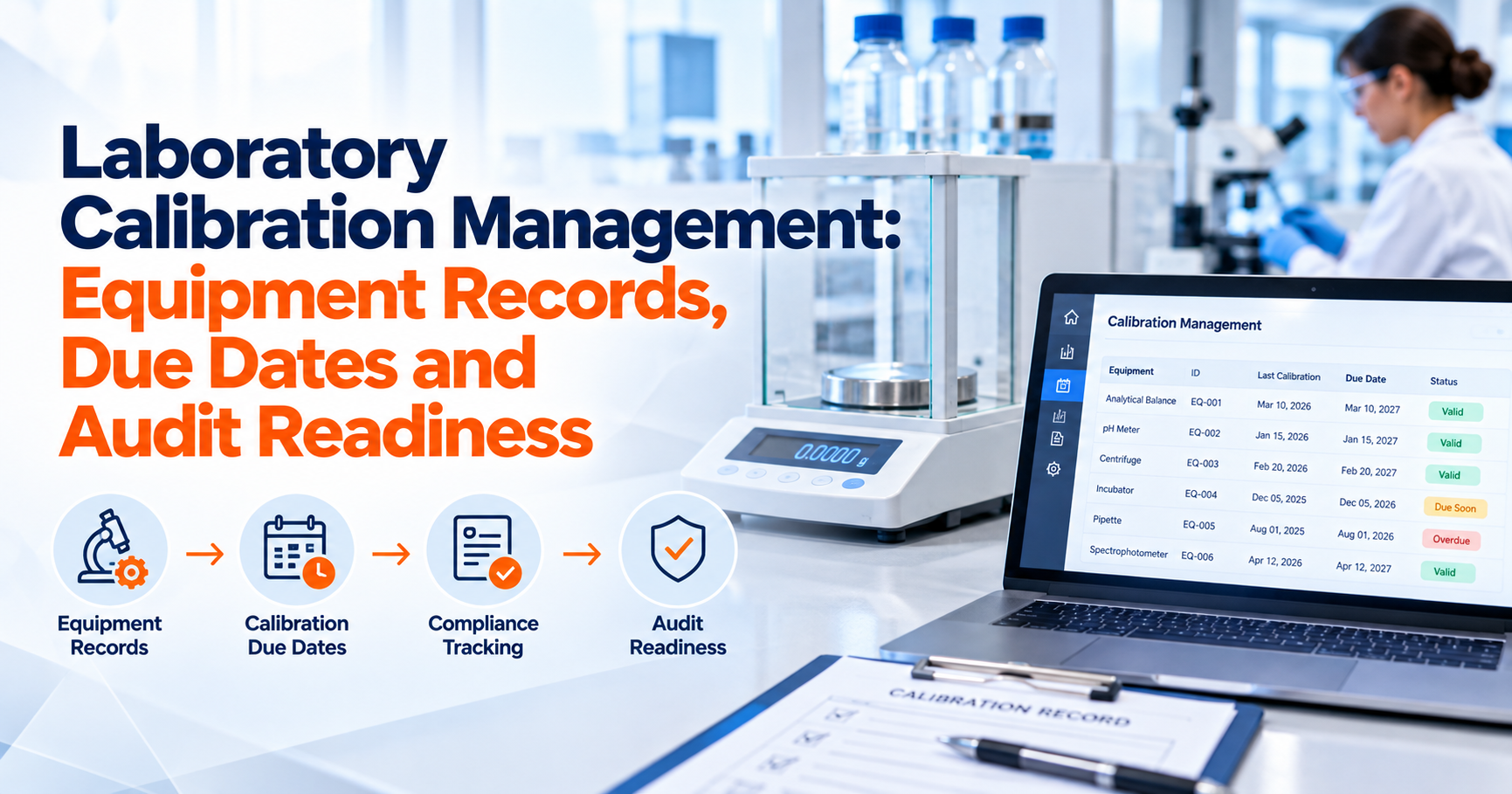
A laboratory can have validated methods, trained analysts and carefully controlled samples, but those controls become much less meaningful if the equipment used to generate measurements is not being managed properly.
A balance may still operate when its calibration is overdue. An instrument may have been serviced, but the certificate is sitting in someone's email. A pipette may have failed calibration, but nobody has yet assessed which work was performed since its last acceptable check.
These are not simply maintenance problems. They are traceability and laboratory-control problems.
Laboratory calibration management is the controlled process of maintaining equipment identities, calibration requirements, calibration intervals, due dates, results, certificates, maintenance history and operational status so laboratory teams can determine whether an instrument is suitable for use and reconstruct its history when needed.
A strong system does more than remind staff that a calibration is approaching. It connects the equipment with its current status, historical records, responsible users, supporting certificates and, where appropriate, the laboratory methods and testing that depend on it.
That connection is what makes calibration management useful during normal operations and during an audit.
What Is Laboratory Calibration Management?
Laboratory calibration management is the organized control of equipment throughout its working life, from initial registration and qualification for use through recurring calibration, maintenance, repair, status changes and eventual retirement.
The process typically starts with an equipment master record.
That record identifies the instrument and stores the information needed to manage it consistently. The laboratory then defines whether calibration is required, how often it should occur, who is responsible, which acceptance criteria apply and what should happen when results are unacceptable or activities become overdue.
Calibration results and supporting documentation are then retained against the same equipment history. A good instrument management software workflow therefore helps answer practical questions such as:
Is this instrument currently available for testing?
When is its next calibration due?
Who owns the task?
Which certificate supports the most recent calibration?
Was maintenance performed after the last calibration?
Has the instrument ever been out of calibration?
Which status changes occurred?
What happened before it was returned to service?
Without one connected record, laboratories often answer these questions by searching spreadsheets, shared folders, service emails and paper certificates.
Calibration Is Not the Same as Maintenance
Calibration and maintenance are related but different activities.
Calibration evaluates measurement performance against defined requirements using appropriate standards or references.
Maintenance keeps equipment operating as intended through activities such as inspection, servicing, cleaning, replacement of parts or repair.
An instrument can be maintained without being calibrated. It can also be calibrated without needing maintenance.
For example, replacing a worn component may be a maintenance activity. After the repair, the laboratory may need calibration, verification or other checks before returning the instrument to use.
A strong lab equipment management software system should preserve both histories without treating them as interchangeable.
This becomes important when reviewing equipment performance later. A calibration result may make much more sense when the reviewer can see that a major repair occurred immediately beforehand.
What Laboratory Software Can Keep Instrument Maintenance and Calibration Records in One Place?
A LIMS with calibration and equipment-management functionality can centralize equipment identity, calibration schedules, due dates, calibration results, maintenance activities, certificates, service records and current instrument status within one controlled record.
This is more useful than maintaining one calibration spreadsheet and another maintenance spreadsheet because the history remains connected to the same physical asset.
For example, a laboratory instrument record may show that a GC-MS was calibrated in January, underwent preventive maintenance in March, required a repair in April and was recalibrated before returning to routine use.
Authorized users can understand that sequence without reconstructing it from several independent files.
LabZila's calibration management software is designed around this model. The platform can maintain equipment records, recurring calibration schedules, due dates, results, certificates, maintenance history, current status and responsible users in one equipment workflow.
The objective is not simply digital storage. It is to make the equipment's current suitability and historical context easier to understand.
Build One Equipment Master Record for Each Asset
Reliable calibration tracking starts with equipment identification. Every managed asset should have a unique equipment record that remains stable throughout its lifecycle.
The record may contain the equipment ID, manufacturer, model, serial number, location, responsible owner, equipment type and current status. It can also include calibration requirements, maintenance intervals, supporting procedures, documents and other laboratory-specific information.
For example:
| Equipment Record Field | Example |
|---|---|
| Equipment ID | HPLC-07 |
| Manufacturer | Manufacturer name |
| Model | Model identifier |
| Serial Number | Manufacturer serial number |
| Location | Chemistry Lab 2 |
| Responsible Owner | Instrument team |
| Calibration Frequency | Defined by laboratory program |
| Current Status | Available |
| Next Calibration Due | 15 Dec 2026 |
| Maintenance Interval | Defined schedule |
The exact fields should reflect the laboratory's procedures. The important principle is that one physical instrument should not appear under several inconsistent names in different spreadsheets.
If the calibration team calls an instrument HPLC-07, analysts call it HPLC-B, and service documents identify it only by model number, linking its records reliably becomes harder. A controlled equipment ID solves that problem.
How Should Laboratories Determine Calibration Intervals?
Calibration intervals should be based on the laboratory's actual requirements and evidence rather than assuming every instrument should be calibrated annually.
NIST explicitly states that it does not generally prescribe one fixed recalibration interval for measuring instruments or standards. It identifies factors such as accuracy requirements, contractual or regulatory requirements, instrument stability and environmental influences as considerations when setting intervals. NIST also recommends using measurement-assurance information and calibration history to evaluate and refine the interval where appropriate.
NIST guidance on recommended calibration intervals
That is an important point for laboratory managers. A simple rule such as "calibrate everything every 12 months" may be easy to administer, but it does not automatically represent the most appropriate program.
One instrument may demonstrate strong long-term stability. Another may operate under demanding environmental conditions or require tighter measurement uncertainty.
A frequently moved field device may have a different risk profile from a stable instrument installed permanently in a controlled laboratory. External requirements may also define or influence the interval.
Calibration management software should therefore allow the laboratory to configure schedules based on the requirements of each asset rather than forcing one universal frequency.
Calibration Intervals Should Be Reviewed, Not Forgotten
The initial interval is not necessarily permanent. Calibration history can provide information about how an instrument behaves over time.
If several consecutive calibrations show stable performance comfortably within acceptance requirements, the laboratory may have information relevant to its future interval decision, subject to its procedures and any applicable external requirements.
If equipment repeatedly needs adjustment before the planned due date, the opposite may be true.
ILAC G24:2022 specifically provides laboratories with guidance for determining and reviewing recalibration intervals for measuring equipment as part of an established calibration program.
ILAC G24 guidance on recalibration intervals
The important idea is that calibration scheduling should be managed as a controlled technical decision, not simply as a recurring calendar appointment.
How Do Laboratory Managers Track Equipment Calibration Schedules and Maintenance Logs?
The most reliable approach is to maintain a centralized equipment record with the current calibration schedule, next due date, maintenance plan, responsible owner, completed activities, supporting documents and operational status. The system should distinguish future work from completed history.
For upcoming activities, managers need visibility into what is due soon, what is currently due and what has become overdue.
For historical activities, they need the actual completion date, result, responsible person or service provider, supporting certificate and any adjustment, maintenance or follow-up action.
This creates two useful views of the same equipment.
One view answers: What needs attention next?
The other answers: What has happened to this instrument in the past?
LabZila allows laboratories to configure recurring or one-time calibration activities, assign responsible personnel, maintain maintenance schedules and monitor upcoming and overdue tasks within the equipment record.
That avoids relying on a spreadsheet that someone has to remember to open every morning.
Calibration Due Dates Need Context
A due date by itself is not enough. The laboratory should understand what the date means operationally.
For example, does the instrument remain available until the end of that date?
Does the laboratory use an internal warning period before the deadline?
What happens when the activity is overdue?
Who is responsible for changing equipment status?
Can testing continue while calibration is being scheduled?
These decisions should be defined in the laboratory's procedures and system configuration. The software should support those decisions rather than invent them.
A useful system may show that an instrument is "Calibration Due Soon" several weeks before the actual deadline, while the equipment remains available.
Once the defined due date has passed, the laboratory's configured procedure may change the status to "Overdue" or restrict use. The terminology should be meaningful to users.
Can a LIMS Alert Users When an Instrument Calibration or Maintenance Activity Is Due?
Yes. A LIMS can use configured schedules and due dates to notify responsible users about upcoming calibration or maintenance activities and escalate overdue work according to laboratory rules.
For example, the system might alert the equipment owner 30 days before calibration is due, issue another reminder seven days before the deadline and notify a supervisor if the activity becomes overdue.
That is only an example. The correct timing should reflect the laboratory's workload and procedures. The goal is to provide enough notice to schedule calibration without creating constant notifications that users eventually ignore.
LabZila's laboratory workflow automation capability can support recurring schedules, task assignments, due-date reminders, review routing and escalation of overdue equipment activities.
Automation here is particularly useful because the trigger is predictable. The software does not need to make a scientific decision. It simply needs to recognize that a configured deadline is approaching.
Calibration Certificates Should Stay With the Equipment Record
Calibration certificates often become difficult to manage because they arrive from several sources.
An external service provider may email a PDF.
An internal calibration may produce a controlled electronic record.
A certificate may be stored in a shared network folder named by year.
Later, an auditor asks for the most recent certificate and the laboratory spends time determining which version is current.
A better approach is to attach the calibration certificate and supporting service documentation directly to the relevant calibration activity and equipment record. This creates context.
The user sees not only the document but also the instrument, calibration date, result, service provider and status associated with it. It also reduces the chance that an old certificate is mistaken for the current one.
What Should a Calibration Record Include?
The exact record depends on the type of equipment and laboratory requirements, but the calibration history may need information such as the date performed, responsible person or external provider, applicable procedure, reference standards, measured results, acceptance criteria, adjustments, final outcome and relevant comments.
Where external certificates are used, the laboratory should review them according to its procedures rather than treating the existence of a PDF as automatic evidence that everything is acceptable.
For example, staff may need to confirm that the certificate corresponds to the correct instrument and serial number, the required calibration was actually performed, reported results meet the laboratory's acceptance requirements and the provider is appropriate for the intended use.
The supporting document should then remain linked to the instrument history.
Maintain Reference-Standard Information Where Relevant
Calibration often depends on other measuring standards or reference devices. Where traceability requirements apply, laboratories may need to retain appropriate information about those standards and supporting calibration evidence.
The equipment-management system should therefore be capable of recording relevant reference standards or linking them to calibration activities.
This can be especially useful when several instruments were calibrated using the same reference device.
If a problem is later identified with that standard, the laboratory can more easily determine which calibration activities may require evaluation. This type of relationship is difficult to reconstruct when records live only as standalone documents.
Preventive Maintenance Belongs in the Same Equipment History
Calibration tells the laboratory whether measurement performance meets defined requirements at a particular point. Maintenance helps keep the equipment in suitable operating condition. These activities should remain connected.
A preventive maintenance schedule may include inspections, cleaning, replacement of wear components or manufacturer-recommended servicing. The equipment history can then show when each task was scheduled and completed.
If a repair occurs outside routine maintenance, that event should also be recorded. Depending on the nature of the repair, the laboratory may determine that calibration, verification or other checks are needed before returning the instrument to service.
LabZila can maintain preventive maintenance activities, repairs, replaced components, service visits and equipment downtime alongside calibration history.
Equipment Status Should Be Visible Before Testing Begins
One of the most useful controls in equipment calibration software is clear operational status. A user selecting an instrument for testing should not need to search for the latest certificate to determine whether the asset is available.
The system can maintain statuses such as:
Available
Calibration Due Soon
Calibration Overdue
Under Maintenance
Out of Calibration
Restricted
Out of Service
Retired
The exact terminology should match the laboratory's process. More importantly, status should have operational meaning. For example, equipment marked Out of Service should not remain available for routine test assignment.
LabZila supports configurable equipment statuses and can connect those statuses with testing workflows so restricted or out-of-calibration equipment can be prevented from being selected where the laboratory has configured that control.
What Should Happen When Calibration Becomes Overdue?
An overdue calibration should trigger the laboratory's defined status and escalation process rather than being treated as a simple missed reminder.
The instrument may need to be restricted until calibration is completed.
The responsible person should be notified.
The laboratory may also need to determine whether the overdue condition affects scheduled testing.
The correct action depends on the laboratory's procedures and applicable requirements.
The important point is that the system should make the condition visible.
A spreadsheet where an overdue date turns red is useful only if somebody opens the spreadsheet and notices it.
A connected system can change status, notify responsible users and make the equipment's availability clear to analysts before additional work is assigned.
What Is an Out-of-Calibration Event?
An out-of-calibration event occurs when calibration or related evaluation shows that equipment does not meet defined acceptance requirements. This situation needs more attention than simply entering a new calibration date.
The laboratory should follow its approved process for restricting equipment, documenting the result and deciding what additional action is required. That may include adjustment, repair, recalibration or retirement.
Depending on the instrument, magnitude of the problem and type of work performed, the laboratory may also need to assess whether previous testing could have been affected.
This impact assessment should be based on technical evidence and the laboratory's procedures.
Software should help connect the event with the equipment history, but it should not automatically decide that every previous result is invalid. That conclusion requires appropriate technical evaluation.
Link Out-of-Calibration Events With Quality Processes When Needed
Some equipment failures may require a formal quality event. For example, an unacceptable calibration result might lead to an investigation into work performed since the last acceptable calibration.
If the laboratory identifies an actual or potential impact, it may need to document nonconforming work, a deviation, corrective action or another quality record according to its quality system.
Keeping equipment and quality information connected makes this process much easier to reconstruct.
LabZila's laboratory QMS software can connect equipment-related deviations, investigations and CAPAs with supporting records when the laboratory determines that a formal quality workflow is required.
Not every overdue calibration automatically requires CAPA. The response should be proportional to the actual event and laboratory requirements.
Connect Equipment With Tests and Methods
Calibration management becomes more valuable when the laboratory knows which work depends on each instrument.
An HPLC may support several analytical methods.
A balance may be used across many workflows.
A temperature device may affect a specific storage process.
When equipment records are connected with methods and testing, the laboratory gains more useful traceability. Suppose an instrument later fails calibration.
The team can investigate not only the instrument history but also which relevant methods or laboratory work may need review.
LabZila can connect approved equipment with laboratory methods, samples and results so the equipment record sits within the testing workflow rather than remaining an isolated asset register. This relationship is particularly useful for highly regulated or technically complex laboratories.
Equipment and Instrument Integration Are Different Things
An equipment-management record and an instrument integration serve different purposes. Equipment management controls identity, calibration, maintenance, status and supporting history.
Instrument integration transfers data between the instrument and laboratory systems. One does not replace the other.
A GC-MS may be fully integrated with the LIMS for automated result transfer and still require a separate controlled calibration and maintenance program.
Similarly, a simple balance may have no digital integration but still require detailed equipment management.
For laboratories evaluating data connectivity, LabZila's LIMS integrations can be assessed according to the specific instrument model, available interface, data format and workflow.
How Calibration Management Supports ISO/IEC 17025 Workflows
Equipment control is an important part of laboratory competence and measurement traceability.
Laboratories operating under ISO/IEC 17025 need to manage equipment in a way that supports valid results, appropriate calibration and technical traceability.
Software can help organize the records used to support those processes, including calibration schedules, certificates, equipment status, maintenance history and relationships with laboratory testing.
LabZila's ISO 17025 LIMS software connects equipment records with methods, technical records, quality activities and other laboratory information.
However, software does not make a laboratory ISO/IEC 17025 accredited. Accreditation depends on the laboratory's competence, procedures, quality system, implementation and assessment by an appropriate accreditation body.
Calibration Management and Audit Readiness
Audit readiness does not mean creating documents immediately before an assessor arrives. It means maintaining records as part of normal work so the laboratory can demonstrate what happened without reconstructing the history later.
For a piece of equipment, an auditor or internal reviewer may want to understand its identity, calibration status, maintenance history, supporting certificates, current availability and how the laboratory responded to unusual events.
A centralized equipment history makes those questions easier to answer. Instead of searching several locations, the laboratory can move chronologically through the asset's history.
Registered
Calibrated
Available
Maintained
Recalibrated
Restricted
Repaired
Returned to service
Retired
That chronological view is often more useful than a folder containing several certificates with no obvious relationship between them.
Maintain an Audit History of Changes
The equipment record itself may change over time.
The instrument may move to another laboratory.
The owner may change.
Calibration requirements may be revised.
A status may change from available to under maintenance.
Where controlled records are required, the laboratory should be able to understand relevant changes and who performed them. Role-based permissions and time-stamped activity histories can help maintain that accountability.
The level of audit history required will depend on the laboratory's regulatory, accreditation and quality environment. The software should support the process, while the laboratory remains responsible for establishing appropriate access, review and governance.
Common Calibration Management Problems
One common problem is using spreadsheets as calendars rather than as controlled equipment records. The spreadsheet may show the next calibration date but not the calibration result, certificate, maintenance history or current status.
Another common problem is storing certificates independently from equipment records. Staff know the calibration was performed, but retrieving the correct document months later becomes difficult.
A third problem is treating calibration and maintenance as unrelated programs. A repair may significantly affect measurement performance, yet the calibration team has no visibility into the service event.
Laboratories can also create unnecessary risk when they allow overdue equipment to remain available because nobody changed its status.
Finally, some laboratories apply identical intervals to every instrument without periodically evaluating whether those intervals still make technical sense. A good calibration program addresses all of these issues through process design first and software second.
How to Move From Spreadsheet Tracking to Calibration Management Software
Start with the equipment inventory. Determine which assets need controlled calibration, maintenance or both. Assign a stable equipment ID to each asset and reconcile duplicates.
Then gather the existing information: manufacturer, model, serial number, location, owner, current calibration status, next due date, maintenance schedule and relevant certificates. Do not simply import years of inconsistent spreadsheet data without reviewing it.
Next, define standard equipment statuses. Determine what "Available," "Overdue," "Restricted," "Under Maintenance" and "Retired" actually mean in your laboratory. Then configure scheduling and notifications.
Establish who owns each calibration activity and how far in advance reminders should appear. Finally, define the exception workflows.
What happens when an instrument is overdue?
What happens if calibration fails?
Who may return equipment to service?
Does a repair require recalibration?
When is an impact assessment required?
These questions determine whether the software actually controls the process or simply stores dates. The LIMS requirements checklist can help laboratories document requirements like these before configuring a new system.
What Should You Look for in Calibration Management Software?
The most useful calibration management software should provide more than a calendar.
Look for a centralized equipment registry, configurable schedules, due-date visibility, assignment of responsible personnel, calibration result records, maintenance history, certificate storage and operational status controls.
The system should also handle the difficult situations.
Can equipment be marked unavailable immediately?
Can a failed calibration remain visible in history?
Can supporting certificates be retrieved easily?
Can overdue activities trigger notifications?
Can maintenance and repairs remain connected to the instrument?
Can equipment be linked with methods or testing?
Can authorized users see a complete chronological history?
Can the system prevent restricted equipment from being selected where the laboratory requires that control?
Those questions reveal whether the software manages the equipment lifecycle or simply tracks the next due date.
Where LabZila Fits
LabZila brings equipment identification, calibration schedules, maintenance activities, certificates, responsible personnel and equipment status into one connected laboratory workflow.
Teams can register instruments, configure recurring or one-time calibration schedules, monitor due dates, record calibration information, attach certificates and retain maintenance or repair history.
Configurable statuses can identify equipment that is available, due soon, overdue, under maintenance, out of calibration, restricted or retired.
LabZila can also connect equipment with methods, samples, quality records and laboratory results so instrument history remains part of the wider laboratory record.
This supports stronger operational visibility, but the laboratory still remains responsible for determining its calibration intervals, acceptance criteria, traceability requirements, technical impact assessments and quality procedures.
Laboratories currently managing calibration dates, service records and certificates across spreadsheets and shared folders can contact LabZila to discuss their equipment and calibration-management workflow.
Frequently Asked Questions
What laboratory software can keep instrument maintenance and calibration records in one place?
A LIMS with equipment and calibration management functionality can centralize instrument identification, calibration schedules, due dates, calibration results, certificates, preventive maintenance, repairs, service history and current operational status. This is generally more useful than separate calibration and maintenance spreadsheets because all activities remain connected to the same equipment record.
How do laboratory managers track equipment calibration schedules and maintenance logs?
Use a centralized equipment register in which each instrument has a unique ID, configured calibration schedule, maintenance schedule, responsible owner, due dates and chronological history. Completed calibration and maintenance activities should remain linked with supporting documents such as certificates and service reports. Managers can then review upcoming, current and overdue work separately from the historical record of completed activities.
Can a LIMS alert users when an instrument calibration or maintenance activity is due?
Yes. A configurable LIMS can monitor calibration and maintenance schedules and send notifications before due dates or escalate overdue activities according to the laboratory's configured rules. It can also update equipment status so users can see whether an instrument is available, due for calibration, overdue, under maintenance or restricted. The laboratory should define the reminder periods, escalation rules and conditions for restricting or returning equipment to service.