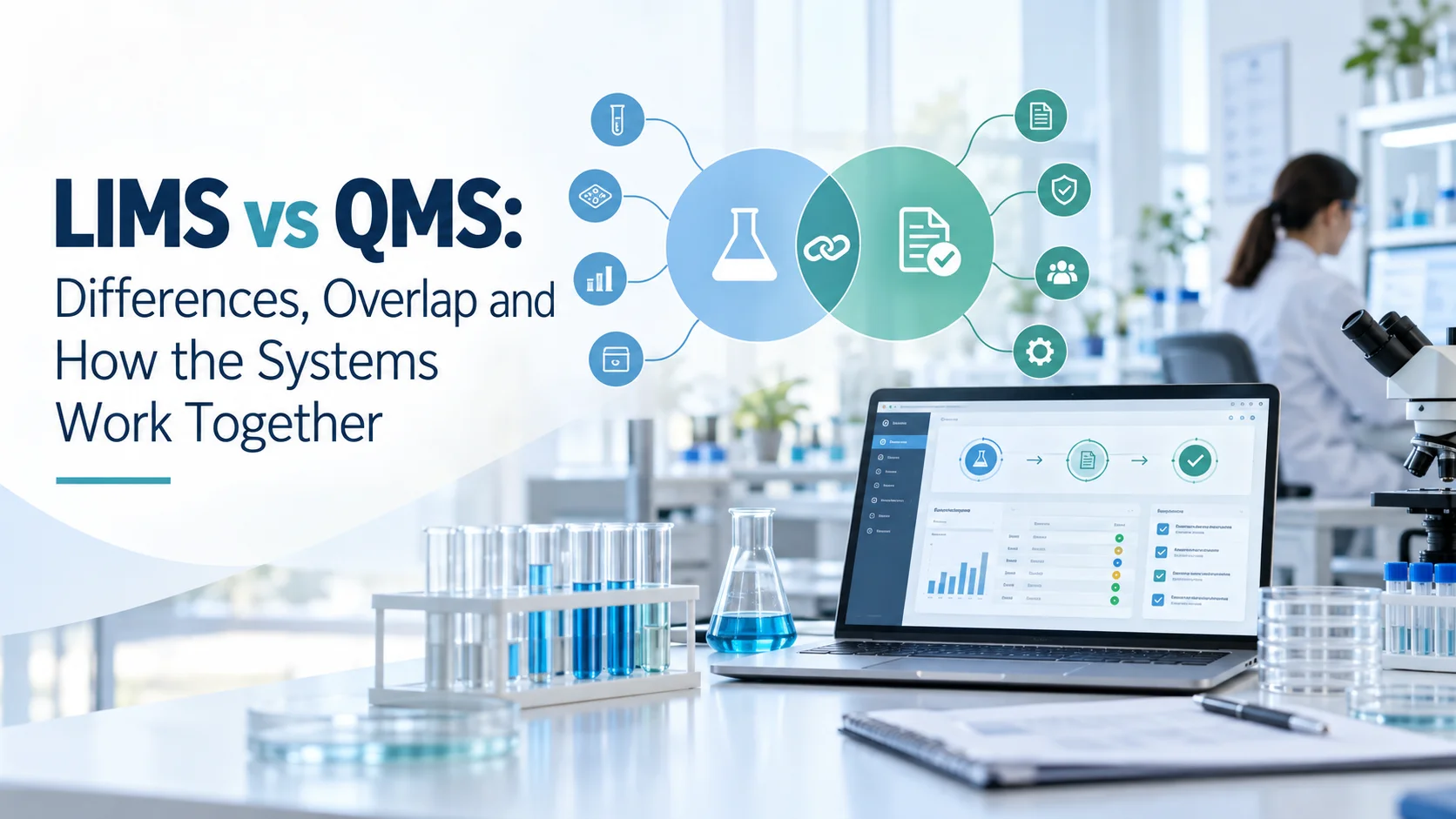
A laboratory can manage samples perfectly and still have weak quality processes. It can also maintain excellent SOPs, CAPAs and audit records while struggling to see where samples are or which tests are waiting for review.
That is because LIMS and QMS solve different but closely connected problems. A LIMS primarily manages laboratory operations such as samples, tests, methods, results, instruments, reviews and reporting.
A QMS manages the broader quality system, including deviations, CAPA, controlled documents, training, audits, change control and quality events. They overlap wherever laboratory work triggers a quality process or quality requirements govern laboratory work.
For most laboratories, the practical question is therefore not whether LIMS or QMS is better. It is where one system's responsibility ends, where the other begins, and how information should move between them.
If you are still building the fundamentals, our guide to what a Laboratory Information Management System is explains the operational role of LIMS before comparing it with other laboratory systems.
What Is a LIMS?
LIMS stands for Laboratory Information Management System. A LIMS is designed to organize laboratory operations and the information created by those operations.
Typical LIMS functions include sample registration, sample tracking, test assignment, method and specification management, result capture, instrument connectivity, technical review, approval and reporting.
NIST describes a LIMS as software developed to support laboratory operations, including tracking specimens and workflows and collecting or aggregating laboratory datasets.
You can review the broader definition in the NIST Research Data Framework. The important point is that a LIMS is usually centered on laboratory work.
A sample enters the laboratory. Tests are assigned. Analysts perform work. Results are captured. Records move through review. Approved information becomes part of a laboratory report or another deliverable. That operational sequence is where LIMS is strongest.
What Is a QMS?
QMS stands for Quality Management System**.** A QMS is broader than the individual testing workflow. It defines and controls how an organization manages quality-related responsibilities, procedures, records, investigations, corrective actions, training, audits and improvement activities.
In software terms, laboratory QMS functionality commonly includes: deviation management, CAPA, document and SOP control, training records, audit management, change control, risk management, quality events, review and approval workflows and supporting quality records.
LabZila's current product architecture deliberately separates these responsibilities from routine sample and testing operations. Its laboratory QMS software is structured around deviations, CAPAs, documents, training, audits and connected quality actions rather than treating the QMS as another name for sample management.
LIMS vs QMS: The Main Difference
The simplest distinction is this: LIMS manages the work performed by the laboratory. QMS manages the quality system governing how that work and other quality-related activity is controlled, reviewed, corrected, and improved.
Consider a sample that fails to meet an applicable specification. The LIMS may contain: the sample, assigned test, method, instrument, result, specification, analyst, and technical-review record.
But the unexpected result may require a formal quality process. That process might involve: an investigation, a deviation, root-cause analysis, corrective action, preventive action, effectiveness verification, and management approval. Those broader quality activities are QMS territory.
The two systems therefore meet at the point where laboratory operations create or are affected by a quality event.
LIMS vs QMS at a Glance
| Area | LIMS | QMS |
|---|---|---|
| Primary purpose | Manage laboratory operations | Manage quality-system processes |
| Main focus | Samples, tests, methods, results and workflows | Deviations, CAPA, documents, training, audits and quality events |
| Typical users | Analysts, technicians, supervisors, QC staff, lab managers | QA staff, quality managers, auditors, department owners |
| Sample tracking | Core capability | Usually referenced rather than primary |
| Test management | Core capability | Usually not the main function |
| Result management | Core capability | May reference results during investigations |
| Instrument records | Often important | May reference equipment in deviations or change control |
| Deviations | May trigger or reference them | Core quality-management process |
| CAPA | May link to CAPA | Core QMS process |
| Document control | May manage methods or operational records | Broader controlled-document lifecycle |
| Training management | May track task-related authorization | Broader role/SOP/quality training management |
| Audits | Usually secondary | Core QMS function |
| Approvals | Results, tests, reports, workflow stages | Documents, investigations, CAPA, changes and quality records |
| Reporting | Laboratory results and operational reports | Quality metrics, audit reports, CAPA/deviation summaries |
This is a practical distinction rather than a rigid software-industry rule. Modern systems can include both LIMS and QMS functionality in one platform.
Where Does Laboratory Operations Management End?
A LIMS follows the laboratory's operational workflow. Imagine a pharmaceutical QC laboratory receiving a raw-material sample. The sample is registered. Required testing is assigned. The appropriate method and specification are associated with the sample.
An analyst performs the test. The result is recorded. A reviewer checks the work. The laboratory then decides whether the result can proceed according to the approved process. These activities belong naturally within LIMS.
Our guide to the functions of a Laboratory Information Management System explains these routine operational functions in more detail. The LIMS gives the laboratory control over what work is happening and maintains the data associated with that work.
Where Does Quality Management Begin?
Quality management becomes more prominent when the laboratory needs to control an exception, investigate a problem or manage a process that extends beyond the individual sample. Suppose the raw-material result is unexpected. The laboratory may need to determine:
Was there a testing error?
Was the instrument functioning appropriately?
Was the correct method used?
Was sample preparation performed correctly?
Does the issue affect other samples?
Is a formal deviation required?
Does corrective action need to be assigned?
Should an SOP change?
Does additional training need to occur?
These questions reach beyond ordinary test execution. They involve the organization's quality system. A QMS provides the structure for documenting the event, assigning responsibility, collecting evidence, reviewing the investigation, managing corrective actions and eventually determining whether the issue can be closed.
A QMS Is Bigger Than the Laboratory Test
This distinction is especially important for QA and QC managers. A sample result may trigger a quality event, but the QMS needs to manage many quality processes that are not tied to one specific result. An internal audit finding may create a CAPA.
- A revised SOP may trigger training assignments.
- A recurring equipment problem may require change control.
- A process modification may need risk assessment.
- An inspection observation may generate corrective actions.
- A supplier issue may create another investigation.
These are organizational quality processes. A LIMS may provide supporting information, but the QMS manages the broader lifecycle of the quality event. FDA's pharmaceutical quality-system guidance provides a useful regulated-industry example.
It describes a quality-system model that includes management responsibilities, resources, manufacturing operations and evaluation activities rather than treating quality as a laboratory testing function alone.
For the pharmaceutical context, see the FDA Quality Systems Approach to Pharmaceutical CGMP Regulations. That guidance is specific to pharmaceutical CGMP environments, but it illustrates the broader principle: quality management extends beyond the analytical result itself.
Where Do LIMS and QMS Overlap?
The systems overlap wherever operational laboratory information becomes part of a quality decision. Several areas are particularly important.
- Deviations
A deviation records a departure from an approved process, requirement, or expected condition according to the laboratory's own procedures and applicable requirements.
A laboratory deviation might involve: a missed procedural step, incorrect sample handling, equipment malfunction, an unexpected workflow event, or another situation requiring documented assessment.
The LIMS may contain the sample, test, instrument, and result information associated with the event. The QMS manages the deviation itself. That may include initial reporting, impact assessment, investigation, responsible users, supporting evidence, review and closure.
LabZila's QMS design allows deviations to remain connected with affected samples, methods, equipment and related quality records rather than creating an isolated quality file. That connection is where LIMS and QMS become particularly valuable together.
- CAPA
CAPA means Corrective and Preventive Action. A CAPA process is intended to address identified problems and, where appropriate, reduce the likelihood of recurrence or prevent related issues.
The exact process and terminology depend on the laboratory's quality system and applicable requirements. A CAPA might result from: a deviation, audit finding, recurring laboratory issue, quality trend, complaint, or another investigation.
The LIMS may provide the evidence. The QMS manages the corrective-action workflow. This may include action ownership, deadlines, supporting documentation, approval and effectiveness verification.
LabZila's laboratory QMS structure keeps CAPA ownership, completion evidence and effectiveness checks connected through closure.
- OOS and OOT Results
Out-of-specification and out-of-trend situations are another common point of overlap. The LIMS or laboratory QC workflow may identify or display the analytical result. The laboratory then determines what the result means and what procedure applies.
If a formal investigation is required, the record can move into or become linked with the QMS. This is why LabZila's product architecture keeps laboratory QC and QMS separate but connected.
Its laboratory quality control software handles control samples, specifications, limits, result trends and technical review, while applicable exceptions can be connected to deviations, investigations or CAPAs in the QMS. That distinction prevents three concepts from being mixed together:
- LIMS manages laboratory operations.
- QC monitors analytical performance and applicable result criteria.
- QMS manages the broader quality-system response.
- Document and SOP Control
Laboratories depend on controlled procedures. A test may need to follow an approved method or SOP. The LIMS needs to know which method or instruction applies to the work. The QMS, however, may manage the broader document lifecycle.
That can include: document creation, review, approval, version history, effective dates, periodic review, retirement, and related training acknowledgement. This is another example of overlap without duplication.
The LIMS uses the approved procedure during laboratory work. The QMS controls how that procedure is governed over time.
- Training and Competency
A LIMS may need to know whether a user can perform or approve particular work. The QMS may maintain the underlying training process. For example, when an SOP changes, relevant personnel may need new training.
The quality system can assign the training, track completion and maintain acknowledgement or competency records according to the organization's process. The operational LIMS can then apply appropriate role or workflow permissions where configured.
LabZila's QMS content specifically includes role- or procedure-based training assignments and completion records. Again, the functions are related but not identical.
- Reviews and Approvals
Both LIMS and QMS require controlled review processes. A LIMS may route: test results, sample records, technical reviews, laboratory reports, and Certificates of Analysis.
A QMS may route: deviations, CAPAs, SOPs, audit findings, change controls, and investigation records. The underlying workflow concept may be similar. The business meaning is different.
This is why shared laboratory workflow automation can be useful across operational and quality processes: assignments, notifications, reviews and approvals can follow configured responsibilities while each record retains its own purpose.
- Audit Trails and Record History
Both systems may also need traceability around electronic records. Laboratories often need to understand who performed an action, what changed and when it occurred.
For operational records, that history may relate to sample status, result review or report authorization. For QMS records, it may relate to deviation changes, document approvals, CAPA actions or closure decisions.
Audit trails and record histories therefore support both areas, although the applicable requirements depend on the laboratory and regulated context.
For FDA-regulated workflows where Part 11 applies, LabZila provides a dedicated 21 CFR Part 11 LIMS page explaining relevant electronic-record, signature, access and traceability controls.
Software can support these processes, but laboratories remain responsible for determining applicability, configuration, validation, procedures, training and proper system use.
LIMS vs QMS vs QC: Do Not Confuse the Three
This distinction deserves special attention because the terms quality management and quality control are frequently treated as though they mean the same thing. They do not.
- LIMS
LIMS manages operational laboratory information. Think: samples, tests, methods, results, instruments, review, and reporting.
- Laboratory QC
QC focuses more directly on monitoring analytical quality and performance. Think: control samples, control materials, specifications, limits, control charts, OOS/OOT visibility, and result trends.
- Laboratory QMS
QMS manages broader quality-system processes. Think: deviations, CAPA, controlled documents, training, audits, change control, and quality events.
LabZila's content strategy deliberately maintains this separation. QMS owns CAPA, deviations, documents, training, audits and quality events, while QC owns control samples, control charts, rules, specifications, OOS/OOT and result trends.
Keeping those responsibilities clear helps prevent software selection based on vague promises such as "complete quality management."
A Practical LIMS and QMS Workflow
Consider a QC laboratory testing a finished-product sample.
Step 1: The sample enters the LIMS
The sample is registered and given a unique identity. Tests, methods and specifications are assigned.
Step 2: Testing is performed
An analyst performs the required work and records or imports the result. The LIMS keeps the result connected to its sample, method and supporting laboratory context.
Step 3: The result requires attention
The result does not meet the applicable expectation or another problem becomes visible. The appropriate laboratory procedure determines what happens next.
Step 4: The operational record remains in the LIMS
The sample, testing activity, instrument information and original result remain part of the laboratory operational history.
Step 5: A quality event is opened where required
The QMS creates a deviation, investigation or another applicable quality record. That record can reference the underlying laboratory information rather than forcing users to recreate it manually.
Step 6: Investigation and actions are managed
Quality personnel review the issue, assign responsibilities and document relevant evidence. If CAPA is required, actions and deadlines can be managed through the quality workflow.
Step 7: The issue is reviewed and closed
Authorized personnel assess the investigation and associated actions. Closure follows the laboratory's applicable procedure.
Step 8: The connected history remains available
The laboratory can trace the quality event back to the sample, test or instrument that triggered it. This connected workflow is considerably more useful than maintaining the result in one application and an unrelated investigation in another with no reliable link between them.
What Happens When LIMS and QMS Are Completely Separate?
Separate systems are not automatically a problem. Many organizations intentionally use specialized applications for different purposes. The difficulty appears when those systems do not share enough information.
Imagine a deviation is created in the QMS because of a laboratory result. Quality personnel then manually type the sample ID into the QMS. They copy the result. They attach a PDF export. Later, the sample record changes or additional testing is completed.
The QMS record now contains an earlier snapshot. Someone investigating the event must move between systems to reconstruct the full history. This can create duplicate entry and make context harder to maintain.
Integration or a platform containing connected LIMS and QMS capabilities can reduce these handoff problems. The objective should not necessarily be putting every function into one giant module. The objective is maintaining clear relationships between operational and quality records.
Does Every Laboratory Need a Separate QMS?
Not necessarily. The answer depends on the size of the organization, industry, quality framework, process complexity and existing technology.
A smaller laboratory might use one configurable platform containing both operational and quality-management functionality.
A large company might operate an enterprise QMS across the entire organization while a specialist LIMS manages laboratory operations.
Another organization may already have corporate document control, training and CAPA systems that the laboratory must use.
In that case, duplicating the same process inside a LIMS may create more problems than it solves. The correct architecture comes from deciding which system owns each process.
When Can an Integrated LIMS and QMS Be Useful?
A connected approach becomes particularly useful when quality processes frequently depend on laboratory information. Examples include laboratories with regular:
deviations tied to samples, OOS or OOT investigations, instrument-related quality events, CAPAs linked with testing, controlled method changes, equipment issues, and quality review requirements.
Rather than copying information between systems, the organization can preserve connections among samples, tests, equipment and quality records.
LabZila's planned architecture follows this model. A LIMS handles operational laboratory records while the QMS functionality centralizes deviations, CAPAs, documents, training and audits.
Can a LIMS Replace a QMS?
Only if the LIMS actually provides the quality functionality the organization requires. A system should not be called a QMS simply because it has an audit trail and approval buttons.
If the organization needs structured management of CAPA, deviations, documents, audits, training, changes and quality events, those workflows need to be evaluated individually.
A LIMS may include all of them. It may include only some. Or the organization may intentionally use another QMS. The product label is less important than the process coverage.
Can a QMS Replace a LIMS?
Usually not when the laboratory needs detailed operational sample and testing management. A QMS can manage excellent quality processes without knowing:
- where a sample is stored,
- which tests remain incomplete,
- which analyst owns the work,
- which instrument produced the result,
- which method applies,
- or which report is waiting for approval.
Those are LIMS questions. A quality system may reference the information, but it is not necessarily designed to manage the complete sample-to-report workflow.
What Should QA Managers Evaluate?
QA teams should focus on quality-process control. Ask whether the system can manage: deviations from identification through closure, CAPA ownership and effectiveness checks, controlled documents and revisions, training linked with procedures, audit findings, change control, review responsibilities, and quality-record traceability.
Then ask how easily those records can connect with laboratory operations. If QA receives an investigation from QC, can the relevant sample, result and instrument context be reached without rebuilding the history manually? That connection matters as much as the individual QMS feature.
What Should QC Managers Evaluate?
QC managers should start with laboratory work.
- How are samples registered?
- How are methods and specifications associated with testing?
- How are results captured?
- How is QC performance monitored?
- How are exceptions identified?
- How are technical reviews performed?
- Then evaluate what happens when routine laboratory work becomes a formal quality issue.
- Can a relevant result be linked into a deviation?
- Can an OOS/OOT workflow connect with an investigation or CAPA?
- Can the quality team see the supporting laboratory record?
The strongest LIMS-QMS architecture makes that transition clear.
What Should Laboratory Directors Evaluate?
Laboratory directors need to look across both systems. A highly capable QMS does not fix poor sample management. A strong LIMS does not automatically create an effective organizational quality system.
The laboratory needs both operational control and quality governance appropriate to its work. That means evaluating: workflow ownership, data duplication, system integration, user responsibilities, reporting requirements, quality metrics, validation requirements where applicable, and long-term governance.
The right architecture should reduce ambiguity rather than create another layer of administration.
How LabZila Approaches LIMS and QMS
LabZila treats laboratory operations and quality management as distinct but connected areas. The LIMS side manages samples, testing, methods, instruments, results, workflows, and reporting.
The QMS side manages quality events, deviations, CAPAs, controlled documents, training, audits, and related quality approvals. This structure allows a quality event to remain connected with the underlying laboratory context instead of becoming an isolated record.
For regulated or accredited laboratories, those software capabilities can support controlled processes, but software does not by itself establish compliance or accreditation. LabZila's strategy explicitly requires that distinction to remain clear.
Final Thoughts
The LIMS vs QMS distinction becomes much easier when you focus on responsibility. A LIMS manages the operational laboratory workflow. It tracks samples, testing, methods, results, instruments, reviews, and reports.
A QMS manages the broader system used to control quality. It organizes deviations, CAPAs, documents, training, audits, changes, and other quality activities. They overlap because laboratory work frequently creates information that becomes part of a quality process.
A result may trigger a deviation. A deviation may create a CAPA. A CAPA may lead to an SOP change. The revised SOP may require training. That training may affect who is authorized to perform future laboratory work.
This is why the best architecture is not necessarily LIMS instead of QMS or QMS instead of LIMS. It is an architecture in which both responsibilities are clearly defined, and the records can remain connected.
If your laboratory is evaluating how operational and quality workflows should work together, contact LabZila to discuss your sample, testing, QA, and QMS requirements.
================================================================