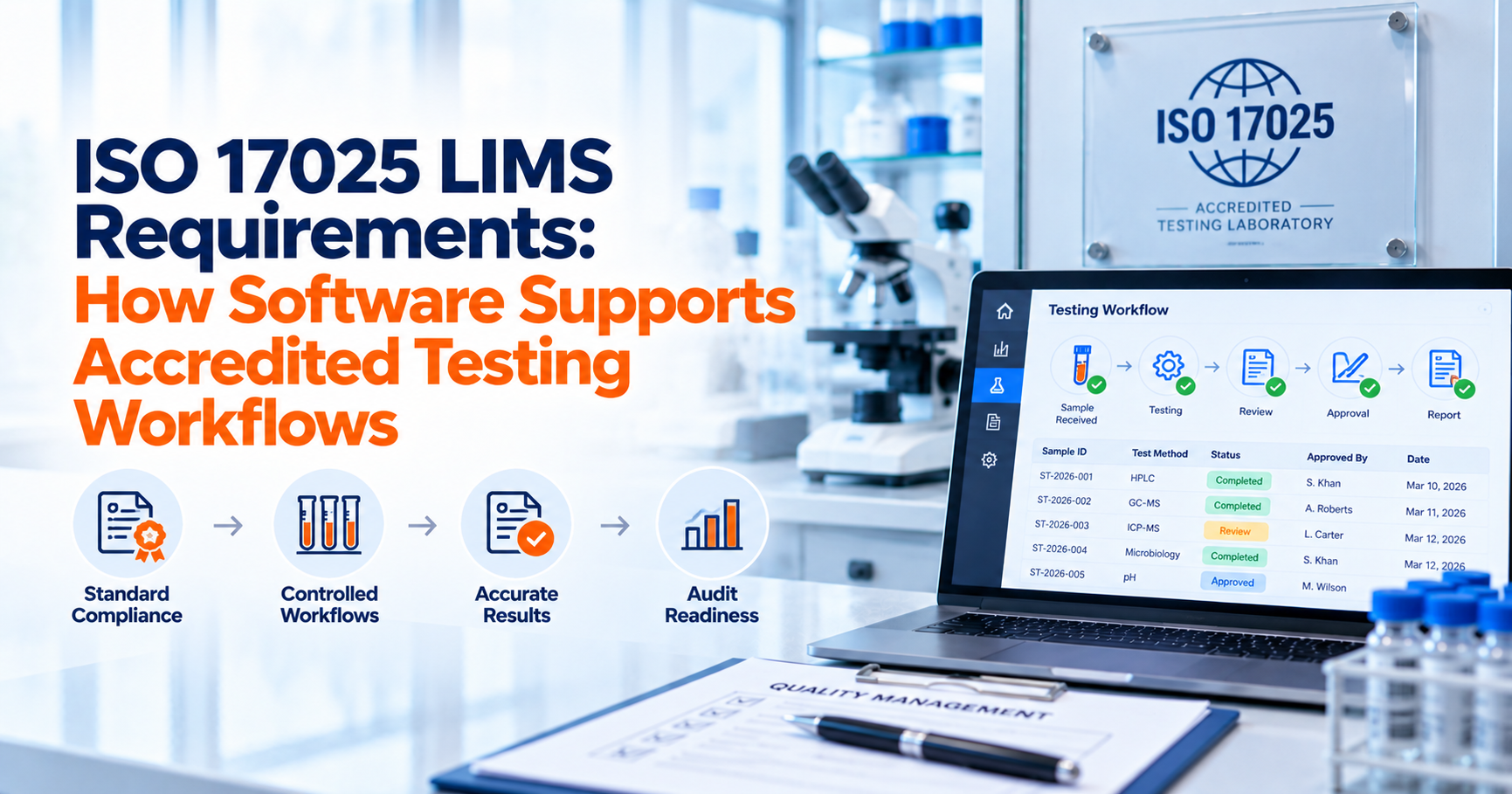
A testing laboratory can have excellent software and still fail to demonstrate technical competence. That distinction matters when discussing ISO/IEC 17025.
A LIMS can organize methods, samples, equipment, calibration records, personnel competency, quality control, technical records, audits and corrective actions. It can make evidence easier to retrieve and processes easier to follow. But software does not perform the accreditation assessment, establish competence by itself or make a laboratory accredited simply because the system contains an "ISO 17025" feature.
ISO 17025 LIMS requirements are the laboratory information, workflow and record-control capabilities needed to support the processes a testing or calibration laboratory manages under ISO/IEC 17025.
These commonly include controlled methods, competent and authorized personnel, suitable equipment, calibration and metrological traceability, sample and technical records, quality-control evidence, nonconforming work, corrective actions, internal audits and controlled documentation.
ISO/IEC 17025:2017 is the current edition of the international standard for testing and calibration laboratories. ISO states that it establishes requirements for laboratory competence, impartiality and consistent operation. The 2017 edition was reviewed and confirmed in 2023 and remains current.
ISO: ISO/IEC 17025:2017 official overview
The key point for laboratories evaluating software is that accreditation is broader than recordkeeping. The system should help the laboratory control and demonstrate its processes, while technical decisions and accreditation responsibility remain with qualified personnel and the laboratory itself.
What Is ISO/IEC 17025?
ISO/IEC 17025 is an international standard used for the competence of testing and calibration laboratories. It applies to organizations that perform testing, calibration and, within applicable scopes, sampling activities associated with subsequent testing or calibration.
The standard is concerned with more than having written procedures. A laboratory needs to show that its people are competent, methods are appropriate, equipment is suitable, measurement processes are controlled, records are reliable and results can be technically supported.
This is why ISO/IEC 17025 accreditation is different from simply purchasing a quality-management system. An accreditation body evaluates the laboratory's actual management system and technical competence for a defined scope.
In the United States, NIST's National Voluntary Laboratory Accreditation Program provides a useful example of this principle. NVLAP states that accreditation involves evaluating a laboratory's technical qualifications and competence for specific tests or calibrations and includes an application, assessment, resolution of identified nonconformities, proficiency testing and technical evaluation.
NIST: National Voluntary Laboratory Accreditation Program overview
Software can help organize the evidence used during that process. It does not replace the process.
What Should an ISO 17025 LIMS Actually Support?
A useful ISO 17025 LIMS software environment should connect the operational and quality information required to run a competent testing laboratory. That usually means more than sample tracking.
The laboratory may need to maintain controlled methods and specifications, employee qualifications and authorizations, instrument records, calibration certificates, reference standards, sample histories, technical observations, test results, QC information, internal audits, nonconforming work and corrective actions.
Those records are related. An analytical result may depend on a particular method version, qualified analyst, calibrated instrument and reference material.
If those relationships are maintained only in separate spreadsheets and folders, demonstrating the complete technical history can require substantial manual reconstruction.
The LabZila ISO 17025 LIMS software is designed to keep these areas connected, including methods, competency, equipment, calibration, samples, quality-control activities, audits and corrective actions.
What Systems Help Testing Laboratories Support ISO/IEC 17025 Requirements?
Testing laboratories commonly use a combination of LIMS, QMS, document-control, equipment-management and competency-management capabilities to support ISO/IEC 17025 processes. These functions may exist in one integrated platform or in connected systems, provided responsibilities and records remain controlled and traceable.
There is no requirement that every laboratory must purchase one specific type of software. A smaller testing laboratory may prefer one configurable platform covering operational and quality records.
A larger organization may use a LIMS for samples and testing, an enterprise QMS for corrective actions and document control, a learning system for training and another application for equipment. Either architecture can work. The important questions are:
Which system owns each record?
How are related records connected?
How does the laboratory prevent duplicate or contradictory information?
How are authorized users controlled?
Can evidence be retrieved when needed?
A software architecture should make these questions easier to answer, not create more systems that need reconciliation.
Controlled Methods Are Central to the Testing Workflow
Testing results need method context. A laboratory should be able to determine which approved method applied when work was performed.
This becomes important when methods are revised over time. Suppose Method M-104 Revision 3 was used for a test in January, but Revision 4 became effective in April.
The historical January result should continue to show that Revision 3 was the applicable method when the work occurred.
Updating the current method should not make historical work appear as though it used the newer revision.
A LIMS can help maintain this relationship by connecting tests with controlled method identifiers, versions, effective status and applicable specifications.
The system should also distinguish between maintaining a method reference and serving as the formal controlled-document repository.
If an organization already manages approved SOPs and methods in another document-management system, unnecessary duplicate document control can create confusion. The laboratory should decide which system owns the controlled document and how the LIMS references it.
Method Validation and Verification Need Traceable Evidence
Using a method does not necessarily mean the laboratory can simply enter its title into the LIMS and begin testing. Depending on the method and laboratory context, appropriate validation or verification may be required.
The laboratory may need records demonstrating performance characteristics, fitness for intended use or confirmation that a standardized method performs appropriately under laboratory conditions.
Software can help organize that evidence and connect it with the applicable method. However, the system should not automatically declare a method technically valid. That conclusion depends on the scientific work, evidence and authorization performed by competent personnel.
Personnel Competence Is More Than a Training Record
One of the most important areas in ISO/IEC 17025 is personnel competence. A training-completion checkbox does not prove that a person is competent to perform a specific laboratory activity.
Competence may be demonstrated through appropriate education, training, experience, observation, practical assessment, proficiency, authorization or other methods defined by the laboratory.
The exact evidence depends on the work. A useful competency management software process should therefore distinguish among: training received, competency evaluated, and work authorized. Those are related but different states.
An employee may have completed training on a method without yet being authorized to perform it independently. Another employee may be competent to perform a test but not authorized to review or approve other analysts' results. A LIMS can help maintain these distinctions.
Connect Personnel Authorization With Laboratory Work
Competency information becomes more useful when it affects the operational workflow. Suppose an employee is authorized to perform Test A but not Test B. The system should ideally make that authorization visible when work is assigned.
Similarly, if competency for a method expires or requires reassessment, laboratory managers should be able to identify which personnel need attention.
LabZila supports personnel qualifications, training, competency assessments and method-specific authorizations as part of its ISO 17025 workflow.
The laboratory still determines its competence criteria and how competence is demonstrated. Software manages the evidence and workflow around that decision.
Equipment Must Be Suitable for the Work
ISO 17025 laboratories need control over equipment that can affect laboratory activities and the validity of results. An equipment register should therefore contain more than an asset number.
The laboratory may need to maintain the equipment identity, manufacturer, model, serial number, location, calibration requirements, maintenance history, current status and supporting certificates.
It should also be possible to determine whether the equipment is suitable and available for use.
For example, an instrument that is overdue for calibration or under maintenance should not appear to an analyst as though it were fully available if the laboratory's procedure prohibits its use.
The LabZila calibration management software can connect equipment profiles with calibration schedules, maintenance activities, certificates, responsible users and equipment status.
The LabZila calibration management software can connect equipment profiles with calibration schedules, maintenance activities, certificates, responsible users and equipment status.
Calibration evidence becomes difficult to manage when certificates are stored separately from the assets they support.
A laboratory may have one spreadsheet for due dates, a network folder for certificates, another system for maintenance and email messages containing service information.
An assessor asking for the complete history of one instrument can then trigger a manual search across several systems.
A stronger workflow maintains the calibration record with the equipment.
That record may include the calibration date, applicable procedure, responsible person or service provider, reference standards, results, acceptance criteria, adjustments and supporting certificate.
Maintenance and repair history should also remain visible because these activities may affect equipment performance and calibration decisions.
Metrological Traceability Is Not Just a Calibration Certificate
This distinction is particularly important. Having an instrument calibrated does not automatically make every measurement produced by that instrument metrologically traceable.
NIST describes metrological traceability as a property of a measurement result in which that result can be related to a reference through a documented unbroken chain of calibrations, with each calibration contributing to measurement uncertainty.
NIST also emphasizes that simply having equipment calibrated by NIST is not by itself enough to establish traceability for subsequent measurements. The laboratory therefore needs to understand the measurement process and the relevant traceability chain.
A LIMS can help preserve relationships among equipment, reference standards, calibration records, methods and results. It does not create metrological traceability merely by storing a certificate.
Sample Traceability and Metrological Traceability Are Different
Laboratories sometimes use the word "traceability" broadly.
Sample traceability concerns the history and identity of the sample.
It may include receipt, accessioning, locations, transfers, testing and final disposition.
Metrological traceability concerns the measurement result and its documented relationship to an appropriate reference through the calibration chain.
Both may matter in an ISO 17025 workflow, but they are not the same concept. A well-configured laboratory system should maintain both without confusing them.
For example, a result may need to be traceable to the correct sample and also supported by a measurement process using appropriately controlled equipment and reference standards.
Technical Records Need Enough Information to Reconstruct the Work
A laboratory should maintain technical records that preserve the information needed to understand the work performed and the basis of the reported result. The exact content depends on the laboratory activity.
Relevant information can include the sample or item, method, analyst, observations, raw or imported data, calculations, equipment, environmental conditions where relevant, QC information, results, reviews and changes to the record.
The goal is not to create documentation for its own sake. The record should allow an appropriately qualified person to understand how the result was produced. A LIMS helps by keeping those elements connected rather than requiring the reviewer to search separate worksheets.
Changes to Technical Records Should Remain Traceable
Errors happen.
An analyst may enter the wrong result.
A calculation may need correction.
A sample attribute may have been recorded incorrectly.
Correcting the record should improve accuracy without destroying the earlier history where traceability is required.
A controlled system can retain the original information, corrected information, responsible user, timestamp and relevant reason or comment according to laboratory procedures.
This gives reviewers context. Simply overwriting a value can make it impossible to understand how the record changed.
Quality Control Supports the Validity of Results
Quality control is one of the mechanisms laboratories use to monitor the ongoing validity of their results. The specific QC approach depends on the test.
It may involve control samples, blanks, duplicates, spikes, reference materials, replicate testing, control charts, proficiency testing or other appropriate activities.
A LIMS can help manage these activities by associating QC information with the relevant analytical workflow. This is different from broader quality management.
The LabZila laboratory quality control software focuses on analytical QC records, specifications, trends and review rather than treating every QC observation as a CAPA or quality-system event.
A control result may show that something requires attention. Qualified personnel still need to determine what the signal means.
QC Problems May Become Quality-System Problems
A failed control does not automatically mean the laboratory needs a formal corrective action. The event should first follow the appropriate technical review and investigation process.
If the laboratory determines that the problem reflects a broader or recurring weakness, the event may move into nonconforming work or corrective action.
This is where the distinction between LIMS, QC and QMS becomes important. The LIMS contains the operational laboratory context. QC helps monitor analytical performance.
The QMS manages broader quality processes such as nonconforming work, corrective actions, audits and controlled documents. The LIMS vs QMS guide explains why those areas overlap but should not be treated as identical.
Nonconforming Work Needs a Controlled Response
When laboratory work does not conform to procedures, customer requirements or other applicable criteria, the issue should not disappear into an email or handwritten note.
The laboratory may need to identify the affected work, evaluate its significance, determine whether work should stop or results should be withheld, assess impact and define appropriate follow-up.
A LIMS or QMS can help link the event to the relevant samples, results, equipment, methods and personnel. That relationship is important.
A quality record saying "instrument problem identified" provides limited value if the laboratory then has to search several systems to determine which testing used that instrument. Connected records shorten that reconstruction.
Corrective Action Should Address Cause, Not Only the Symptom
A laboratory may correct an immediate problem without addressing why it occurred. For example, recalibrating an instrument may restore its performance.
If the underlying reason for repeated overdue calibration was unclear ownership, the broader issue remains.
A corrective-action process should therefore identify the cause appropriately, define action, assign responsibility, set due dates, retain completion evidence and evaluate effectiveness where required.
LabZila's laboratory QMS software can connect nonconforming work, investigations and corrective actions with supporting laboratory records. The laboratory remains responsible for the quality and scientific basis of the investigation.
Internal Audits Should Evaluate the System in Practice
An internal audit should not be reduced to confirming that procedures exist. The laboratory needs to assess whether its management system and laboratory activities are operating as intended and meeting applicable requirements.
Software can support audit planning, scope, schedules, findings, evidence, responsible owners and follow-up actions. That is useful, but the value of the audit comes from the actual assessment. An internal auditor should be able to follow a process through real records.
For example:
Was an analyst authorized for the method?
Was the correct method version used?
Was the instrument suitable?
Was calibration current?
Were required QC activities acceptable?
Was the technical record complete?
Was the result appropriately reviewed?
Did the final report reflect the approved data?
A connected system makes this type of process audit much easier than working from disconnected records.
Document Control Should Preserve the Current and Historical Context
Laboratories use controlled documents such as policies, SOPs, methods and work instructions. Users should be able to identify the current approved version relevant to their work.
At the same time, historical records may need to show which document version applied when older work was performed. Simply replacing an old PDF with a new one can destroy that context.
A document-control workflow can maintain approval status, revision history, effective dates and scheduled review.
Where document changes require training, the new version can also be connected with applicable training activities. The important goal is consistency between the controlled procedure and actual laboratory work.
Management Review Needs More Than a Meeting Date
Management review gives laboratory leadership a structured opportunity to evaluate whether the management system remains suitable and effective. Software can help organize inputs, decisions, assigned responsibilities and follow-up actions.
For example, management may review audit results, corrective actions, proficiency testing, resource needs, changes affecting laboratory activities, customer feedback and other relevant indicators.
The system can help ensure the resulting decisions do not disappear after the meeting.
If management identifies an equipment-capacity problem, someone should own the action.
If recurring audit findings point to a training weakness, there should be follow-up.
Management review becomes useful when decisions are connected with action.
Can a LIMS Support ISO 17025 Calibration, Competency, Method and Quality Records?
Yes. A suitably configured LIMS can support centralized equipment and calibration records, personnel qualifications and competency, controlled methods, sample and technical records, QC activities, audits, nonconforming work and corrective actions. The laboratory must still define the technical criteria, maintain appropriate procedures and demonstrate competence within its accreditation scope.
This distinction prevents one of the most common mistakes in laboratory software selection.
The system manages information and workflow.
Qualified laboratory personnel establish whether a method is fit for purpose.
They determine whether an analyst is competent.
They decide whether equipment is suitable.
They assess QC.
They investigate nonconforming work.
The software can make those decisions traceable. It should not pretend to make them automatically.
What Does "Accreditation Scope" Mean for the LIMS?
A laboratory is not simply "ISO 17025 accredited" for everything it could possibly test. Accreditation is tied to a defined scope of accredited activities.
This is why the LIMS should make it practical to identify the methods, personnel, equipment and other resources relevant to the laboratory's accredited work. Activities outside the accreditation scope may still be managed in the same LIMS.
The laboratory simply needs to avoid presenting non-accredited work as though it falls within the accredited scope. This distinction can affect reports, certificates, method configuration and review workflows.
The software should support the laboratory's scope controls, while the accreditation body determines the formally accredited scope.
Software Does Not Grant ISO 17025 Accreditation
This point should be explicit. No LIMS vendor can grant ISO/IEC 17025 accreditation. Accreditation is awarded through an accreditation process performed by an appropriate accreditation body.
The laboratory has to demonstrate the required competence and management-system controls.
The software may help organize evidence.
It may help make calibration records easier to retrieve.
It may connect personnel authorization with methods.
It may track audit findings and corrective actions.
Those capabilities can make the system easier to operate and assess. They do not replace the accreditation decision.
Accreditation Readiness Is a Daily Process
A laboratory should not begin organizing evidence only when an assessment is approaching. If methods, equipment, competency, QC and corrective-action records are maintained properly during routine work, assessment preparation becomes much more straightforward.
An assessor asking for an equipment history should not require a week of document searching.
A request for analyst authorization should not trigger several emails asking who has the latest training file.
A question about a corrective action should lead to the linked event, investigation, action and effectiveness record.
This is where laboratory compliance software provides practical value. It does not "create compliance." It helps the laboratory maintain controlled records while the work is actually happening.
How Does ISO 17025 Software Support Audit Readiness?
A connected system helps organize the evidence that laboratories may need during internal or accreditation assessments. For example, an authorized user can retrieve an approved method and its history.
The same system can identify authorized personnel, relevant equipment, calibration status, sample records, QC information, test results and review history. If a quality issue occurred, the associated nonconforming-work and corrective-action records can remain linked.
This creates a more coherent evidence trail.
The value is not that every piece of evidence sits on one screen.
The value is that the relationships remain understandable.
Is LabZila Suitable for Contract Testing Laboratories Working Toward or Maintaining ISO 17025 Accreditation?
Yes, LabZila can support contract testing laboratories that need to manage ISO 17025-related methods, personnel competency, equipment, calibration, samples, QC, audits and corrective-action records. Whether a particular implementation is suitable depends on the laboratory's accreditation scope, methods, users, integrations, data migration and quality processes. Accreditation is still granted by an accreditation body, not by LabZila.
Contract laboratories have an additional layer of complexity because they often manage several clients, different methods, varying reporting requirements and large numbers of sample submissions.
The LabZila contract research and testing LIMS connects clients, projects, samples, testing, quality records and reporting while supporting relevant ISO 17025 workflows. For an accredited contract laboratory, that can help preserve separation among client work while maintaining technical traceability through the laboratory process.
What Should a Contract Testing Laboratory Evaluate Before Choosing ISO 17025 LIMS Software?
Start with the scope and the actual laboratory workflow rather than the vendor's compliance page.
Identify the methods covered by the current or planned accreditation scope.
Determine which personnel can perform and review each activity.
Document equipment and calibration requirements.
Define the QC records required for each method.
Determine how samples are received, identified and tracked.
Map how technical records are created and reviewed.
Define how nonconforming work and corrective actions are handled.
Document reporting requirements.
Then test the software against realistic examples.
Ask the vendor to demonstrate what happens when an analyst loses authorization for a method.
Ask what happens when equipment becomes overdue for calibration.
Ask how a method revision affects historical records.
Ask how a failed QC activity is linked with an investigation.
Ask how audit evidence can be retrieved.
Ask how client records remain separated.
That is a much more useful evaluation than asking whether the vendor has an "ISO 17025 module."
What Should Laboratories Avoid When Configuring an ISO 17025 LIMS?
One mistake is recreating every current spreadsheet exactly as it exists. If the current process contains duplicate records and inconsistent terminology, digitizing it will preserve the same problems.
Another mistake is allowing too many free-text fields where controlled values are important. For example, an instrument should not appear as:
HPLC 1
HPLC-01
Main HPLC
Waters system
if all four names represent the same equipment. Similarly, method and user authorization records should use controlled identities. Another mistake is excessive automation.
The software can enforce that only authorized users perform certain actions, but it should not automatically conclude that an analyst is competent or that an unusual result is technically acceptable. Those remain human responsibilities.
ISO 17025 LIMS Requirements Should Be Tested Before Go-Live
A configuration that looks correct on a screen may still fail under realistic use. Testing should therefore use scenarios based on the laboratory's intended workflow.
Register a sample.
Assign a method.
Attempt to assign work to an unauthorized analyst.
Select equipment.
Change its status to overdue.
Enter test data.
Review QC.
Correct a technical record.
Route the result for review.
Create a nonconforming-work record.
Assign corrective action.
Retrieve the complete history.
Then test exceptions.
What happens if the method has expired?
What happens if the instrument is unavailable?
What happens if the analyst's authorization changes?
What happens if a record needs correction after review?
These scenarios show whether the configuration actually supports the laboratory's quality and technical processes.
How LabZila Supports ISO 17025 Laboratory Workflows
LabZila combines operational LIMS records with quality-management capabilities that can support ISO/IEC 17025 testing and calibration workflows. Methods and specifications can remain connected with testing.
Personnel records can maintain training, competency assessments and method-specific authorizations. Equipment can be tracked with calibration schedules, maintenance histories, certificates and operational status.
Samples, tests, observations, calculations, results and approvals can remain connected through the technical record. QC information can support ongoing review of analytical performance.
Internal audits, nonconforming work and corrective actions can be tracked through structured quality workflows. Management-review decisions and follow-up actions can also remain part of the quality history.
This combination helps laboratories organize accreditation-supporting evidence and reduce dependence on separate spreadsheets and folders. LabZila's public ISO 17025 feature information also makes clear that accreditation itself remains dependent on the laboratory's procedures, competence and accreditation assessment.
Final Thoughts
ISO/IEC 17025 is fundamentally about laboratory competence and confidence in testing or calibration results. Software supports that objective when it makes laboratory processes controlled, connected and traceable.
The strongest ISO 17025 LIMS implementation should help a laboratory answer practical questions:
Which method was used?
Was it current and appropriate?
Was the analyst competent and authorized?
Was the equipment suitable?
Was calibration current?
Can the measurement traceability be supported?
What QC evidence accompanied the work?
Can the technical record be reconstructed?
What happened when work did not conform?
Were corrective actions followed through?
Can audit and management-review evidence be retrieved?
Those questions are more meaningful than simply asking whether software is "ISO 17025 compliant." LabZila can support methods, competency, equipment, calibration, testing, quality records, audits and corrective actions within one connected LIMS.
Laboratories preparing for accreditation or improving an existing accredited workflow can contact LabZila to discuss how their accreditation scope and laboratory processes should be represented in the system.
Frequently Asked Questions
What systems help testing laboratories support ISO/IEC 17025 requirements?
Testing laboratories may use a LIMS, QMS, document-control system, equipment and calibration system, competency-management software or an integrated platform containing several of these capabilities. The appropriate architecture depends on the laboratory's accreditation scope and existing systems. The important requirement is that methods, personnel, equipment, samples, technical records, QC, audits and corrective actions remain controlled and traceable without creating conflicting records across multiple systems.
Can a LIMS support ISO 17025 calibration, competency, method and quality records?
Yes. A configurable LIMS can centralize equipment and calibration histories, personnel qualifications and method authorizations, controlled method references, technical records, QC information, audit findings, nonconforming work and corrective actions. The software can organize and connect these records, but qualified laboratory personnel remain responsible for technical decisions such as competence, method suitability, equipment fitness, measurement traceability and result validity.
Is LabZila suitable for contract testing laboratories working toward or maintaining ISO 17025 accreditation?
Yes. LabZila can support contract testing laboratories by connecting clients, projects, sample submissions, methods, personnel competency, equipment, calibration, testing, QC, audits, corrective actions and reporting in one configurable environment. Suitability should still be evaluated against the laboratory's actual accreditation scope, methods, sample volume, integrations, reporting requirements and quality processes. LabZila can support accreditation-related workflows and evidence management, but an accreditation body determines whether the laboratory meets ISO/IEC 17025 requirements and grants accreditation.