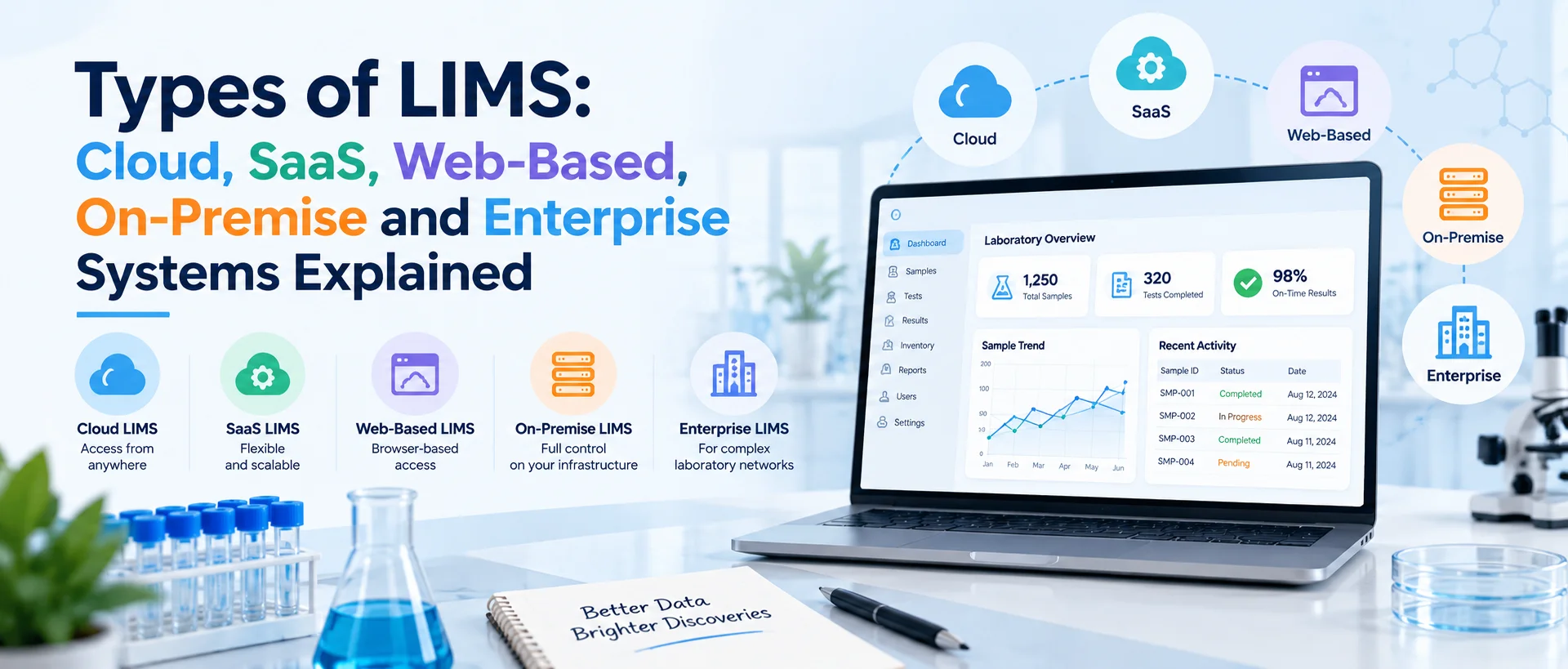
Choosing a Laboratory Information Management System becomes confusing quickly because vendors use terms such as cloud LIMS, SaaS LIMS, web-based LIMS, on-premises LIMS and enterprise LIMS as though they describe completely different types of software.
They do not. Some terms describe where the system runs, others describe how the software is delivered, while others describe how users access it or the scale at which it is designed to operate.
The main types of LIMS are commonly described as cloud, SaaS, web-based, on-premises, and enterprise systems. However, these categories overlap. A SaaS LIMS is normally cloud-hosted, a web-based LIMS can be either cloud-hosted or on-premises, and an enterprise LIMS may use cloud, SaaS or on-premises deployment depending on the organization’s requirements.
Understanding these differences helps laboratory directors and IT teams compare systems based on real operational requirements rather than terminology alone. If you are still building the foundation, start with our guide explaining what a Laboratory Information Management System is before comparing deployment models.
Why Are There Different Types of LIMS?
Laboratories do not all have the same technology environment. A small independent testing laboratory may have limited internal IT resources and want the software provider to manage most of the technical infrastructure.
A larger organization may already operate its own data centers, security systems and enterprise applications. A multi-site laboratory group may need hundreds of users working across different locations.
Another laboratory may have specialized instrument integrations, data-residency requirements or internal policies that strongly influence where software can be hosted. Because these requirements differ, LIMS can be deployed and delivered in different ways.
The National Institute of Standards and Technology defines cloud computing around on-demand network access to shared, configurable computing resources and distinguishes between service models such as Software as a Service, Platform as a Service and Infrastructure as a Service.
It also identifies public, private, community and hybrid cloud deployment models. For a detailed technical definition, see the NIST Definition of Cloud Computing. The important lesson for LIMS buyers is that terms such as SaaS and cloud are related, but they are not identical.
First, Understand What Each LIMS Term Actually Describes
Before comparing individual options, it helps to separate five concepts.
| Term | Primarily Describes | Typical Meaning |
|---|---|---|
| Cloud LIMS | Hosting/deployment environment | LIMS operates using cloud infrastructure rather than relying entirely on laboratory-owned local infrastructure |
| SaaS LIMS | Software delivery/service model | Provider delivers and manages the application as a service, typically through subscription access |
| Web-Based LIMS | User access/interface | Users access the LIMS through a web browser |
| On-Premise LIMS | Hosting and infrastructure responsibility | Software runs on infrastructure controlled by the laboratory or organization |
| Enterprise LIMS | Organizational scope and scale | LIMS is designed to support larger, more complex or multi-site organizations |
These categories can overlap. For example, a system might simultaneously be: cloud-hosted + SaaS + web-based + enterprise-scale. Another system might be: on-premises + web-based + enterprise-scale.
That distinction prevents one of the most common mistakes in LIMS selection: comparing terms that actually describe different aspects of the system.
1. What Is a Cloud LIMS?
A cloud LIMS runs using cloud computing infrastructure rather than depending entirely on servers physically maintained inside the laboratory's own facility. Authorized users typically connect to the application through a network connection, often using a browser.
Depending on the architecture and service agreement, infrastructure responsibilities such as servers, storage, backups, platform availability and technical maintenance may be handled partly or largely by the provider.
This can reduce the amount of infrastructure the laboratory needs to purchase and maintain internally. However, the phrase cloud LIMS by itself does not tell you everything about the architecture.
Cloud environments can be public, private or hybrid. A system could use shared cloud infrastructure with logical separation between customers, or it could operate within infrastructure dedicated to one organization.
That is why laboratories should ask vendors what they actually mean when they say "cloud." LabZila's Cloud LIMS software focuses on centralized browser-based access to laboratory workflows while reducing the requirement for laboratories to maintain extensive local application infrastructure.
What Are the Practical Advantages of Cloud LIMS?
For many laboratories, reduced infrastructure responsibility is one of the main attractions. The organization may not need to purchase and manage the same level of local application servers, storage systems and supporting infrastructure that a traditional deployment requires.
Cloud deployment can also make access across multiple laboratory locations easier because users are not necessarily tied to a workstation connected to one local server environment.
Scaling may also be more straightforward when sample volume, storage requirements or user numbers grow, although the actual scalability depends on the provider, architecture and commercial agreement.
Updates and platform maintenance may also be handled centrally rather than requiring every laboratory location to manage separate installations. These factors are some of the reasons laboratories evaluating the benefits and advantages of a LIMS increasingly consider deployment strategy alongside functional capabilities.
What Should Laboratories Check Before Choosing Cloud LIMS?
Cloud deployment does not remove the need for technical due diligence. Laboratories should understand:
- where their data is hosted,
- who manages infrastructure,
- how backups and recovery operate,
- how access is controlled,
- what availability commitments exist,
- how software updates are handled,
- whether integrations with local instruments are practical,
- how data can be exported,
- and what happens if the commercial relationship ends.
Security should also be evaluated based on actual controls rather than assumptions. Cloud systems are not automatically more secure simply because they are hosted by a specialist provider.
Likewise, an on-premises system is not automatically safer because the hardware is physically located inside the organization. Security depends on architecture, configuration, identity management, monitoring, patching, backup practices, organizational processes and other controls.
2. What Is a SaaS LIMS?
SaaS stands for Software as a Service. A SaaS LIMS is provided as an ongoing software service rather than as software that the customer installs and manages entirely on its own infrastructure.
Under the NIST definition of SaaS, customers use the provider's application running on cloud infrastructure while the provider manages the underlying servers, storage, operating systems and much of the application environment.
Users generally access the software through a browser or another supported interface. SaaS LIMS is therefore usually cloud-based, but the word SaaS describes the service model more specifically than the general term cloud.
SaaS LIMS vs Cloud LIMS: What Is the Difference?
These terms are often used interchangeably in marketing, but there is a useful distinction.
- Cloud LIMS tells you broadly that cloud infrastructure is being used.
- SaaS LIMS tells you that the application itself is delivered as a managed software service.
Imagine an organization runs a LIMS application on cloud infrastructure but manages the operating system, application configuration, upgrades and much of the technical environment itself.
That system may be cloud-hosted, but it is not necessarily the same type of fully managed SaaS application that most buyers expect when they hear "SaaS LIMS."
By contrast, with a typical SaaS model, much of the technical application environment remains the provider's responsibility. This difference matters when comparing staffing requirements, upgrade responsibilities, contracts and long-term system administration.
Why Might a Laboratory Choose SaaS LIMS?
A laboratory with limited IT resources may prefer not to manage servers, operating systems and application deployments internally. SaaS can shift more of those operational responsibilities toward the software provider.
It may also simplify software updates because users generally work from a centrally maintained application rather than numerous separate local installations. Commercially, SaaS systems commonly use subscription-based pricing.
However, laboratories should not assume SaaS means there are no implementation costs. Configuration, workflow design, data migration, integrations, validation activities, training and change management may still require substantial work. Deployment model and implementation complexity are separate considerations.
3. What Is a Web-Based LIMS?
A web-based LIMS is a system whose user interface can be accessed through a web browser. That sounds similar to cloud and SaaS, but the distinction is important.
Web-based describes how users interact with the software. It does not necessarily tell you where the application is hosted. A browser-based LIMS could run:
- in a public cloud,
- in a private cloud,
- as SaaS,
- on servers inside the organization's own facility,
- or in another managed hosting environment.
This means web-based LIMS and cloud LIMS are not automatically the same thing. An organization could run a browser-accessible LIMS entirely on-premises.
Users might open Chrome or another supported browser to access the application, but the application server and database could still reside inside the organization's own infrastructure.
Why Does Web-Based Access Matter?
Traditional desktop applications may require software to be installed and maintained on individual computers. A web-based interface can reduce that dependency because users access the application through a supported browser.
This can simplify access from different workstations and locations, depending on network and security configuration.
For multi-department or multi-site laboratories, browser access can make deployment easier because users are interacting with a centralized application rather than numerous independent desktop installations.
However, laboratories should still check supported browsers, network requirements, authentication methods, device compatibility and performance expectations. "Runs in a browser" should never be treated as a complete technology evaluation.
4. What Is an On-Premise LIMS?
An on-premise LIMS, more precisely called an on-premises LIMS, is installed and operated using infrastructure controlled by the laboratory or its parent organization.
That infrastructure may include servers, databases, storage, networks, backup systems and other technical components. The organization's internal IT team usually assumes more responsibility for maintaining the environment.
IBM describes an on-premises environment as one where an organization runs and manages its own hardware, software, data storage, and computing resources at its physical location. For a broader comparison of deployment environments, see IBM's explanation of hybrid, cloud and on-premises computing.
Why Do Some Laboratories Choose On-Premise LIMS?
Organizations may choose on-premises deployment because they want greater direct control over the infrastructure. Some already operate mature internal data centers and technical teams, making local deployment practical.
Others may have internal policies, specialized systems or integration requirements that influence the decision. A laboratory may also have instruments or applications deeply connected to a local network environment.
In those situations, on-premises deployment can provide IT teams with direct control over system architecture, network configuration, deployment schedules and supporting infrastructure.
What Responsibilities Come With On-Premise LIMS?
Greater infrastructure control also means greater infrastructure responsibility. The organization may need to manage: server hardware, operating systems, database administration, backups, disaster recovery, security patches, network configuration, capacity planning and system monitoring.
Software updates may also require more internal coordination. For laboratories without sufficient IT capacity, this can create a significant operational burden.
On-premises software therefore should not automatically be viewed as the "safer" or "more controlled" option. The organization must actually have the people, procedures and infrastructure needed to exercise that control effectively.
5. What Is an Enterprise LIMS?
The term enterprise LIMS describes something different from cloud, SaaS and on-premises deployment. Enterprise generally refers to the scale, governance and organizational complexity the system is designed to support.
An enterprise LIMS may be used across several laboratories, business units, departments, geographic locations or testing environments.
It may need to support large numbers of users, high sample volumes, multiple workflows and extensive integration with other organizational systems.
Enterprise environments may also require centralized governance with enough configuration flexibility to accommodate differences between individual laboratory locations.
Enterprise LIMS Is Not a Hosting Model
This distinction is worth emphasizing. An enterprise LIMS could be:
- SaaS,
- cloud-hosted,
- on-premises,
- privately hosted,
- or part of a hybrid architecture.
The word enterprise tells you more about organizational scale than infrastructure location. For example, a pharmaceutical manufacturer may operate several QC laboratories across different facilities.
The organization may want common data structures, methods, security policies and reporting standards across those locations while still supporting site-specific workflows.
That is an enterprise requirement. Whether the application runs in SaaS infrastructure or in the organization's own data center is a separate decision.
What Does an Enterprise Laboratory Typically Need?
Enterprise requirements often include more than increasing the number of user licenses. The system may need:
centralized user and role management, multiple laboratory locations, configuration governance, high-volume data management, standardized master data, integration with enterprise systems, reporting across sites and controlled differences between local workflows.
The LIMS also needs to fit into a larger technology environment. That makes integrations especially important. Laboratories comparing enterprise platforms should evaluate how the LIMS exchanges information with instruments, ERP platforms, ELNs and other systems.
LabZila's LIMS integrations provide an example of the types of instrument and system connectivity that need to be considered during this evaluation.
Cloud vs SaaS vs Web-Based vs On-Premise vs Enterprise LIMS
The following comparison makes the distinctions clearer.
| Type | Main Characteristic | Infrastructure Responsibility | Common Access | Best Understood As |
|---|---|---|---|---|
| Cloud LIMS | Uses cloud infrastructure | Usually shared between provider and customer depending on model | Network/browser | Hosting environment |
| SaaS LIMS | Application delivered as a managed service | Mostly provider-managed | Browser or supported interface | Service model |
| Web-Based LIMS | Application interface runs through browser | Depends on deployment | Web browser | Access method |
| On-Premise LIMS | Runs on organization-controlled infrastructure | Mostly customer-managed | Browser or installed client depending on system | Hosting model |
| Enterprise LIMS | Supports larger or more complex organizations | Depends on deployment choice | Depends on architecture | Scale and organizational scope |
This is why procurement teams should avoid requests such as: "Do you offer SaaS or web-based LIMS?" A SaaS LIMS will commonly also be web-based.
A better set of questions would be: Where is the application hosted? Who manages the infrastructure? How do users access it? How are updates delivered? Can it support our number of laboratories and users?
Those questions reveal the architecture much more clearly.
What About Public, Private and Hybrid Cloud LIMS?
Cloud deployment can be divided further. A public cloud uses cloud infrastructure offered by a provider for multiple customers while individual environments and data are logically controlled according to the service architecture.
A private cloud provides cloud resources dedicated to one organization. A hybrid cloud combines distinct cloud environments in a way that allows applications or data to work across them. For most laboratory buyers, however, the technical label is less important than understanding what it means operationally.
Ask where your LIMS application runs, where laboratory data resides, what infrastructure is shared or dedicated, how systems connect and who is responsible for each technical layer. Two vendors may both call their product "cloud LIMS" while delivering considerably different architectures.
Is Cloud LIMS Always Better Than On-Premise?
No. There is no deployment model that is automatically right for every laboratory. Cloud and SaaS systems can reduce internal infrastructure management and simplify access for distributed teams.
On-premises deployments can give organizations more direct infrastructure control. Enterprise systems can support complex multi-site environments regardless of whether they are hosted in the cloud or locally.
The correct choice depends on actual requirements. A smaller independent laboratory with little internal IT capacity may value provider-managed infrastructure.
A large organization with a mature IT department and specialized infrastructure policies may reach a different conclusion. The purpose of evaluating LIMS types is therefore not to identify one universal winner. It is to identify which model fits the laboratory's operating environment.
Does a Cloud LIMS Mean Laboratory Data Is Less Secure?
Not necessarily. The location of an application does not determine security by itself. A cloud environment can be poorly configured. An on-premises server can also be poorly configured, inadequately patched, or insufficiently monitored.
Laboratories should evaluate security based on controls. Questions should cover areas such as user authentication, role-based permissions, encryption, backups, incident response, monitoring, software patching, data export, vendor responsibilities, and internal administration.
The same principle applies to compliance. No hosting model automatically makes a laboratory compliant with a regulatory requirement or accredited to a laboratory standard. Technology is only one part of a broader system that also includes configuration, validation where applicable, procedures, training and operational controls.
What About Integration With Laboratory Instruments?
Deployment architecture can affect integration planning. Laboratory instruments frequently reside on local networks. An on-premises LIMS may communicate with those instruments within the same organizational infrastructure.
A cloud or SaaS LIMS may require supported interfaces, middleware, agents, APIs or other secure mechanisms to move information between local instruments and the hosted application.
That does not make cloud integration impractical, but it means integration requirements should be understood before selecting the architecture. Inventory your important instruments and systems early.
For each one, identify: what data needs to move, in which direction, how frequently, through which interface and what happens if the connection becomes unavailable. Integration should be part of deployment planning, not something discovered after the LIMS has already been selected.
How Does Deployment Affect Multi-Site Laboratories?
Organizations operating several laboratories need to think beyond individual installations. A centrally hosted cloud or SaaS platform can make it easier for authorized users across several sites to access a shared environment, subject to the system's architecture and security controls.
An enterprise on-premises environment can also support multiple sites, but the organization may be responsible for more of the networking, infrastructure and system administration required to keep those locations connected.
The decision therefore depends partly on how centralized the organization wants its laboratory information to be. Questions may include:
- Should every site use the same master methods?
- Do sites require different workflows?
- Will results be reported centrally or locally?
- Should user administration be centralized?
- Do management teams need reporting across all laboratories?
LabZila's LIMS solutions by industry demonstrate why workflow requirements need to remain part of this discussion: pharmaceutical QC, environmental, clinical, cannabis, food and contract-testing laboratories can have very different operational requirements even when they use similar deployment technology.
How Do LIMS Types Affect Cost?
Deployment model influences cost, but it does not determine total cost on its own. SaaS systems typically use recurring subscription pricing and can reduce the need for customers to purchase and maintain some infrastructure.
On-premises systems may involve infrastructure purchases, database or platform requirements, IT administration, backup systems and ongoing maintenance. However, both models may still involve costs for:
configuration, implementation, data migration, instrument integrations, training, validation activities, support and long-term administration.
This is why comparing only the subscription fee or software license price can be misleading. A meaningful comparison should examine total cost of ownership over the expected life of the system.
Our upcoming LIMS cost guide will examine these factors separately so the informational deployment article does not overlap with LabZila's commercial pricing intent.
Which Type of LIMS Should Your Laboratory Choose?
The most useful way to make this decision is to start with requirements rather than terminology.
- Consider Your Internal IT Resources
Does your organization have people who can reliably manage servers, databases, backups, security patches and application infrastructure?
If not, provider-managed SaaS or cloud deployment may reduce operational burden. If the organization already has mature infrastructure and specialist IT teams, on-premises deployment may remain practical.
- Consider How Many Locations Need Access
A laboratory operating from one facility has different access requirements from an organization with laboratories in several states or countries.
Distributed operations should consider networking, authentication, central administration, performance and data governance.
- Consider Your Instrument Environment
Identify which instruments and external systems need to exchange information with the LIMS. Do not assume every deployment model will connect to every instrument in the same way.
- Consider Security and Governance Requirements
Document actual security and organizational requirements rather than starting with an assumption that one architecture is automatically more secure.
Determine which controls are required, who will operate them and how responsibilities are divided between your laboratory and the software provider.
- Consider Configuration and Growth
- How many users will the laboratory have today?
- What about three years from now?
- Will you add new testing departments?
- Additional locations?
- New instruments?
- Different client workflows?
The chosen system should support realistic growth without forcing the laboratory into an unnecessarily complex architecture from the beginning.
- Consider Who Will Maintain the System
A LIMS requires ongoing administration regardless of where it is hosted. The difference is which responsibilities stay with the customer and which are handled by the provider. Make that division explicit before signing an agreement.
Questions to Ask a LIMS Vendor About Deployment
Rather than simply asking whether the product is "cloud" or "enterprise," ask specific questions.
Where is the application hosted?
Is the product delivered as SaaS?
Who manages servers, operating systems, databases and application updates?
Can users access the system through a browser?
How are local laboratory instruments connected?
Where is our laboratory data stored?
What backup and recovery processes are included?
How are updates scheduled and communicated?
How can we export our data?
Can the architecture support additional users and laboratory locations?
Which technical responsibilities remain with our IT team?
Answers to these questions are much more valuable than deployment labels alone.
A Practical Example: Two Laboratories Can Need Different LIMS Types
Consider two laboratories that perform similar analytical testing. The first is an independent laboratory with 20 employees and one IT generalist. It wants users to access the system from different areas of the laboratory without maintaining application servers internally.
A SaaS LIMS may be a practical option because much of the software infrastructure can be managed by the provider. The second laboratory belongs to a large manufacturing company.
Its parent organization has centralized infrastructure, dedicated database administrators, cybersecurity teams and strict internal architecture standards. The laboratory may have deeply integrated local systems and corporate applications.
That organization may reasonably evaluate on-premises, private-cloud or enterprise deployment differently. Neither choice is automatically superior. Each laboratory has different operational and technical constraints. That is why deployment decisions should follow requirements rather than trends.
Where Does LabZila Fit?
LabZila is designed around modern, configurable laboratory workflows and provides cloud-based LIMS capabilities for laboratories that want centralized access to samples, testing, quality processes, instruments and reporting. Its broader LIMS software features show how those operational modules connect within the platform.
For a laboratory evaluating deployment, however, the decision should still be based on its own users, sample volume, security requirements, integrations, quality processes and IT environment. The system architecture should support the laboratory's work rather than becoming another source of complexity.
Final Thoughts
Understanding the types of laboratory information management system requires separating several concepts that are often mixed together.
- A cloud LIMS describes a system using cloud infrastructure.
- A SaaS LIMS describes software delivered as a provider-managed service.
- A web-based LIMS describes how users access the application.
- An on-premise LIMS runs using infrastructure controlled by the organization.
- An enterprise LIMS describes a system designed for larger or more complex organizational requirements and can use several different hosting models.
The most important lesson is that these categories are not mutually exclusive. A LIMS can be SaaS, cloud-based, browser-accessible and enterprise-ready at the same time.
For laboratory directors, IT managers and procurement teams, the better question is therefore not simply "Which type of LIMS is best?"
It is: "Which deployment and service model gives our laboratory the right balance of access, infrastructure responsibility, integration capability, governance and long-term scalability?"
Once those requirements are clear, the terminology becomes much easier to evaluate. If your laboratory is currently comparing deployment options, review the LabZila Cloud LIMS capabilities or contact LabZila to discuss your workflow, infrastructure and integration requirements.
=================================================================