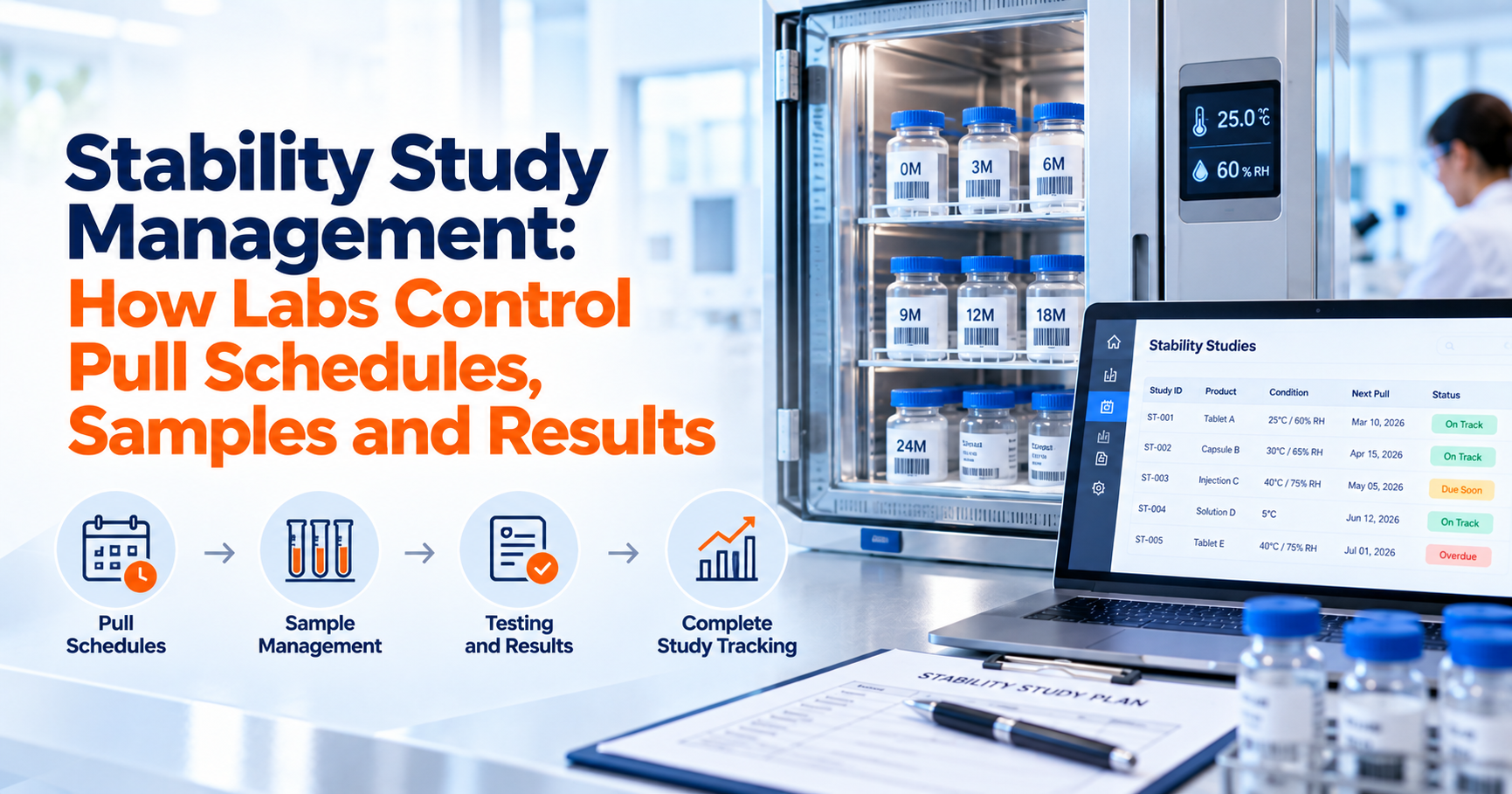
A stability study may run for months or years, but many of its critical activities happen on specific dates.
Samples have to be placed under defined storage conditions. Planned timepoints need to be monitored. The correct quantity of material has to be available when each pull becomes due. Testing must follow the approved protocol. Results need review. Storage excursions, missed pulls and protocol changes need to remain traceable. Data from different timepoints then has to be evaluated as part of the larger stability picture.
Managing all of that through calendars, spreadsheets, chamber logs, emails and separate test records can become difficult surprisingly quickly.
Stability study management is the controlled process of planning a stability protocol, linking products and batches with defined storage conditions and timepoints, maintaining sufficient sample inventory, scheduling pulls, performing the required testing, reviewing results, documenting deviations and changes, and preserving the complete study history through reporting and closure.
For pharmaceutical laboratories, stability testing is directly connected with determining and supporting appropriate storage conditions, retest periods and product shelf life. FDA's final ICH Q1A(R2) guidance explains that stability studies are intended to show how the quality of a drug substance or drug product changes over time under factors such as temperature, humidity and light, and to support appropriate storage conditions and shelf life or retest periods.
U.S. Food and Drug Administration FDA Q1A(R2) Stability Testing of New Drug Substances and Products
The challenge for the laboratory is not simply scheduling tests. It is maintaining the relationship among the approved study design, the physical samples, the storage environment, the planned pull dates, the analytical work and the results generated over time.
That is where structured stability study management software can provide practical value.
What Is a Stability Study?
A stability study evaluates how a material or product behaves over time under defined environmental conditions.
For pharmaceutical products, the study may examine physical, chemical, biological or microbiological characteristics that could change during storage. The specific attributes depend on the product and the approved stability protocol.
A stability study may include long-term conditions, accelerated conditions and, where applicable, intermediate or other justified conditions.
For the general drug-product case described in ICH Q1A(R2), examples include long-term storage at either 25°C ± 2°C with 60% RH ± 5% RH or 30°C ± 2°C with 65% RH ± 5% RH, intermediate storage at 30°C ± 2°C with 65% RH ± 5% RH when applicable, and accelerated storage at 40°C ± 2°C with 75% RH ± 5% RH. Those values should not be copied automatically into every study because refrigerated products, frozen products, semipermeable containers and other product types can require different conditions.
The stability protocol should define what applies to the actual product being studied. Software can help manage those requirements, but it should not determine scientifically appropriate study conditions on behalf of the laboratory.
What Does Stability Study Management Include?
A complete stability workflow usually begins before samples are placed into a chamber.
The laboratory needs a defined protocol containing the study identity, product or material, relevant batches, packaging configuration, study type, storage conditions, duration, planned timepoints, tests, methods, specifications and responsibilities.
The required amount of sample then needs to be calculated and allocated. Samples are placed in the appropriate storage conditions and remain traceable to the correct study, batch and timepoint plan.
As each timepoint approaches, samples need to be pulled according to the protocol and routed into the required laboratory testing. Results are reviewed and connected with the correct timepoint.
Over the life of the study, laboratory personnel may also need to manage storage excursions, missed pulls, protocol amendments, invalid or repeated testing, changing study requirements and other exceptions.
The final study history should remain understandable without reconstructing information from several unrelated systems.
LabZila's stability study management software is designed around this connected structure, bringing protocols, conditions, batches, stability samples, pull schedules, testing and reporting into one workflow.
Start With a Controlled Stability Protocol
The stability protocol is the foundation of the study. It should define enough information that laboratory personnel understand what is being studied and what activities are required.
The specific content varies, but a protocol may include the product or drug substance, study type, batch or lot, container-closure configuration, storage condition, study duration, scheduled timepoints, required tests, methods, specifications and responsibilities.
The protocol should also establish how exceptions will be handled.
For example, what is the allowed pull window around a planned timepoint?
What happens if a chamber excursion occurs?
How is a missed timepoint documented?
Who can approve a protocol amendment?
How should additional testing be linked with the original scheduled testing?
Defining these questions before the study begins makes the later workflow much easier to control. A digital system should then represent the approved protocol instead of forcing users to re-enter the same information separately for every sample and timepoint.
Study Design Should Reflect the Product and Regulatory Context
There is no single universal stability design for every product. The storage conditions, testing frequency, number of batches, analytical tests and duration depend on the product type, intended storage, development stage, packaging and applicable regulatory requirements.
ICH Q1A(R2), for example, recommends that long-term testing for the general case be frequent enough to establish the stability profile. For drug products with a proposed shelf life of at least 12 months, the guidance describes testing normally every three months during the first year, every six months during the second year and annually afterward through the proposed shelf life. Accelerated testing generally includes at least three timepoints over six months, while additional testing may be appropriate under defined circumstances.
These are regulatory guidance principles for relevant pharmaceutical stability programs, not generic schedules for every laboratory study. The protocol should always define the schedule actually applicable to the study.
Storage Conditions Need More Than a Chamber Name
Writing "Chamber 3" in a spreadsheet is not a complete stability record. The study should remain connected with the required environmental condition. That might include temperature, relative humidity and other conditions relevant to the study.
The laboratory may also need to know which physical chamber or storage location contains each sample group. A structured record therefore separates the required condition from the physical storage asset.
For example, the required condition may be 25°C and 60% RH within defined tolerances, while the actual assigned location may be Stability Chamber SC-04.
This distinction matters if samples later move between equivalent qualified chambers. The study condition remains the same, but the equipment history changes.
LabZila can connect stability studies with defined storage conditions and relevant chamber or location records. Where equipment control is important, the study can also relate to laboratory calibration management so chamber and environmental-monitoring records do not become disconnected from the wider equipment history.
Stability Samples Need Their Own Traceable Lifecycle
A stability program can involve a substantial number of physical samples. One product may have several batches.
Each batch may be stored under several conditions.
Each condition may have multiple scheduled timepoints.
Each timepoint may require enough units for several analytical tests.
A laboratory therefore needs to know more than the total number of samples originally placed on study.
It needs to know which samples belong to which batch, condition and timepoint, what quantity is still available, which units have already been pulled, and what happened to the remaining material.
This is a specialized form of stability sample tracking. A sample-management system should preserve those relationships throughout the study.
LabZila's sample management software can support the underlying sample identities, locations and lifecycle records, while the stability module adds the protocol, condition, timepoint and pull-schedule context required for stability work.
Sample Inventory Should Be Planned Before the Study Starts
A study can fail operationally even when the protocol itself is scientifically sound if the laboratory does not allocate enough material.
The amount placed on stability should be planned from the testing requirements across all scheduled timepoints.
The calculation may need to account for the quantity required for each planned test, sample preparation, destructive testing, replicate requirements where applicable, different storage conditions and other justified needs.
The laboratory should also decide how additional material for investigations, confirmation work or retained samples will be handled when such needs apply.
The goal is not simply to put "extra" samples in a chamber. The goal is to understand what quantity is required and maintain visibility into available inventory throughout the study.
A stability-management system can help by connecting planned timepoints with the sample quantities allocated to them. That makes it easier to identify potential shortages before a future pull becomes due.
What Is a Stability Pull Schedule?
A stability pull schedule is the planned calendar of timepoints at which samples are removed from their defined storage conditions so the protocol-required testing can be performed.
The schedule may include timepoints such as initial, 3 months, 6 months, 9 months, 12 months and later intervals, depending on the study.
Each scheduled pull should remain associated with the correct study, batch, condition and required tests. This is where stability management differs from an ordinary laboratory calendar.
An entry saying "Stability pull Friday" is not enough. The system should identify exactly which material needs to be removed, from which condition, for which timepoint and what testing must follow.
Pull Date and Testing Date Are Not Necessarily the Same Thing
A stability timepoint can involve several dates.
There is the nominal timepoint.
There may be a protocol-defined pull window.
There is the actual date the sample was removed from storage.
There may then be a separate date when analytical testing starts and when it is completed.
Those dates should not be treated as interchangeable. For example, a 12-month sample could be pulled within an approved window but testing may take several days to complete.
The laboratory should follow the protocol and applicable procedures for how those dates are controlled and documented. Good stability pull schedule software should therefore distinguish planned and actual events instead of replacing one date with another.
How Can Laboratories Automate Stability-Testing Schedules and Sample Pull Reminders?
A laboratory can automate stability scheduling by configuring the approved study timepoints and pull windows in a LIMS, assigning responsible users or teams, and generating reminders before each planned pull. The system can then flag due or overdue activities and route the pulled samples into the required testing workflow.
For example, after a study is approved, the system can calculate the future pull schedule from the defined study start date and protocol timepoints. Rather than relying on someone to review a spreadsheet manually each week, upcoming activities can appear in work queues or scheduled notifications.
A stability coordinator may receive advance notice that a six-month pull is approaching. The system can identify the study, batch, condition, timepoint and required samples. When the material is actually removed, the user records the real pull event. Testing can then be assigned to the appropriate laboratory team.
LabZila's laboratory workflow automation software can support notifications, assignments, review routing and escalations around these scheduled laboratory activities. The system can remind people that the pull is due. It cannot physically remove the sample from the chamber or replace the person responsible for confirming that the correct material was pulled.
Use Advance Notifications Without Creating Alert Fatigue
A reminder is useful only if people pay attention to it. Sending dozens of notifications far in advance of every pull can make important messages disappear into noise. Laboratories should define reminder timing according to the work required.
A study coordinator may need advance notice to reserve laboratory capacity or coordinate shipment to another testing site.
An analyst may need notification only when the actual test assignment becomes available.
A supervisor may need escalation only when a planned pull is approaching the end of its defined window or has become overdue. The workflow should reflect those different responsibilities.
What Software Can Track Stability Samples, Storage Conditions, Timepoints and Test Results?
A LIMS with dedicated stability study management functionality can connect the protocol, product, batch, packaging configuration, storage condition, chamber or location, stability samples, scheduled timepoints, actual pulls, tests and approved results in one study record.
That is different from using a generic project-management tool.
A calendar can remind the laboratory that an event is due.
A stability-aware LIMS should also understand which sample, study condition and testing requirements belong to that event.
It can preserve the connection after testing is completed so results remain attributable to the correct timepoint. LabZila's stability-management capability centralizes study protocols, storage conditions, timepoints, pull schedules, sample inventory, testing and study reports.
For pharmaceutical QC laboratories, it can sit within the broader pharmaceutical LIMS workflow so stability work remains connected with samples, specifications, laboratory testing, equipment, reviews and other quality processes.
What Happens When a Stability Sample Is Pulled?
The pull event should change the physical and electronic state of the study.
The laboratory should record that the required material was removed from the defined condition.
The actual pull date and relevant user information should be retained.
The sample quantity available for that timepoint should be updated.
The required analytical work can then move into the testing workflow.
If the study uses multiple tests, those activities may go to different laboratory sections. The stability record should still remain the common reference connecting them.
For example, assay may go to chromatography while microbial testing goes to another department.
Those tests should not become unrelated work simply because different teams perform them. The study, batch, condition and timepoint context should follow the testing.
Testing Requirements Should Come From the Approved Study Design
Each stability timepoint may require a defined set of tests. Those tests should be connected with appropriate methods and specifications. Users should not have to remember from experience which tests belong to the 6-month accelerated condition and which belong to the 24-month long-term condition.
The protocol or configured study design should define them.
The system can then generate the appropriate work when the timepoint becomes active.
This reduces the risk of accidentally omitting a required test or adding an incorrect one.
However, automatic test assignment does not remove the need to maintain controlled methods and specifications. If the applicable method changes during the study, the laboratory should determine how the change affects future testing and historical comparability.
Missed Stability Pulls Need Controlled Handling
A pull that occurs outside the protocol-defined timing should be documented and evaluated according to the laboratory's deviation procedure rather than being hidden by changing the scheduled date. A missed pull does not automatically mean the entire study is invalid.
Its significance depends on factors such as the approved protocol, the length of the delay, the product, the condition, the timepoint and the intended use of the resulting data. The important first step is preserving what actually happened.
Do not backdate the pull.
Do not silently move the scheduled date so the record appears on time.
The actual pull date should remain visible. The laboratory can then assess the deviation and determine what scientific or quality action is needed.
LabZila's laboratory QMS software can help connect study deviations such as missed pulls or storage excursions with investigations, actions and supporting evidence where a formal quality workflow is required.
Pull Windows Should Be Defined Before the Timepoint Arrives
Many laboratories use protocol-defined windows around planned stability pulls. For example, the protocol may allow a particular timepoint to be pulled within a defined number of days around the nominal date.
The acceptable window should be scientifically and procedurally justified. It should not be invented after a timepoint has already been missed.
Stability software can make these windows operationally useful by displaying not only the nominal due date but also the status of the pull relative to its configured window.
That enables the laboratory to distinguish among upcoming, due, approaching the end of the window and overdue activities. The exact rules should come from the approved protocol.
Storage Excursions Need to Remain Connected to the Study
A stability chamber may temporarily move outside its defined operating range. That does not automatically mean every sample inside the chamber is unusable. It does mean the event may need evaluation.
The laboratory should retain the relevant environmental information, duration of the excursion, affected studies and samples, investigation and resulting decision according to its procedures.
This becomes much easier when the stability records are connected with the chamber and quality system.
A spreadsheet listing only the assigned storage condition may not show that a particular chamber experienced an excursion during the study.
A connected system can preserve the relationship among the chamber, study, affected samples and quality record.
Protocol Changes Need Controlled Change Management
Long-running studies sometimes change.
A method may be replaced.
A specification may be revised.
A reporting requirement may change.
Additional timepoints may be added.
A product change may create a need for another study or condition. These changes should not rewrite the historical study as though the new configuration had existed from the beginning.
A controlled protocol amendment should preserve what changed, why it changed, who authorized it and when the change became effective.
Future pulls can then follow the revised requirements while historical records retain the configuration that applied when earlier work was performed.
This is particularly important for data interpretation. If two timepoints were tested using different method versions, reviewers need to understand that context before comparing them.
Stability Results Need More Than a Pass or Fail Status
Each individual result may be evaluated against its applicable specification, but stability review also looks across time. A result can remain within specification while still showing a developing pattern that deserves scientific attention.
For example, assay may gradually decline over several long-term timepoints.
A degradation product may rise consistently.
Dissolution behavior may shift.
Moisture may increase.
The interpretation depends on the product, attribute, analytical variability and available data.
Stability software should therefore make approved results available across timepoints, batches and conditions so qualified personnel can review patterns without manually combining several spreadsheets.
It should not automatically declare that a product's shelf life is acceptable simply because every individual result currently passes.
How Should Stability Trends Be Evaluated?
Stability trends should be evaluated using the complete approved data set, the study design, relevant analytical variability and applicable regulatory or scientific methods. Software can organize and visualize the data, but qualified personnel should make the scientific interpretation.
FDA's final ICH Q1E guidance explains how stability data generated under Q1A(R2) can be evaluated when proposing a retest period or shelf life, including circumstances in which extrapolation beyond available long-term data may be considered.
U.S. Food and Drug Administration FDA Q1E Evaluation of Stability Data
This distinction is important for stability testing software.
Charts can show the data.
Statistical tools can assist analysis.
Alerts can identify configured conditions.
But the system should not replace the scientific assessment of whether a trend is meaningful, whether data are comparable or whether the evidence supports a proposed shelf life.
Compare Timepoints Without Losing Batch Context
Stability data should remain attributable to the correct batch. Combining everything into one trend line without preserving batch identity can hide useful information. A reviewer may need to examine whether one batch behaves differently from others.
Similarly, results should remain associated with the relevant packaging configuration and storage condition.
A value from accelerated storage should not accidentally appear as though it came from the long-term condition. The data model should therefore maintain these relationships even when results are displayed together for comparison.
Review Approved Results, Not Preliminary Values
Trend analysis should use the appropriate reviewed data. If an analyst has entered a preliminary result but technical review later corrects it, the stability trend should not continue using the preliminary value.
A connected workflow should distinguish result entry, review and approval status. Only data that meet the laboratory's defined criteria should feed formal reporting or approved trend evaluations.
This is another reason stability management works better when integrated with laboratory testing rather than managed entirely in a separate spreadsheet.
Repeat Testing Should Preserve the Original History
If stability testing needs to be repeated, the original activity should not simply disappear. The laboratory should preserve the original result or activity according to its procedures and connect any repeat testing with the reason it was performed.
The authorization and scientific justification for repeat testing may also be important.
For pharmaceutical OOS situations, the laboratory should follow applicable investigation requirements rather than using repeat testing simply to obtain a passing result.
The stability system should support traceability, while the scientific and quality decision remains with qualified personnel.
Reporting Should Reflect the Complete Study Record
A stability report should draw from controlled study information rather than requiring users to manually rebuild the study history.
Depending on the study, the report may need information about the protocol, batches, conditions, scheduled and actual pulls, methods, results, deviations, amendments and conclusions.
The reporting process should use reviewed information and preserve the relationship with the underlying study records.
LabZila can prepare structured study summaries and reports from the connected protocol, sample, pull and testing data.
That can reduce repetitive compilation while keeping the final report traceable back to its source information.
How Can a LIMS Help Prevent Missed Stability-Study Pulls and Disconnected Records?
A LIMS can help by generating pull schedules from the approved study design, showing upcoming timepoints, assigning responsibility, sending reminders, escalating overdue activities and connecting each completed pull with the correct samples, tests and results.
The system reduces dependence on individual memory. It also reduces the number of separate records that have to agree with one another.
Instead of maintaining one spreadsheet for the protocol, another for chamber inventory, a shared calendar for pull dates and separate test records for results, the study can remain connected within one structured data model.
This does not guarantee that a pull will never be missed.
People still need to perform the physical work.
Equipment can fail.
Unexpected events can occur.
The practical benefit is that upcoming responsibilities and overdue activities are much more visible, while any deviation from the plan remains traceable.
Why Spreadsheets Become Difficult for Stability Studies
A spreadsheet can manage a small study. Problems emerge as complexity increases. Suppose a laboratory manages ten products, three batches per product, three storage conditions and eight timepoints.
That is already hundreds of product-batch-condition-timepoint relationships before individual samples and tests are considered.
Add chamber locations, inventory, pull windows, analysts, specifications, protocol versions, deviations and results, and the workbook can become difficult to control. The laboratory may then create additional spreadsheets to make the first spreadsheet manageable.
One tracks inventory.
Another tracks chambers.
Another tracks upcoming pulls.
Another contains results.
Now the team has a synchronization problem.
The weakness is not the spreadsheet's ability to store data.
The weakness is maintaining reliable relationships across a long-running, multi-dimensional study.
A LIMS can represent those relationships directly.
Stability Management Should Connect With Equipment Control
Stability chambers are part of the study environment. Their calibration, maintenance and operational status may therefore be relevant to the reliability of the study.
If a chamber experiences a problem, the laboratory should be able to determine which studies and samples were affected. This requires a connection between study information and equipment information.
Similarly, environmental records should remain identifiable to the correct chamber and time period. The laboratory may then perform an evidence-based impact assessment rather than relying on memory about what was stored where.
Stability Management Should Connect With Quality Management
Missed pulls, excursions, protocol deviations and certain unusual results can become quality events. The stability system should allow those events to remain connected with the study.
A deviation record should identify the relevant study, condition, batch, timepoint and supporting evidence. If investigation leads to corrective or preventive action, that relationship should remain visible.
The previously discussed CAPA management workflow is relevant here because the quality action may originate from a stability event but continue after the immediate study problem has been addressed.
Stability Management Should Connect With Workflow Automation
Many stability activities are predictable.
A timepoint is known in advance.
The responsible department is known.
The required tests are known.
The review path is known.
Those are strong candidates for automation.
The system can create work, route it and send notifications.
However, important scientific decisions should remain under human control.
Software should not automatically decide whether an excursion affected product quality, whether a missed pull invalidates data, whether a trend is significant or whether a study supports a shelf-life conclusion. Those decisions require context and qualified review.
What Should Laboratories Look for in Stability Study Management Software?
A useful platform should manage more than a calendar of pull dates.
It should keep the study protocol, product, batches, packaging configuration, conditions, chambers, samples, timepoints, sample inventory, required testing and results connected.
It should make upcoming pulls visible and record actual pulls.
It should distinguish scheduled dates from actual dates.
It should support controlled protocol changes.
It should preserve study history.
It should connect deviations and excursions with the relevant study.
It should allow approved results to be reviewed across timepoints and conditions.
It should provide reporting without breaking traceability to the underlying data.
Most importantly, the laboratory should test the system using realistic exceptions.
Ask what happens when a pull is late.
Ask what happens when one batch has insufficient sample quantity.
Ask how a chamber excursion is linked to affected studies.
Ask whether a protocol amendment changes historical records.
Ask what happens when a test is repeated.
Ask whether an overdue pull can be escalated without changing its original planned date.
A realistic demonstration reveals whether the software actually manages stability studies or merely stores study information.
How LabZila Supports Stability Study Management
LabZila brings study protocols, products, batches, storage conditions, stability samples, pull schedules, tests, results and reports into one configurable stability workflow.
Laboratories can define study types, durations, storage conditions, timepoints and assigned responsibilities.
Stability samples can remain connected to the appropriate product, batch, condition and packaging configuration.
Upcoming and overdue pulls can be monitored, and responsible users can receive notifications for activities requiring attention.
Required tests, methods, specifications and due dates can remain connected with each scheduled pull.
Approved results can then be reviewed across timepoints, batches and conditions.
LabZila can also connect missed pulls, storage excursions and protocol deviations with quality records, investigations and CAPAs when appropriate.
These capabilities can support structured pharmaceutical stability workflows, but LabZila does not determine scientifically appropriate study designs, automatically establish product shelf life or replace qualified regulatory and scientific review.
Laboratories remain responsible for the protocol, regulatory strategy, data interpretation, change control and final stability conclusions.
Organizations currently coordinating long-running studies across spreadsheets, chamber logs and separate testing records can contact LabZila to discuss their stability-study workflow.
Frequently Asked Questions
How can laboratories automate stability-testing schedules and sample pull reminders?
Configure the approved study protocol, start date, storage conditions, timepoints and applicable pull windows in stability study management software or a LIMS. The system can calculate future pull activities, assign responsible users, display upcoming work and send reminders before timepoints become due. It can also flag or escalate overdue pulls. The actual sample removal and any scientific decision about delayed or missed pulls should remain under the laboratory's controlled procedures.
What software can track stability samples, storage conditions, timepoints and test results?
A LIMS with dedicated stability study management functionality can maintain the protocol, product, batch, packaging configuration, storage conditions, chamber or location, sample inventory, scheduled timepoints, actual pulls, required tests and approved results within one connected study record. This is more comprehensive than using a calendar or spreadsheet only for pull dates because the study activities remain linked with the laboratory data generated from them.
How can a LIMS help prevent missed stability-study pulls and disconnected records?
A LIMS can make future pulls visible, assign responsibility, provide advance reminders and escalate overdue activities while connecting each pull to the correct study, batch, condition, samples and testing requirements. It also reduces the need to maintain separate protocol, inventory, scheduling and result spreadsheets. A LIMS cannot guarantee that a physical pull will never be missed, but it can make responsibilities, deadlines and deviations much easier to identify and trace.