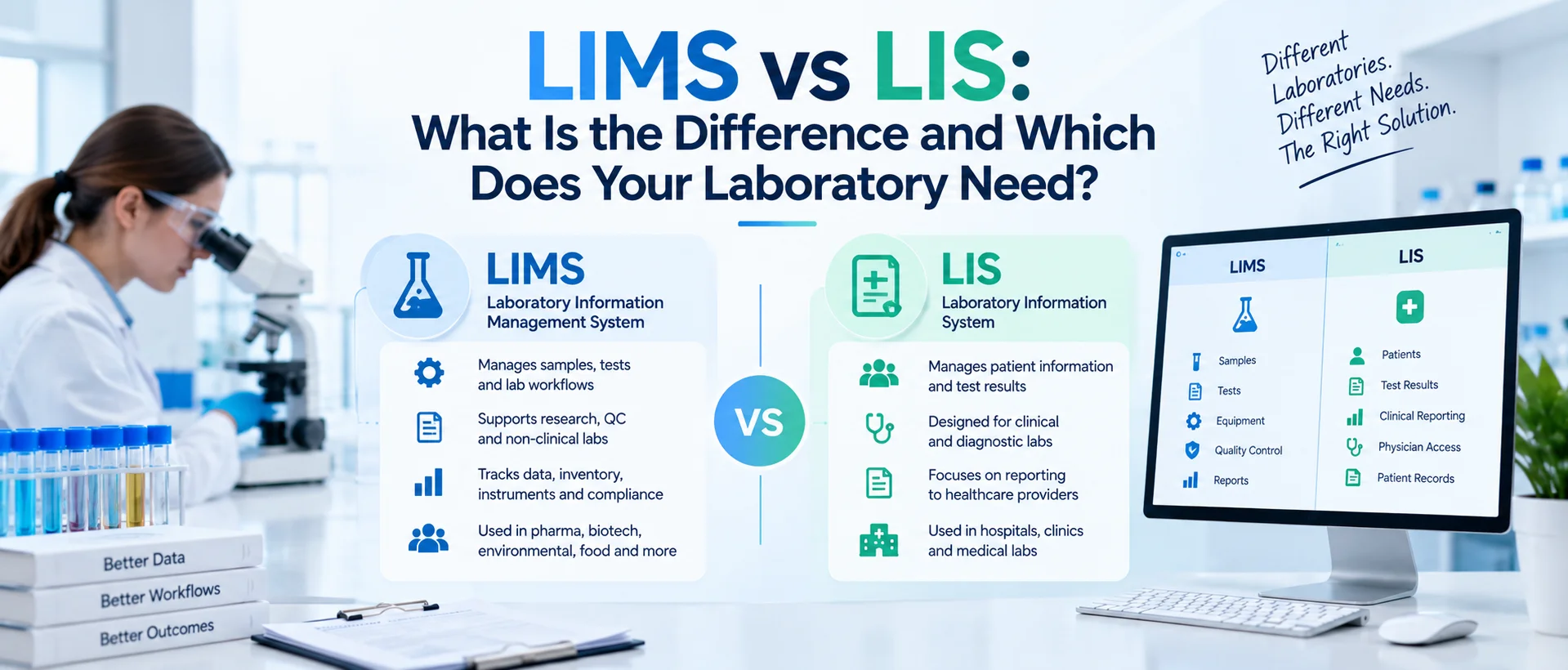
If you manage a clinical or diagnostic laboratory, you may encounter two terms during a software search: LIMS and LIS. They are sometimes treated as completely different systems. In other situations, vendors and laboratories use the terms almost interchangeably.
Both can manage specimens, testing, laboratory data, instruments and results, so the distinction is not always obvious from a feature list. The difference becomes clearer when you look at the workflow each system is primarily designed to support.
Traditionally, a LIMS is more sample- and workflow-centered, managing specimens, testing processes, methods, laboratory data, quality activities and traceability. An LIS is traditionally more patient- and clinical-workflow-centered, connecting patient-specific specimens with test orders, results and healthcare systems. Modern platforms overlap significantly, so laboratories should evaluate actual capabilities rather than choosing software based only on the LIMS or LIS label.
This distinction is especially important for clinical laboratories. LabZila's own clinical content strategy requires clear communication about where the platform functions as a LIMS and whether a laboratory also requires full LIS or EHR functionality.
What Does LIMS Mean?
LIMS stands for Laboratory Information Management System. A LIMS provides a structured system for managing laboratory samples, testing workflows and the information generated during those processes.
Depending on the platform and laboratory, a LIMS can support sample accessioning, unique identification, test assignment, methods, specifications, instrument information, result capture, quality-control records, reviews, approvals and reporting.
NIST describes a LIMS as software developed to support laboratory operations such as tracking specimens and workflows and collecting, annotating and aggregating datasets. For a broader introduction, see our guide explaining what a Laboratory Information Management System is.
A major strength of the LIMS model is maintaining relationships throughout the sample lifecycle. Instead of treating a sample, test result and report as separate records, the system can keep them connected from receipt through final disposition.
What Does LIS Mean?
LIS stands for Laboratory Information System. The term is most commonly associated with clinical laboratories, where laboratory testing is closely connected with patients, healthcare providers and clinical care.
An LIS may manage patient demographics, test orders, specimen accessioning, analyzer interfaces, result verification, reference ranges, critical values, result delivery and communication with other healthcare applications.
The CDC and Association of Public Health Laboratories describe an LIS as a computer-based information-management system specifically created for laboratories. Their guidance explains that an LIS can track information from sample login through reporting, store and analyze laboratory data, report results for patient care and communicate information to other organizations.
The same guidance notes that LIS and LIMS are sometimes used interchangeably, but traditionally associates LIS with clinical and patient-specific specimens while LIMS has been more commonly associated with sample-centric research, public-health, reference or other non-clinical environments.
LIMS vs LIS: The Difference at a Glance
| Area | LIMS | LIS |
|---|---|---|
| Traditional focus | Samples, testing processes and laboratory workflows | Patients, clinical specimens and diagnostic results |
| Primary organizing entity | Sample, batch, project, study or testing workflow | Patient, test order, encounter and specimen |
| Common environments | QC, research, environmental, food, cannabis, contract testing, pharma and other testing labs | Hospitals, diagnostic laboratories, reference clinical laboratories |
| Sample/specimen tracking | Core capability | Core capability |
| Test and method management | Commonly central | Common, often structured around clinical test catalogs |
| Patient demographics | May be limited or integration-dependent | Typically important |
| Provider test orders | May require integration or configuration | Common clinical function |
| Result verification | Common | Common |
| EHR integration | May be supported through interfaces | Often an essential requirement |
| Billing/clinical administration | Usually secondary or external | May be part of the workflow or connected system |
| Quality control | Common | Common |
| Instrument integration | Common | Common |
| Chain of custody | Often important in testing workflows | Depends on clinical workflow |
| Project/batch workflows | Common | Usually less central |
| Patient-centered reporting | Depends on product and integrations | Typically central |
This table describes the traditional orientation of the two system categories, not a rigid industry standard. Modern systems increasingly cross these boundaries.
The Biggest Difference: Sample-Centric vs Patient-Centric Workflows
The most useful way to understand LIMS vs LIS is to ask what sits at the center of the information model. In a traditional LIMS environment, the central object is often the sample.
That sample might be a pharmaceutical batch sample, environmental water sample, food product, cannabis sample, research specimen or clinical specimen.
The system tracks what the sample is, where it is, which tests are required, which methods apply, what results were produced and what happened throughout its lifecycle.
In an LIS environment, the workflow often begins with a patient and clinical test order. A healthcare provider orders laboratory testing for a particular patient. A specimen is collected and associated with that patient and order.
The laboratory performs testing, verifies the result and communicates that information back into the healthcare environment. The laboratory work itself can look similar in both systems. The surrounding context is what changes.
How a Typical LIMS Workflow Works
Consider a contract or quality-control laboratory. A sample arrives and is registered. The system creates a unique sample identifier and assigns the required tests. Analysts perform testing using applicable methods and instruments.
Results are captured, reviewed and approved. The system may then generate a report or Certificate of Analysis. Sample location, status, aliquots, custody history and other records can remain connected throughout the process.
LabZila's sample management software follows this type of sample-centered structure, maintaining registration, identifiers, testing, locations, transfers and lifecycle records within a connected workflow.
Our guide explaining how a Laboratory Information Management System works covers this sample-to-report process in greater detail.
How a Typical LIS Workflow Works
A clinical LIS workflow usually contains another layer around the laboratory process. Imagine a physician orders a complete blood count for a patient. Patient and order information enters the laboratory environment.
A specimen is collected and labeled. The laboratory receives the specimen and connects it to the appropriate patient and order. Testing is performed on the relevant analyzer. Results are reviewed and verified.
Once authorized, the results may be transmitted to an EHR or another clinical system so they can become available to the healthcare provider and, depending on the organization's workflow, other authorized users.
The laboratory therefore has to manage not only what happened to the specimen, but also who the patient is, who ordered the test, and where the clinically verified result must go.
CDC describes modern electronic laboratory exchange as an end-to-end process in which test orders and results move between healthcare facilities, laboratories and patient medical records.
Why Are LIMS and LIS Sometimes Used Interchangeably?
Because their functions increasingly overlap. CDC laboratory-informatics training explicitly notes that in clinical settings a LIMS may sometimes be called an LIS.
It also describes LIMS functionality including specimen tracking, workflow automation, instrument interfaces, result management, electronic reporting, QC and other laboratory processes.
Modern LIS platforms have also expanded beyond basic patient and result management. Similarly, modern LIMS platforms can support clinical specimen tracking, laboratory QC, analyzer integration, reporting and healthcare-data interfaces.
That means the acronym alone cannot tell you whether a system fits your laboratory. Two systems called "LIMS" may have very different clinical capabilities.
Two products marketed as "LIS" may also differ substantially in workflow depth, analyzer connectivity and enterprise integration. The practical evaluation should therefore focus on requirements rather than labels.
Where Do LIMS and LIS Overlap?
There is substantial functional overlap in several areas.
- Specimen Registration and Tracking
Both systems need to maintain the identity of specimens entering the laboratory. They may record accession numbers, specimen types, collection information, received times, status and testing requirements.
- Instrument Interfaces
Clinical analyzers and other laboratory instruments generate data that may need to move into the laboratory system.
Both LIMS and LIS platforms can support instrument interfaces, depending on the system and technical compatibility.
LabZila's LIMS integrations support planned connections with compatible instruments and external systems using supported interfaces, APIs, middleware and structured data formats.
Result Management
Both systems need to capture, organize and review laboratory results. Results need appropriate context, including the specimen, test and relevant workflow information.
Quality Control
Clinical laboratories need to manage QC information alongside patient testing. A LIMS or LIS may therefore help organize control results, configured limits, trends and technical-review information.
LabZila's laboratory quality control software focuses on centralized QC samples, specifications, acceptance limits, results and review workflows.
Reporting
Both systems ultimately need to communicate laboratory results. The major difference is often the destination and clinical context of those results.
Where Does LIS Usually Go Beyond a General LIMS?
This is the part clinical laboratory buyers should examine most carefully. A general LIMS may be excellent at specimen management and still not provide every function required of a clinical LIS.
Patient Demographics
Clinical laboratory records frequently need to be associated with patient information. Depending on the organization, this may include identifiers, demographic information and other clinical context required for the test workflow.
A general-purpose LIMS should not be assumed to provide a complete patient-management model unless that functionality is specifically confirmed.
Clinical Test Orders
Many clinical workflows begin with an order from a physician, hospital, clinic or connected healthcare system. An LIS may need to receive and manage those orders electronically and associate specimens and results with them.
EHR Connectivity
Clinical results often need to flow back into the organization's Electronic Health Record. That makes interoperability a central requirement rather than an optional convenience.
Clinical laboratories evaluating LabZila should therefore review both the clinical diagnostics LIMS workflow and required system integrations instead of assuming specimen-management functionality alone covers the entire clinical architecture.
LabZila's current clinical positioning explicitly states that suitability depends on the required LIS, EHR, analyzer and billing integrations.
Clinical Result Distribution
A diagnostic result may need to reach physicians, hospitals, other healthcare applications, public-health systems and potentially patients through approved channels. That is different from simply generating a laboratory PDF report.
Critical Results Workflows
Some clinical laboratories need processes for handling critical or urgently significant results, including notification and documentation requirements defined by the organization and applicable requirements. These workflows should be explicitly evaluated during LIS selection.
Clinical Billing
Depending on the laboratory and system architecture, billing, payer or reimbursement workflows may also be relevant.
A LIMS should not be assumed to provide these functions unless they are part of the confirmed product or connected architecture.
Where Does LIMS Often Go Deeper Than LIS?
The opposite can also be true. Some LIMS platforms offer operational capabilities that are particularly important outside conventional patient-centered diagnostic workflows.
These may include complex sample hierarchies, batch management, aliquots, stability studies, manufacturing QC workflows, chain of custody, multi-client projects, product specifications and research-oriented processes.
For example, a pharmaceutical laboratory may be more interested in raw-material samples, product batches, specifications and Certificates of Analysis than patient records.
An environmental testing laboratory may care about field collection, preservation, holding times and custody history. A contract testing laboratory may manage thousands of samples from different clients and projects. Those workflows are naturally suited to a sample-centric LIMS model.
Does a Clinical Laboratory Need LIMS or LIS?
For many clinical laboratories, the answer depends on the wider information environment. If your laboratory primarily needs patient-centered order entry, clinical specimen processing, analyzer connectivity, result verification and direct EHR communication, a full clinical LIS is likely to be central to the architecture.
If your laboratory primarily needs advanced sample tracking, configurable laboratory workflows, testing management, QC, instrument data, quality records and operational reporting, LIMS functionality may be highly relevant. Some laboratories need both types of capability.
A clinical reference laboratory, for example, may need patient and order information from an LIS while also requiring sophisticated specimen tracking, workflow management and quality functionality normally associated with LIMS. The systems may therefore complement each other rather than compete.
Can a LIMS Replace an LIS?
Sometimes, but this should never be assumed. A LIMS can replace an LIS only if it actually supports all of the clinical functions the laboratory requires.
That may include patient identity, test orders, specimen accessioning, analyzer connectivity, result verification, clinical reference ranges, result distribution, critical-result workflows, healthcare interoperability and any other required clinical or administrative processes.
The word LIMS on the product page does not prove those capabilities exist. Likewise, a system marketed as an LIS should still be evaluated carefully against laboratory requirements.
This is particularly important for LabZila positioning. The content strategy specifically states that LabZila must explain where it functions as a LIMS and whether it provides complete LIS or EHR functionality so clinical buyers are not misled.
Is LabZila an LIS?
LabZila is positioned as a configurable cloud-based LIMS, including for clinical diagnostic laboratory workflows. For clinical laboratories, LabZila can be configured around specimen tracking, testing status, quality-control information, result review and laboratory reporting.
The platform can also support compatible analyzer and external-system integrations subject to technical discovery. However, clinical buyers should not interpret this as a blanket claim that LabZila automatically replaces every full LIS, EHR, patient portal or billing system.
Whether LabZila can serve as the primary laboratory platform—or should work alongside an LIS or other clinical systems—depends on the laboratory's required workflows and integrations. That distinction is critical when evaluating LabZila's LIMS software features.
How Do HL7 and FHIR Fit Into LIMS vs LIS?
Clinical systems rarely operate alone. A hospital or diagnostic laboratory may need test orders to come from one system, results to return to another and data to flow to other healthcare or public-health applications. Standards and interfaces are therefore important.
HL7 Version 2 messaging has long been widely used for clinical information exchange, including laboratory orders and results. FHIR is another HL7 standard designed for exchanging healthcare information through modern web-based approaches.
LabZila's current clinical content states that HL7-based interfaces can be supported where the required message types, systems and technical scope are compatible, with each implementation confirmed during discovery.
For a clinical laboratory, that integration assessment should happen before selecting a platform. Do not purchase software first and discover later that an essential EHR, analyzer or referral-system interface cannot support the required workflow.
LIMS vs LIS for Clinical Sample Tracking
Specimen tracking is an area where both systems may be capable. A clinical specimen needs an identity from collection through testing and reporting. The laboratory may need to know its accession number, specimen type, collection and receipt information, testing status, current location and relationship to the patient and order.
A LIMS is naturally suited to the sample-tracking portion of this process. An LIS adds the broader clinical context in which the specimen exists. This distinction is why the LabZila clinical content strategy identifies patient and specimen identity as separate but related entities within clinical diagnostics.
LIMS vs LIS for Quality Control
Quality control is not exclusive to either system. Clinical laboratories rely on QC processes to evaluate analytical performance and identify results that may require investigation or other action.
Both LIMS and LIS platforms can provide functionality for managing QC data, depending on the product. The important question is whether the QC information remains connected to the testing workflow and whether the system provides the controls the laboratory actually needs.
Clinical laboratories should also distinguish QC from broader quality-system processes such as documents, training, deviations, CAPA and audits. The product name alone does not tell you how deeply either area is supported.
LIMS vs LIS for Multi-Site Laboratory Networks
Larger clinical organizations may operate several laboratories. That creates additional questions.
- Should test catalogs be standardized across sites?
- Will patient and order data originate from one EHR or several?
- Can specimens move between locations?
- Which laboratory performs each test?
- How are results consolidated?
- Which analyzers must be interfaced?
- Who manages users and permissions?
- Can one location refer testing to another?
At this scale, the LIMS-vs-LIS decision often becomes an enterprise architecture question, not simply a software-category comparison.
IT teams may decide that one system should handle the patient and clinical-order layer while another manages specialist laboratory processes. Alternatively, a sufficiently capable platform may cover both roles. The decision must come from requirements analysis.
Questions to Ask Before Choosing LIMS or LIS
Clinical laboratories should start by mapping their workflow from the point before the specimen reaches the laboratory to the point after the result leaves it. Ask:
- Where does the test order originate?
- Where is patient demographic information maintained?
- How are specimens identified and accessioned?
- How are tests assigned?
- Which analyzers need interfaces?
- Who reviews and verifies results?
- How are reference ranges and result flags handled?
- How are critical results managed?
- Where do final results need to go?
- Is EHR integration required?
- Are HL7 or FHIR interfaces required?
- Are billing or reimbursement workflows required?
- Is patient-facing result access required?
- What QC and broader quality-management functionality is needed?
- Will multiple sites or reference laboratories exchange specimens and results?
Only after answering these questions should a laboratory decide whether it needs a LIMS, LIS or combination of systems.
A Practical Example: Diagnostic Laboratory
Imagine a diagnostic laboratory receives orders from several physician practices. The ordering systems send patient information and requested tests electronically. Specimens arrive at the laboratory, are accessioned and routed to appropriate analyzers.
The laboratory performs testing and QC, reviews results and verifies them for release. Final results must return electronically to the ordering provider's healthcare system. In this environment, specimen tracking alone is not enough.
The laboratory needs reliable management of the relationship between the patient, order, specimen, test and result, plus appropriate interoperability with external healthcare systems. That strongly favors LIS-level clinical functionality, whether supplied by one platform or through an integrated architecture.
A Practical Example: Specialty Testing Laboratory
Now consider a specialty laboratory that receives specimens for highly structured analytical workflows. It may need complex accessioning, aliquot creation, multi-stage testing, specialized instruments, QC, project tracking, controlled reviews and configurable reports.
Patient context may still matter, but the laboratory's operational complexity may require capabilities normally associated with LIMS. In that case, the organization might use a LIMS integrated with an upstream LIS, EHR or order-management system.
This example shows why asking "Is LIMS better than LIS?" is the wrong question. The more useful question is: "Which system should own each part of our laboratory and clinical-data workflow?"
Avoid Choosing Software Based on Acronyms
LIMS and LIS terminology has evolved. CDC itself notes that the terms may be used interchangeably in some laboratory environments. That makes vendor comparison based solely on acronyms unreliable.
Instead, create a requirements matrix. List the capabilities your laboratory must have and classify each one as essential, important or optional. Then ask every vendor to demonstrate how the system handles those workflows.
A product demonstration should show actual steps such as receiving an order, registering a specimen, interfacing with an analyzer, reviewing a result and sending that result to the correct external system. A checklist saying "HL7 supported" or "clinical workflow supported" is not enough.
Which System Should Your Laboratory Choose?
Choose based on the workflow your laboratory must control. A traditional testing, QC, research or sample-intensive laboratory will often align naturally with a LIMS.
A patient-centered diagnostic laboratory requiring order management and clinical-system integration will often require LIS functionality.
A sophisticated clinical or reference laboratory may need functionality from both categories. The key is not forcing your requirements into one acronym. It is determining:
- Which system manages the patient?
- Which system manages the test order?
- Which system manages the specimen?
- Which system manages the analytical workflow?
- Which system verifies the result?
- Which system sends the result back to clinical care?
Once those responsibilities are defined, the technology decision becomes much clearer.
Final Thoughts
The difference between LIMS vs LIS is real, but it is no longer a rigid boundary. Traditionally, LIMS has been more sample- and workflow-centered, while LIS has been more patient- and clinical-workflow-centered.
Modern systems overlap in specimen tracking, testing, instrument interfaces, QC, result management and reporting. That overlap makes actual functionality more important than product terminology.
For clinical laboratories, the safest approach is to map the complete workflow from test order through specimen processing and final result delivery before deciding which system should manage each stage.
LabZila can support configurable clinical laboratory workflows around specimens, testing, QC, reviews, reporting and compatible integrations, but laboratories should confirm every required LIS, EHR, analyzer and clinical interface before deciding whether a LIMS can operate alone or should complement another system.
If your diagnostic laboratory is evaluating that architecture, explore LabZila Clinical Diagnostics LIMS or contact LabZila to discuss your specimen workflows and required integrations.
=================================================================