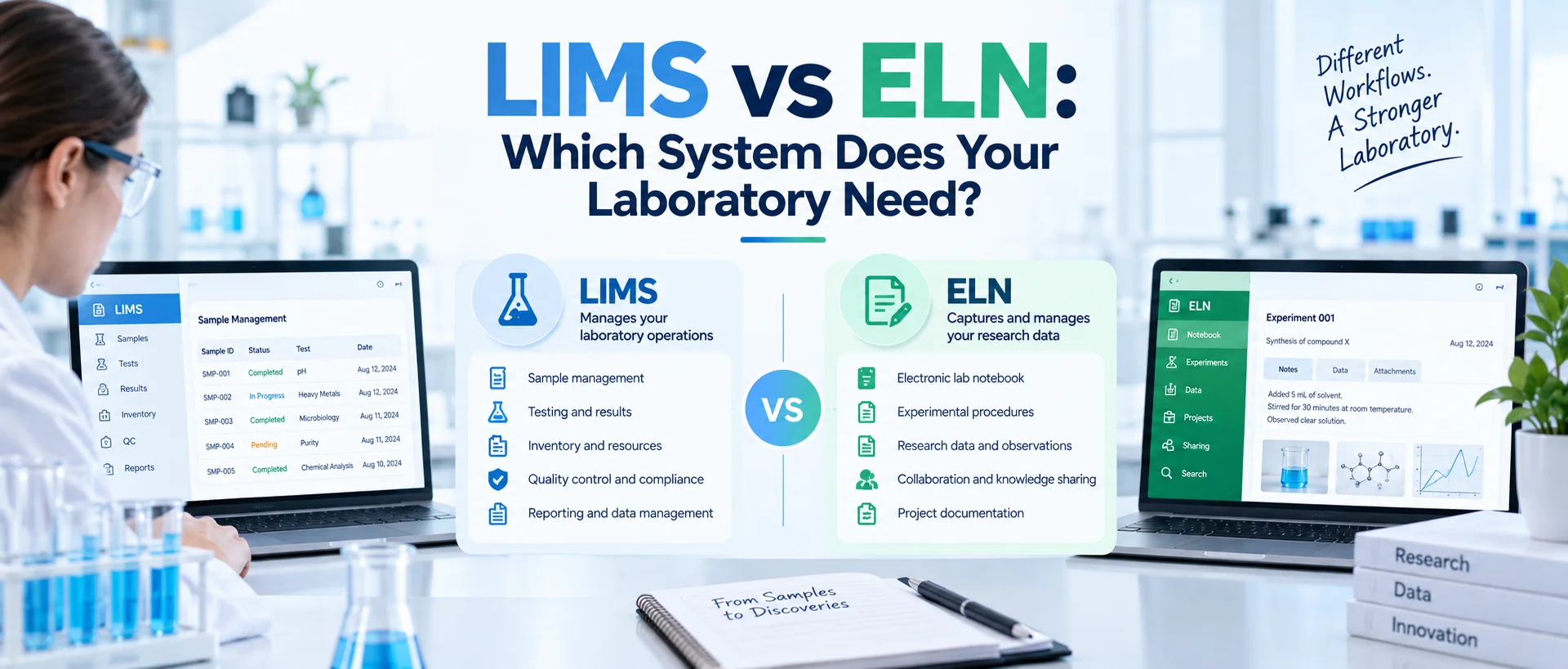
Scientists and laboratory managers often encounter LIMS and ELN when replacing paper notebooks, spreadsheets, or disconnected research systems. Both manage laboratory information. Both can store data.
Both can improve traceability and collaboration. Some platforms even include functions traditionally associated with both categories. But they solve different primary problems. A LIMS is generally designed around structured laboratory operations such as samples, tests, methods, status, results, instruments, reviews and reporting.
An Electronic Laboratory Notebook (ELN) is primarily designed around documenting scientific experiments, observations, protocols, reasoning, analyses and research conclusions. Laboratories with both operational sample workflows and experiment-driven R&D may benefit from using LIMS and ELN together**.**
The distinction is therefore less about which technology is "better" and more about what information your laboratory needs to organize and why. If LIMS itself is still new to you, start with our guide explaining what a Laboratory Information Management System is.
What Is a LIMS?
LIMS stands for Laboratory Information Management System. A LIMS organizes laboratory operations around structured entities and workflows. These commonly include samples, tests, methods, specifications, instruments, results, quality activities, reviews, approvals and reports.
NIST describes a LIMS as software developed to support laboratory operations, including tracking specimens and workflows and collecting, annotating, and aggregating datasets. The important word is structured. Imagine a contract laboratory receives 50 samples. For each sample, the laboratory may need to know:
- what was received,
- who submitted it,
- which tests are required,
- which methods apply,
- where the sample is located,
- which analyst owns the work,
- what results were produced,
- whether those results were reviewed,
- and whether the final report has been issued.
A LIMS is built to maintain those relationships. Our guide to the core components of a Laboratory Information Management System explains how sample management, testing, quality, integrations, workflow and reporting fit together.
What Is an ELN?
ELN stands for Electronic Laboratory Notebook. An ELN is designed to replace or extend the traditional paper laboratory notebook used by scientists to document research.
Instead of writing experimental plans, observations and conclusions in a physical notebook, researchers create electronic records. NIH defines an ELN as a system used to create, store, retrieve and share electronic research records while replacing the functions of a paper notebook.
NIH emphasizes that the research record should document why experiments were undertaken, how they were performed, what observations and data were produced, where data are stored and how results were analyzed and interpreted.
This makes an ELN fundamentally experiment- and documentation-centered. A researcher may use an ELN to record: experimental objectives, hypotheses, protocols, materials, observations, images, attachments, instrument outputs, calculations, analysis, interpretation, and conclusions.
The objective is not simply to know that an experiment occurred. It is to preserve enough context to understand what the researcher did, why they did it and what they learned.
LIMS vs ELN: The Difference at a Glance
| Area | LIMS | ELN |
|---|---|---|
| Primary focus | Laboratory operations and structured workflows | Scientific experiments and research documentation |
| Main organizing entity | Sample, test, batch, project or workflow | Experiment, notebook entry, protocol or research project |
| Typical users | Analysts, technicians, lab managers, QC teams, operations | Scientists, researchers, R&D teams, engineers |
| Sample tracking | Usually a core function | May exist, but depth varies |
| Test assignment | Common | Usually less central |
| Experimental narrative | Usually limited | Core function |
| Observations and reasoning | Can be recorded, but not usually the primary design | Core function |
| Methods and protocols | Structured operational methods | Experimental protocols and documentation |
| Result management | Structured around samples/tests | Structured around experiments/research records |
| Workflow status | Strong operational focus | Often focused on research progress/collaboration |
| Instrument integration | Common depending on system | May support attachments or integrations |
| Reporting | Operational reports, CoAs and result reports | Research summaries and experiment records |
| Research reproducibility | Can support underlying structured records | Often a primary documentation goal |
| Quality and approvals | Often important | Depends heavily on ELN and research environment |
The table shows general differences, not absolute boundaries. Modern laboratory software categories increasingly overlap, so the product name alone should not determine your decision.
The Simplest Way to Understand LIMS vs ELN
Ask two different questions. A LIMS primarily helps answer: "What is happening to this sample or laboratory task?"
An ELN primarily helps answer: **"**What did the scientist do during this experiment, and what did they observe or conclude?"
That distinction explains most of the practical difference. A LIMS follows structured operations. An ELN documents scientific work.
How a LIMS Organizes Laboratory Work
Consider a laboratory sample entering a testing workflow. The LIMS registers the sample and gives it an identity. Required tests are assigned. Methods and specifications are associated with the work.
The sample moves through preparation and testing. Results are entered or transferred from compatible instruments. Completed work moves through review and approval. Approved information may eventually become a laboratory report or Certificate of Analysis.
The laboratory can then retain the sample or dispose of it according to the appropriate process. Our guide explaining how a Laboratory Information Management System works follows this sample-to-report lifecycle in more detail.
The LIMS therefore excels when the laboratory needs repeatability. If 500 samples require the same type of workflow, the system can help make those stages visible and consistent.
How an ELN Organizes Research Work
Research does not always follow such predictable steps. Imagine a scientist developing a new analytical method.
- They may begin with an idea.
- The first experiment fails.
- They change a reagent concentration.
- The next result looks promising.
- They attach instrument output.
- They record unexpected observations.
- They modify a protocol.
- They compare the result with an earlier experiment.
Eventually, several weeks of experimental work lead to a conclusion. That process contains structured data, but it also contains scientific reasoning and narrative context. A traditional paper laboratory notebook is well suited to recording that evolving story.
An ELN digitizes and expands that model. This is why ELNs are particularly relevant to research and development teams where documentation must capture not just final results but the path that produced them.
LIMS Is Usually Process-Centric; ELN Is Usually Experiment-Centric
This is another useful distinction. A LIMS frequently asks the laboratory to define a process before work begins. For example:
sample received → testing assigned → analysis completed → technical review → approval → reporting.
That makes LIMS useful where laboratories perform repeatable or controlled activities. An ELN can accommodate a more exploratory process. The researcher may not know the final sequence when the experiment begins.
They need room to document what happened, add observations, attach results, change direction and explain conclusions. Neither approach is inherently superior. They support different types of laboratory work.
Where Do LIMS and ELN Overlap?
The distinction becomes confusing because both systems can provide similar capabilities.
- Sample Information
An ELN may allow scientists to reference or manage samples. A LIMS almost certainly maintains sample information. The difference is often depth.
A LIMS may track the sample's unique identifier, status, location, testing requirements, custody history, aliquots and lifecycle. An ELN may reference that sample primarily because it was used in an experiment.
- Methods and Protocols
Both systems can involve methods. A LIMS typically uses methods as part of a controlled testing workflow. An ELN may use protocols as part of documenting how an experiment was designed and performed.
- Data Storage
Both systems can store or reference laboratory data. But storing a file is not the same as managing its context. The LIMS may ask which sample and test the result belongs to. The ELN may ask which experiment generated the file and how the researcher interpreted it.
- Collaboration
Both LIMS and ELN platforms can support multiple users. The collaboration objectives may differ. A LIMS team collaborates around operational work: assignments, sample status, testing, review and approval. An ELN team often collaborates around scientific knowledge: experiments, protocols, observations and research findings.
LIMS vs ELN for Sample Management
If sample management is your main problem, a LIMS will usually be the more natural starting point. A growing testing laboratory may need to track hundreds or thousands of samples through registration, storage, testing, review and disposition.
Those records require consistent identifiers and status information. LabZila's sample management software is designed around this operational sample lifecycle, including registration, identifiers, locations, testing activity, transfers and retention.
An ELN may still reference these samples during experiments, but that does not necessarily mean the ELN should become the laboratory's primary sample-management system.
LIMS vs ELN for Research Documentation
If the main challenge is replacing paper research notebooks, an ELN is likely closer to the requirement. Scientists need to record more than structured results. They may need to document why an experiment was performed, experimental setup, modifications, observations, calculations and interpretation.
That type of documentation is central to ELN design. For R&D teams, this can make previous experiments much easier to search and reuse than relying on individual paper notebooks. It can also make collaboration easier because research records are not physically tied to one person's notebook.
LIMS vs ELN for Repetitive Testing
Consider a QC laboratory performing the same approved test every day. The laboratory already knows:
what sample types will arrive,
which methods apply,
which specifications are relevant,
who can perform the work,
how results are reviewed,
and what report needs to be issued. This is a highly structured environment. A LIMS is naturally suited to it. The system can help manage the repeatable sequence and identify exceptions when work does not follow the expected path.
The functions of a Laboratory Information Management System extend across these day-to-day activities, including sample tracking, test assignment, result capture, review and reporting.
LIMS vs ELN for Experimental R&D
Now imagine an R&D laboratory investigating whether a new formulation produces the desired characteristics.
The scientist may perform several experiments using different variables. The objective is not simply to process each sample through an identical predefined workflow. The team wants to understand:
what was attempted,
why conditions changed,
what observations were made,
which data support the conclusion,
and what experiment should happen next.
This is much closer to an ELN use case.
A LIMS could still manage the physical samples and structured testing associated with the research, but the ELN may be better suited to documenting the scientific narrative.
LIMS vs ELN for Laboratory Quality Control
Quality-control laboratories often lean more heavily toward LIMS because the work is structured around defined tests, methods, specifications and approvals.
A pharmaceutical QC laboratory, for example, may need to manage raw-material samples, finished-product testing, instruments, specifications, quality records and final release-related information. That is an operational workflow.
However, the same organization may also have an R&D department developing new analytical methods or formulations. That team may prefer ELN functionality for experimental work. This is a good example of why one company may reasonably use both systems.
Does an ELN Replace a LIMS?
Not automatically. An ELN can replace paper laboratory notebooks extremely well when the requirement is scientific documentation.
But laboratories should be cautious about assuming that an ELN can provide all the structured operational functionality of a LIMS. Ask whether the ELN can genuinely support requirements such as:
sample accessioning, complex sample locations, chain of custody, batch registration, routine test assignment, specifications, analyst workload, structured review stages, laboratory QC, controlled reporting, and large-scale sample lifecycle management.
Some ELN platforms may provide several of these capabilities. Others will not. The correct decision depends on the particular product, not simply the ELN category.
Does a LIMS Replace an ELN?
The reverse is also true. A LIMS can store notes, attachments, methods and laboratory data, but that does not automatically make it an effective electronic research notebook. An R&D team should ask whether the system supports the way scientists actually document experimentation.
Can researchers easily record hypotheses and observations?
Can they create flexible experimental entries?
Can they attach different data types?
Can they document modifications and interpretations?
Can they search earlier experiments?
Can they maintain sufficient experimental context for another scientist to understand and reproduce the work?
If these requirements are central, dedicated ELN functionality may still be necessary.
When Does a Laboratory Need Both LIMS and ELN?
Many research organizations do not have to choose one system exclusively. They may need both. Consider a biotechnology or contract research organization. The ELN could manage experimental design and documentation.
The LIMS could manage samples, testing workflows, instruments, structured results and operational status. Researchers could design and document an experiment in the ELN while sample IDs and testing records remain managed in the LIMS.
The systems can then exchange relevant information where technically appropriate. This division can prevent duplicate work while allowing each application to focus on what it does best.
LabZila's content architecture explicitly includes LIMS and ELN integration as a future integration topic, and its current LIMS integrations page allows for compatible ELN systems to be connected through supported APIs, interfaces and structured data workflows.
What Should LIMS and ELN Integration Actually Accomplish?
Integration should solve a specific workflow problem. Simply connecting two systems because integration is technically possible does not necessarily provide value. First decide which system owns each type of information. For example:
- LIMS may own: sample IDs, sample status, test assignments, structured results and operational workflow.
- ELN may own: experimental design, research narrative, observations, protocol modifications and interpretation.
The integration can then exchange only the information needed to keep those workflows connected. A scientist may reference a LIMS sample ID within an ELN experiment. Relevant experiment metadata may be returned to the LIMS.
Approved structured results may be made available to research teams. The exact architecture will depend on the products and laboratory requirements.
LabZila's own integration positioning is appropriately conditional: connections with compatible ERP, ELN, instruments and other systems depend on available APIs, interfaces, structured data formats and implementation requirements.
Avoid Creating Two Sources of Truth
One of the biggest risks when laboratories use both systems is unclear ownership. Suppose the sample name exists in the LIMS and ELN. Someone updates the LIMS. Another person changes the ELN. Which value is correct?
The same problem can occur with method versions, results, project IDs and status information. Integration planning should therefore define a system of record for important entities.
If the LIMS owns sample identity, users should not independently create conflicting sample identities in another system.
If the ELN owns experimental narrative, the laboratory should avoid unnecessarily duplicating complete notebook records elsewhere. Clear ownership makes integration much easier to govern.
LIMS vs ELN for Contract Research Laboratories
Contract research and testing environments can sit directly between the two software categories. Some contract laboratories perform standardized testing for clients. They primarily need: sample submissions, client and project tracking, defined methods, testing, turnaround management, review, and reporting.
That strongly favors LIMS. Other contract research organizations perform experimental R&D in which scientists repeatedly modify protocols and document scientific reasoning. That may create a genuine ELN requirement. Organizations combining both types of work may benefit from integrating the systems.
LabZila's LIMS for contract research and testing laboratories is oriented toward structured laboratory operations rather than positioning LabZila as a replacement for every research-documentation platform. The keyword strategy also deliberately reserves separate ELN-oriented topics instead of assigning them to LabZila's commercial LIMS pages.
How Do LIMS and ELN Compare With Spreadsheets and Paper Notebooks?
Laboratories often reach LIMS and ELN decisions from different starting points. A testing laboratory may be struggling with spreadsheet sample trackers. An R&D laboratory may be struggling with paper notebooks, shared folders and inconsistent experiment documentation.
The first problem points toward LIMS. The second points toward ELN. Our previous comparison of LIMS vs spreadsheets explains why spreadsheets become increasingly difficult when they must manage sample identities, workflow states, reviews and traceability.
The same logic applies to paper research notebooks in a different context. Paper can work extremely well for individual documentation, but electronic research environments may make searching, sharing and connecting experimental records easier.
What Should R&D Leaders Ask Before Choosing an ELN?
Start with the research process rather than a software demonstration. Ask scientists how they currently document an experiment.
- What needs to be captured?
- Do researchers primarily write free-form observations or work from structured templates?
- Which files need to be attached?
- How are protocols reused?
- How are previous experiments searched?
- How do collaborators access the same research?
- How much flexibility is needed?
The best ELN should fit the scientific documentation process without making experiment recording unnecessarily difficult. Usability matters because a theoretically powerful ELN provides little value if scientists avoid using it.
What Should Laboratory Managers Ask Before Choosing a LIMS?
The questions are different. Follow a sample through the laboratory.
- How is it registered?
- Which tests are assigned?
- How are methods and specifications controlled?
- Where is the sample stored?
- Which instruments produce data?
- How do results move to review?
- Who approves them?
- How are reports created?
- What happens when the normal process fails?
This workflow analysis reveals whether a LIMS can support real operations. The earlier guide on the benefits and advantages of a LIMS explains why connectivity between these stages can become particularly valuable as laboratory complexity increases.
A Practical LIMS vs ELN Decision Framework
Before choosing a system, identify which statements describe your laboratory most accurately.
- A LIMS is likely the stronger priority if:
Your biggest problems involve sample tracking, test assignment, workflow status, instrument data, structured results, quality control, review, approvals or reporting.
You perform large amounts of repeatable laboratory work. Managers need visibility into current laboratory operations. Structured sample traceability is more important than free-form experimental documentation.
- An ELN is likely the stronger priority if:
Your scientists spend significant time designing and documenting experiments. Research reasoning, observations and interpretation are central records.
Projects evolve as results are generated. Teams need to replace paper research notebooks. Reproducing experimental work requires detailed narrative context.
You may need both if:
Your organization performs experimental R&D and high-volume operational testing. Scientists need flexible experiment documentation while operations teams need structured sample workflows.
Samples created or used in experiments must remain connected with formal testing records. Research data needs to move between scientific documentation and laboratory operational systems.
Do Not Choose Based Only on Feature Lists
A software vendor may claim to provide: sample management, experiments, workflows, collaboration, instrument integration, reports, and analytics.
Another product may list exactly the same features. That does not mean they operate the same way. The important questions are how those capabilities behave.
If you create 2,000 samples, can the system manage their status efficiently?
If a scientist conducts a six-week experiment, can they document the evolving reasoning clearly?
Can an analyst quickly identify assigned work?
Can a scientist find an experiment performed two years ago?
Can systems exchange information without creating duplicate sources of truth?
Those workflow demonstrations reveal much more than a product checklist.
Where Does LabZila Fit in the LIMS vs ELN Decision?
LabZila is positioned as a LIMS platform, not as a dedicated electronic laboratory notebook. Its core workflows cover sample registration and tracking, test assignment, method management, results, reviews, approvals, quality processes, inventory and reporting.
For laboratories that already use an ELN, LabZila can potentially connect with compatible external systems through supported integrations. The exact integration should be evaluated according to the ELN, available API or interface, required data exchange and laboratory workflow.
That distinction keeps the technology decision straightforward: Use LabZila when you need structured LIMS operations. Use an appropriate ELN when you need dedicated experiment-centered research documentation. Evaluate integration when your laboratory genuinely needs both.
Final Thoughts
The LIMS vs ELN decision becomes much easier when you stop treating them as competing versions of the same software. A LIMS is primarily designed to manage structured laboratory operations around samples, tests, methods, results, instruments, reviews and reports.
An ELN is primarily designed to document scientific experimentation, including objectives, procedures, observations, analyses and conclusions. A testing or QC laboratory may primarily need LIMS. An experiment-heavy R&D organization may primarily need ELN.
A biotechnology, pharmaceutical or contract research organization may need both. The most important question is therefore not: "Should we buy a LIMS or an ELN?"
It is: "Which system should own our operational laboratory records, and which system should own our experimental research record?"
Once that responsibility is clear, it becomes much easier to determine whether one system is sufficient or whether LIMS and ELN should work together.
If your laboratory needs structured sample, testing and operational workflows while retaining the ability to connect compatible research systems, explore LabZila LIMS software and discuss your integration requirements with the LabZila team.
=================================================================