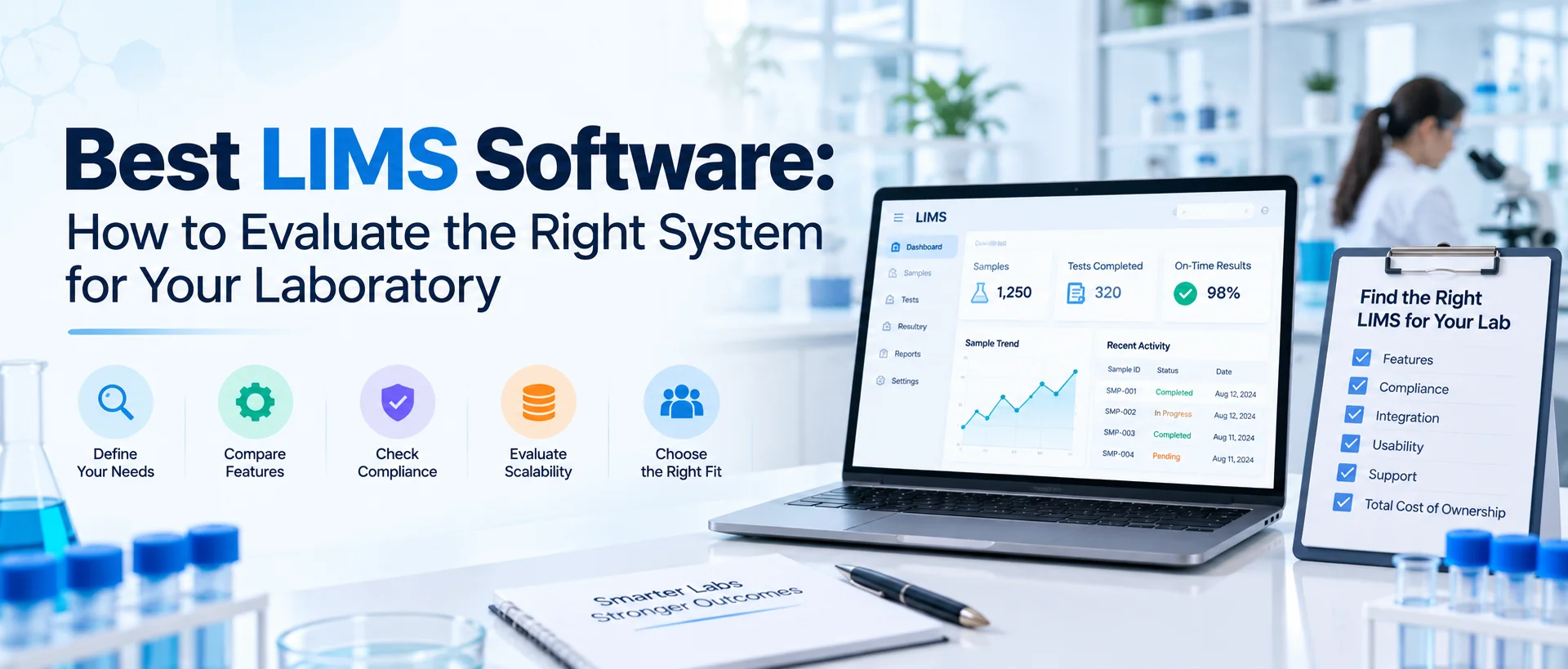
Search for the best LIMS software, and you will quickly find lists ranking products from first to tenth. That sounds helpful, but it can create the wrong starting point.
A pharmaceutical QC laboratory, environmental testing facility, clinical laboratory, and contract testing business may all need a LIMS, yet their workflows, integrations, quality requirements, and reporting processes can be completely different.
The best LIMS software is the system that fits your laboratory's actual samples, tests, workflows, users, instruments, quality requirements, integrations, and growth plans with an acceptable total cost of ownership.
There is no universally best LIMS. The right choice comes from evaluating systems against documented laboratory requirements rather than selecting the vendor with the longest feature list.
This guide explains how laboratory directors, managers, and procurement teams can make that comparison objectively. If you are still defining the technology itself, begin with what a Laboratory Information Management System is before evaluating individual platforms.
What Does “Best LIMS Software” Actually Mean?
“Best” only becomes meaningful when it is connected to a specific requirement. A system can be excellent for a multinational pharmaceutical organization and unnecessarily complex for a 10-person environmental testing laboratory.
Another platform may be highly usable and affordable for a growing testing lab but lack a specialized enterprise integration required by a larger organization. So instead of asking: Which LIMS has the most features?
Ask: Which LIMS can support our critical laboratory workflows with the least unnecessary complexity and an acceptable level of risk, cost and ongoing administration?
That shift changes software evaluation from a marketing comparison into a laboratory requirements exercise.
NIST describes LIMS as providing a framework for managing laboratory data from the outset of the research lifecycle and notes that modern laboratory environments generate increasing amounts of instrument and research data.
That broader role is one reason LIMS evaluation should consider data management and workflow architecture rather than sample tracking alone.
Do Not Start Your LIMS Search With Vendors
A common procurement mistake is requesting several product demonstrations before the laboratory has documented what it actually needs. Each vendor then controls the conversation. Vendor A emphasizes analytics. Vendor B shows automation. Vendor C demonstrates dashboards. Vendor D focuses on AI.
All of these capabilities may look impressive, but the laboratory still has no consistent framework for comparing them. Before creating a shortlist, map your laboratory's current workflow. Understand what happens from sample receipt through testing, review and reporting.
Identify where information is entered, how tests are assigned, which instruments are involved, what quality processes apply and where delays or duplicate work occur. Only then should you evaluate software. Our guide explaining how a Laboratory Information Management System works can help teams map this sample-to-report process before beginning vendor selection.
1. Evaluate Workflow Fit First
Workflow fit should usually receive more weight than the number of features available. The system needs to reflect how your laboratory actually operates. Consider sample receipt.
Can the LIMS capture the information your laboratory requires?
Can it support individual samples and batch registration?
Can different sample types follow different workflows?
Can tests be assigned automatically or manually according to laboratory rules?
What happens if a sample is rejected?
What happens if testing needs to be repeated?
Can a reviewer return incomplete work?
Can approved results move into reporting?
These practical questions reveal whether the system fits real work. A product demonstration showing attractive dashboards tells you very little if the platform struggles with an exception your laboratory handles every week.
Test Normal and Abnormal Workflows
Do not demonstrate only the ideal sample lifecycle. Ask vendors to show exceptions. For example:
- A sample arrives damaged.
- An analyst enters an incorrect result.
- An instrument becomes unavailable.
- A test is repeated.
- A reviewer rejects completed work.
- A method changes.
- A report needs correction after review.
- A quality event is triggered.
Real laboratories spend significant effort managing exceptions. The best LIMS software for your laboratory should handle legitimate exceptions without forcing users into uncontrolled workarounds.
2. Evaluate Sample Management Depth
Sample management is one of the core reasons laboratories adopt LIMS software. But “sample tracking included” is too vague to be useful during procurement. Evaluate whether the system can manage the complete lifecycle required by your laboratory.
Important capabilities may include sample registration, unique identifiers, barcode or QR-code support, status, location, chain of custody, storage, aliquots, sub-samples, batch relationships, retention and disposition. The required depth depends on the laboratory.
An environmental laboratory may place significant emphasis on custody records. A pharmaceutical laboratory may need relationships among raw materials, batches, stability samples, and finished products.
A clinical laboratory may require detailed specimen identity and connections with patient or order information. A contract testing laboratory may need samples linked with clients and projects.
LabZila's sample management capabilities provide one example of a lifecycle-oriented approach covering registration, tracking, locations, transfers, testing and final disposition. The comparison question should not be whether the vendor has a “sample module.” Ask whether it matches your sample lifecycle.
3. Examine Test, Method and Specification Management
Samples are only useful when the system understands what work needs to happen to them. Evaluate how the LIMS handles: test definitions, methods, method versions, specifications, units, calculations, acceptance criteria, test panels, and assignment rules.
The system should make routine testing easier without making occasional or specialist testing impossible. For laboratories using controlled methods, also consider how changes are governed.
If a method is updated next year, can historical records still show which version applied to work performed today? That type of context becomes much more important than simply storing a PDF procedure.
4. Look at Results, Reviews and Approval Workflows
A result entering the LIMS should not automatically be treated as final. Most laboratories need some combination of entry, calculation, technical review, QC review, authorization or reporting approval. Evaluate how these states are represented.
Can different tests require different approval routes?
Can role assign responsibility?
Can work be returned for correction?
Can comments or supporting information remain connected with the decision?
Does the record clearly distinguish entered, reviewed, and approved information?
These questions become especially important when several people interact with the same record. The system should make the status of laboratory work clear without relying on separate spreadsheets or email threads.
5. Evaluate Quality Management Without Confusing QMS and QC
“Quality management” can mean several different things in LIMS marketing. Determine exactly what is included. Laboratory QC may involve control samples, acceptance criteria, charts, specifications, OOS/OOT visibility and trend review.
A broader QMS may involve deviations, CAPA, documents, training, audits and quality events. Those are related areas, but they should not be treated as identical.
If quality processes are important to your organization, ask the vendor to demonstrate them rather than showing a generic approval screen.
For a deeper explanation of the distinction, the LIMS vs QMS comparison explains where laboratory operations and broader quality-management processes overlap.
Compliance Claims Require Extra Scrutiny
Be cautious when a vendor says its LIMS is simply “FDA compliant,” “21 CFR Part 11 compliant,” or automatically makes a laboratory compliant. Software can provide technical controls that support regulated workflows.
Whether those controls are appropriate depends on intended use, configuration, procedures, validation, user administration, and applicable regulations.
FDA guidance on Part 11 specifically recommends considering the impact computerized systems have on the accuracy, reliability, integrity, availability, and authenticity of required electronic records and using a justified, documented risk-based approach to validation.
The best system for a regulated laboratory is therefore not the one making the strongest compliance claim. It is the one whose capabilities can be evaluated, configured, and governed appropriately for the laboratory's intended use.
6. Test Instrument and System Integrations Early
A LIMS rarely operates alone. Laboratories may need connections with: instruments, ERP systems, ELNs, EHRs, billing applications, chromatography systems, client portals, or other business platforms.
Do not leave integrations until the end of vendor selection. An otherwise excellent LIMS can become a poor fit if a critical analyzer or enterprise system cannot connect in the required way. For every important integration, define:
What information moves?
Which direction does it move?
How frequently?
Which system owns the master record?
What interface is available?
How are errors handled?
How will the connection be tested and maintained?
Also distinguish a proven existing connector from “our API can probably do that.” Those are not the same thing. LabZila's LIMS integrations are evaluated according to the instrument or external system, available interfaces, data formats and required workflow rather than assuming universal compatibility.
7. Decide Which Deployment Model Fits Your IT Environment
The best LIMS architecture for one organization can be inappropriate for another. Common options include: cloud, SaaS, web-based, private deployment, and on-premises systems.
A smaller laboratory with limited IT resources may prefer provider-managed infrastructure. A larger enterprise may require greater control over hosting, networking, upgrade schedules or integration architecture.
Other organizations may have data-residency or internal security requirements that influence the decision. Do not compare deployment types only on preference. Evaluate responsibility.
Who handles backups?
Who patches the environment?
Who manages databases?
How are updates released?
How is disaster recovery handled?
What happens during network disruption?
How are users authenticated?
Who monitors the system?
Our guide to the different types of LIMS explains the differences among cloud, SaaS, web-based, on-premises and enterprise approaches.
8. Prefer Configurability Over Unnecessary Custom Development
Laboratories are rarely identical. A suitable LIMS needs flexibility. But flexibility can come from two very different approaches.
Configuration generally adapts existing platform capabilities through settings, forms, rules, workflows, and permissions. Customization may require software development specifically for your organization.
Custom code is sometimes necessary. But unnecessary customization can increase implementation effort, testing, support cost, and upgrade complexity.
During demonstrations, ask vendors to label every requested change as: standard functionality, configuration, integration, or custom development. Do not let those categories remain vague.
A system that supports most laboratory requirements through controlled configuration may be easier to maintain over time than one requiring custom code for ordinary workflow differences.
9. Evaluate Usability With Real Laboratory Users
Software selection teams sometimes focus heavily on executives, IT and procurement while forgetting the people who will use the system every day. Analysts and technicians should participate in evaluation. Give them realistic tasks. Ask an analyst to register a sample.
Find assigned work. Record a result. Locate a method. Review historical information. Handle an exception. Submit work for review. The question is not whether the interface looks modern during a presentation.
The question is whether users can complete laboratory work efficiently and understand what the system expects from them.
A technically capable LIMS that users find unnecessarily difficult can create more training, workarounds and resistance. Usability should therefore have a measurable place in the selection score.
10. Evaluate Reporting and Data Access
Your laboratory will eventually need information back out of the LIMS. Consider both routine reporting and management analysis. Routine outputs may include: laboratory reports, Certificates of Analysis, sample-status reports, QC summaries, and client deliverables.
Management may need: backlog, turnaround time, sample volume, analyst workload, quality events, instrument activity, and other operational indicators. Ask how easily authorized users can build or modify reports.
Does every new report require vendor consulting?
Can data be exported?
Are dashboards configurable?
Can historical information be searched efficiently?
A system that stores data successfully but makes that information difficult to use may create another reporting bottleneck.
11. Check Data Ownership and Portability
One question should appear in every LIMS evaluation: Can we get our data out?
Ask vendors what happens if the organization eventually changes platforms.
Can laboratory records be exported in usable formats?
What about attachments?
Audit histories?
Methods?
Results?
Quality records?
Reports?
How much vendor assistance is required?
Are there additional extraction fees?
A laboratory may use its LIMS for many years. Data portability should therefore be evaluated before signing the agreement, not when the organization is already trying to leave.
12. Evaluate Scalability Against Realistic Growth
Do not purchase only for today's laboratory. At the same time, do not buy an enterprise architecture for hypothetical growth that may never happen. Model realistic changes.
What happens if sample volume doubles?
Can five new analysts be added?
Can another department use the system?
What if you acquire another laboratory?
Can workflows differ between sites?
Can permissions and data access be separated appropriately?
Will storage become expensive?
Can new instruments be connected?
Scalability involves more than server capacity. It also includes configuration, administration, cost and governance.
13. Examine Implementation Before Selecting the Product
A LIMS with excellent functionality can still become a poor investment if implementation is weak. Ask vendors to explain: requirements gathering, workflow configuration, migration, integration setup, testing, validation support, training, go-live planning, and post-launch support.
Clarify who is responsible for each activity. Do not accept “implementation included” without understanding what that actually covers.
How many workflows?
How much historical data?
How many integrations?
How many training sessions?
How many reports?
What happens when requirements change?
Implementation scope is one of the biggest differences between a realistic proposal and an attractive but incomplete quote.
14. Compare Total Cost of Ownership, Not Just License Price
The cheapest subscription is not automatically the cheapest LIMS. Laboratories should evaluate: software, implementation, migration, integrations, validation, training, support, hosting, internal administration, storage, future changes, and upgrade-related effort.
Our complete guide to LIMS cost and budgeting explains how these components contribute to total cost of ownership. A useful procurement comparison should calculate costs over at least several years rather than comparing only the first invoice.
Which LIMS Is Best for Different Types of Laboratories?
The answer changes according to the operating environment.
| Laboratory Type | Capabilities That Often Deserve Higher Weight |
|---|---|
| Small or Growing Testing Lab | Ease of implementation, sample tracking, configurable workflows, reporting, transparent costs |
| Pharmaceutical QC | Specifications, QC, auditability, electronic approvals, validation support, stability and quality workflows |
| Clinical Diagnostics | Specimen tracking, analyzer integration, QC, result review, patient/order context and healthcare interfaces where required |
| Environmental Testing | Chain of custody, field/sample information, preservation, holding times, QC and reporting |
| Food & Beverage | Product and ingredient samples, pathogen/allergen workflows, QC, specifications and CoAs |
| Cannabis Testing | Chain of custody, test panels, quality workflows, reporting and required external integrations |
| Contract Testing | Multiple clients, projects, submissions, configurable workflows, reporting and turnaround visibility |
| R&D / Research | Flexible samples and studies, instrument connectivity and potential ELN integration |
| Enterprise / Multi-Site | Scalability, governance, centralized master data, site configuration, security and enterprise integrations |
This is why generic “Top 10 LIMS” rankings have limited value. A product may rank highly overall while missing one capability that is essential to your particular laboratory.
Build a Weighted LIMS Scorecard
One of the best ways to reduce subjective vendor selection is to score every candidate against the same criteria. A laboratory might create a model like this:
| Evaluation Area | Example Weight |
|---|---|
| Workflow fit | 20% |
| Sample/test management | 15% |
| Quality & compliance capabilities | 15% |
| Integrations | 10% |
| Usability | 10% |
| Configuration flexibility | 8% |
| Reporting & analytics | 7% |
| Deployment & security | 5% |
| Scalability | 5% |
| Implementation & support | 5% |
These percentages are only an example. A clinical laboratory may increase interoperability. A pharmaceutical QC lab may place greater weight on controlled records and validation support.
A small independent laboratory may give usability, implementation and cost more weight. The point is to agree on the weighting before the final demonstrations. Otherwise, teams tend to give disproportionate importance to whichever feature they saw most recently.
Separate Must-Have Requirements From Nice-to-Haves
Every requirement should also be classified.
Must Have
If the system cannot meet this requirement, it should normally be removed from consideration. Examples might include a critical instrument interface, required chain-of-custody workflow or essential approval process.
Important
The laboratory strongly prefers the capability, but an acceptable controlled alternative may exist.
Nice to Have
Useful, but not important enough to determine the purchasing decision. This process prevents attractive but low-value features from overshadowing critical requirements.
Ask Vendors to Demonstrate Your Workflow, Not Theirs
Do not allow every vendor to give a completely different demonstration. Provide the same scenario to each candidate. For example:
Register a sample, assign three tests, create an aliquot, send one result from an instrument, flag another result for review, return it for correction, approve the completed work, and generate the final report.
Then compare what happens.
How many steps were required?
Was the workflow understandable?
Could exceptions be handled?
Was important context visible?
Which steps required customization?
Which required integrations?
A scripted demonstration produces much more useful information than a vendor's standard sales presentation.
Questions Every LIMS Vendor Should Answer
A serious evaluation should establish clear answers to questions such as:
- Which requirements are standard functionality?
- Which require configuration?
- Which require custom development?
- Which integrations already exist?
- How are new instrument integrations scoped?
- Who owns our laboratory data?
- How can we export it?
- How are updates handled?
- What support is included?
- What does implementation include?
- What additional costs can occur?
- How is user access controlled?
- How are record changes tracked?
- What validation support is available where applicable?
- How does pricing change as users, sites or sample volume grow?
- What happens if we terminate the agreement?
A vendor reluctant to answer these questions clearly creates procurement risk regardless of how good the demonstration looks.
Common Red Flags When Comparing LIMS Software
Several warning signs deserve additional investigation.
“Our LIMS Works for Every Laboratory Out of the Box”
Different laboratories have different sample types, workflows, methods and reporting requirements. A product may support many industries, but some configuration should normally be expected.
“We Are Fully Compliant, So You Do Not Need to Worry About Validation”
Software alone does not remove laboratory responsibilities for applicable procedures, intended-use assessment, configuration, validation and training.
“Yes, We Integrate With Everything”
Ask for the actual interface method. A marketing statement is not an integration specification.
“We Can Customize That”
Determine whether the requirement can be configured or requires custom development. Repeated custom development can create long-term maintenance problems.
“Pricing Depends on Your Requirements” With No Explanation
Some tailored pricing is reasonable, particularly for complex implementations. But the vendor should still be able to explain what variables affect price.
“You Can Export Your Data” Without Demonstrating How
Request details on formats, record coverage, attachments and audit history before treating portability as confirmed.
Do You Need an All-in-One LIMS?
Not always. Some laboratories prefer one platform covering samples, testing, QMS, inventory, equipment and reporting. Others deliberately use specialist systems.
- A research organization might connect LIMS with an ELN.
- A clinical laboratory might integrate with an LIS or EHR.
- A large corporation might use a separate enterprise QMS.
- A contract laboratory may integrate LIMS with accounting or ERP software.
The goal should not be eliminating every other application. It should be establishing clear ownership of laboratory records and reliable exchange between systems.
How Many LIMS Vendors Should You Shortlist?
For most evaluations, a small number of serious candidates is more useful than demonstrations from a dozen vendors. Start with a broad market scan. Remove systems that clearly fail mandatory requirements.
Then select a manageable shortlist for detailed evaluation. Three to five candidates is often enough to expose meaningful differences without making the evaluation process unmanageable.
The final number matters less than ensuring every shortlisted vendor meets the basic requirements before significant time is spent on demonstrations.
Should Price Determine the Best LIMS?
Price should influence the decision. It should not define it alone. If two platforms satisfy the laboratory's mandatory requirements similarly, total cost can become an important differentiator.
But choosing a lower-cost platform that cannot support critical processes may lead to: manual workarounds, additional spreadsheets, custom development, extra integration projects, or another system replacement later.
At the opposite extreme, paying for capabilities the laboratory does not need can also waste budget. The best value is the system that provides the required capability at an acceptable total lifecycle cost.
Where Does LabZila Fit Into the Comparison?
LabZila should be evaluated using the same criteria as every other LIMS candidate. It is a configurable LIMS platform covering areas such as sample management, testing and results, quality processes, instruments, reporting, workflow automation, and different deployment options.
Its LIMS software features can be compared directly with your laboratory requirements rather than assuming that one platform is automatically the best choice.
For example, evaluate whether LabZila supports: your sample lifecycle, required workflows, quality processes, instrument environment, reporting, deployment requirements, user structure, and expected growth.
Then perform the same evaluation for the other shortlisted systems. That approach is more credible and more useful than simply declaring any single vendor the “best LIMS software.”
A Simple Final Decision Framework
Before selecting a platform, your laboratory should be able to answer five questions confidently.
1. Can it support our critical laboratory workflows?
Not just the ideal path, but real exceptions as well.
2. Can it integrate with the systems and instruments we actually use?
Technical compatibility should be confirmed.
3. Can we operate and govern it appropriately?
Consider users, IT, quality, security and validation responsibilities.
4. Can it grow with realistic future requirements?
Include volume, users, workflows, sites and integrations.
5. Does the total value justify the total cost?
Look beyond software licensing to implementation and long-term ownership.
If a vendor cannot satisfy one of these areas, a high feature count should not compensate for the gap.
Final Thoughts
There is no single best LIMS software for every laboratory. The best system for your organization is the one that fits your samples, tests, workflows, quality processes, instruments, integrations, users, deployment requirements and growth plans without creating unnecessary complexity.
That means laboratory software should be evaluated through requirements and real workflows not marketing claims. Start by defining what your laboratory must accomplish. Build a weighted scorecard. Shortlist systems that satisfy mandatory requirements. Make each vendor demonstrate the same realistic workflow.
Investigate implementation, integration, security, data ownership and long-term cost. Then choose the platform that produces the strongest overall fit. For teams evaluating LabZila as one of those candidates, you can contact LabZila for a workflow-based LIMS demonstration and compare the platform against the same requirements you use for every other shortlisted system.
=================================================================